

142
N. wLLu)FF
in January. Oviposition then continues for many weeks. The earliest
eggs hatch by the end of January and a new generation of adulta
appears in April. The yellowish-white egg8 are laid singly in the young
green shoots in which the larvae form mines. The presence of the larvae
in shoots can usually be reoogniaed aa the twigs show signs of eplitting
and of slight gall formation. The three larval inoccur in the shoote
throughout the year and pupation also occurs in the mines.
2. Fecundity and cold hardineaa of A. immune
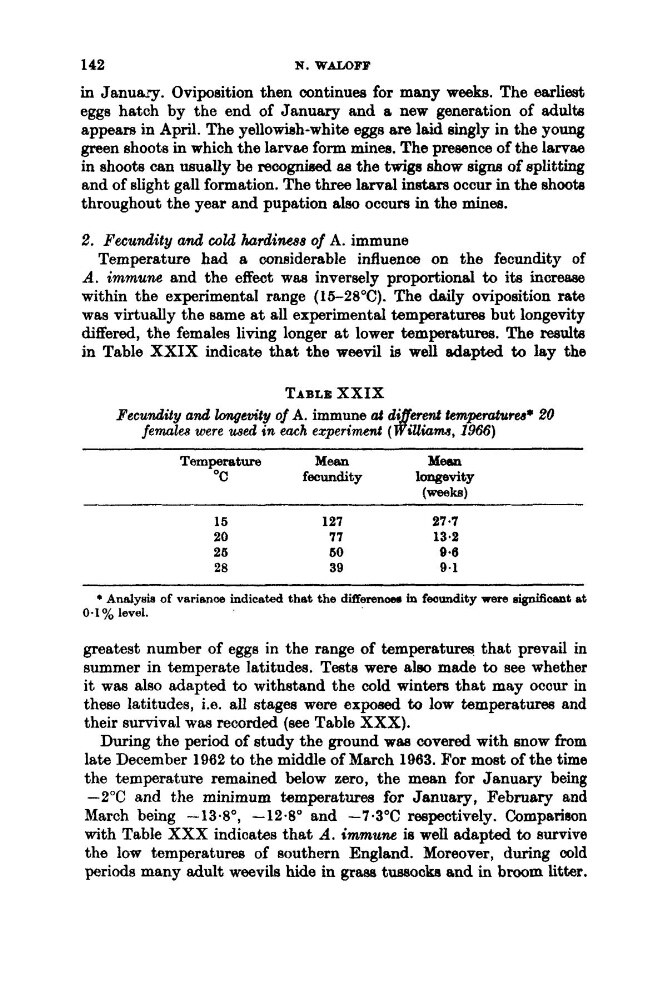
Temperature had a considerable influence on the fecundity of
A. immune and the effect waa inversely proportional to its increase
within the experimental range (15-28OC). The daily oviposition rate
was virtually the same at all experimental temperatures but longevity
differed, the females living longer at lower temperatures. The results
in Table XXIX indicate that the weevil is well adapted to lay the
TABLE XXIX
Fecundity a d longevity of A. immune at
females were used in each experiment
Tempereture
Meen
Mesn
(-W
"C
fecundity
longevits
15
127
27.7
20
77
13.2
25
50
0 -8
28
39
9.1
~
-~ -
~
* Analysis of variance indicated thet the differenoea in feoundity were signifiomt et
0-1 yo level.
greatest number of eggs in the range of temperatures that prevail in
aummer in temperate latitudes. Tests were alm made to see whether
it wm also adapted to withatand the cold winters that may occur in
these latitudes, i.e. all stages were exposed to low temperaturea and
their survival waa recorded (see Table XXX).
During the period of study the ground was covered with snow from
late December 1962 to the middle of March 1963. For most of the time
the temperature remained below zero, the mean for January being
-2°C and the minimum temperatures for January, February and
March being --13.8", -12.8" and -7.3"C reepectively. Cornpariaon
with Table XXX indicates that A. irnrnocne is well adapted to survive
the low temperatures of southern England. Moreover, during cold
periods many adult weevils hide in grass tussocks and in broom litter.
N. wLLu)FF
in January. Oviposition then continues for many weeks. The earliest
eggs hatch by the end of January and a new generation of adulta
appears in April. The yellowish-white egg8 are laid singly in the young
green shoots in which the larvae form mines. The presence of the larvae
in shoots can usually be reoogniaed aa the twigs show signs of eplitting
and of slight gall formation. The three larval inoccur in the shoote
throughout the year and pupation also occurs in the mines.
2. Fecundity and cold hardineaa of A. immune
Temperature had a considerable influence on the fecundity of
A. immune and the effect waa inversely proportional to its increase
within the experimental range (15-28OC). The daily oviposition rate
was virtually the same at all experimental temperatures but longevity
differed, the females living longer at lower temperatures. The results
in Table XXIX indicate that the weevil is well adapted to lay the
TABLE XXIX
Fecundity a d longevity of A. immune at
females were used in each experiment
Tempereture
Meen
Mesn
(-W
"C
fecundity
longevits
15
127
27.7
20
77
13.2
25
50
0 -8
28
39
9.1
~
-~ -
~
* Analysis of variance indicated thet the differenoea in feoundity were signifiomt et
0-1 yo level.
greatest number of eggs in the range of temperatures that prevail in
aummer in temperate latitudes. Tests were alm made to see whether
it wm also adapted to withatand the cold winters that may occur in
these latitudes, i.e. all stages were exposed to low temperaturea and
their survival waa recorded (see Table XXX).
During the period of study the ground was covered with snow from
late December 1962 to the middle of March 1963. For most of the time
the temperature remained below zero, the mean for January being
-2°C and the minimum temperatures for January, February and
March being --13.8", -12.8" and -7.3"C reepectively. Cornpariaon
with Table XXX indicates that A. irnrnocne is well adapted to survive
the low temperatures of southern England. Moreover, during cold
periods many adult weevils hide in grass tussocks and in broom litter.