

124
N. WALOPP
Thus a series of successive stimuli evoked a chain of reactions, each
response being initiated and supplemented by the following one. This
analysis, although in itself incomplete, Le analogous to the analyses of
instinctive behaviour quoted by Tinbergen ( 1951).
V. PHYTOPHAGOUS INSECTS FEEDING ON PLANT JUICES
This section deals with some of the Hornoptera associated with broom
and with the heteropteran pentatomid Piezodorus Ziturutus (Fabricius).
The Homoptera include aphids and psyllids, the most abundant insects
on the nost plant and the most abundant food of the numerous predatory insects.
A. THE STUDY OF FACTORS AFFECTING ABUNDANCE OF
APHIDS ON BROOM (B. D. Smith, 1966a, 1966b)
The two species of aphids on broom, Acyrthosiph sprtii (Koch)
and Aphis (PergundeZa) surotharnni Franssen do not have alternab
hosts. Smith's study was primarily concerned with Acyrthosiphon because it was numerous and it was possible to identify its nymphal
instars in the field. The study was made in Area 3 and on each occasion
sampling was of 72 unit lengths of stem on bushes selected a t random.
1. Life histmy of Acyrthosiphon spartii
The overwintered eggs hatched by the end of March in 1956 and by
the end of February in 1957. Alatae were not present in the offspring
of fundatrices, but some occurred in the next generation and 8 larger
proportion in the third generation. Throughout summer, only apterae
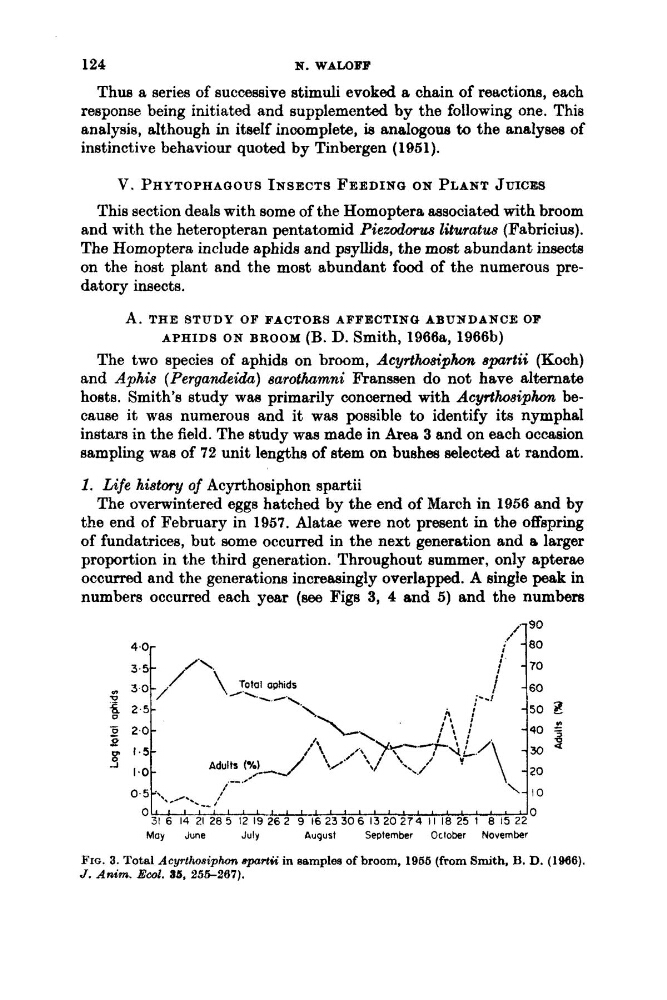
occurred and the generations increasingly overlapped. A single peak in
numbers occurred each year (see Figs 3, 4 and 5 ) and the numbers
4.0r
- 5 0 2
0
316 1 4 2 1 2 8 5 1219262 9 1 6 2 3 3 0 6 1 3 2 0 2 7 4 1 1 1 8 2 5 1 8 1 5 2 2
May
June
July
August
September
October November
FIG. 3. Total ACyTlho8@hJt& qxwtii in samples of broom, 1966 (from Smith, B. D. (1966).
J . Anim. E d . 86, 25K-207).
N. WALOPP
Thus a series of successive stimuli evoked a chain of reactions, each
response being initiated and supplemented by the following one. This
analysis, although in itself incomplete, Le analogous to the analyses of
instinctive behaviour quoted by Tinbergen ( 1951).
V. PHYTOPHAGOUS INSECTS FEEDING ON PLANT JUICES
This section deals with some of the Hornoptera associated with broom
and with the heteropteran pentatomid Piezodorus Ziturutus (Fabricius).
The Homoptera include aphids and psyllids, the most abundant insects
on the nost plant and the most abundant food of the numerous predatory insects.
A. THE STUDY OF FACTORS AFFECTING ABUNDANCE OF
APHIDS ON BROOM (B. D. Smith, 1966a, 1966b)
The two species of aphids on broom, Acyrthosiph sprtii (Koch)
and Aphis (PergundeZa) surotharnni Franssen do not have alternab
hosts. Smith's study was primarily concerned with Acyrthosiphon because it was numerous and it was possible to identify its nymphal
instars in the field. The study was made in Area 3 and on each occasion
sampling was of 72 unit lengths of stem on bushes selected a t random.
1. Life histmy of Acyrthosiphon spartii
The overwintered eggs hatched by the end of March in 1956 and by
the end of February in 1957. Alatae were not present in the offspring
of fundatrices, but some occurred in the next generation and 8 larger
proportion in the third generation. Throughout summer, only apterae
occurred and the generations increasingly overlapped. A single peak in
numbers occurred each year (see Figs 3, 4 and 5 ) and the numbers
4.0r
- 5 0 2
0
316 1 4 2 1 2 8 5 1219262 9 1 6 2 3 3 0 6 1 3 2 0 2 7 4 1 1 1 8 2 5 1 8 1 5 2 2
May
June
July
August
September
October November
FIG. 3. Total ACyTlho8@hJt& qxwtii in samples of broom, 1966 (from Smith, B. D. (1966).
J . Anim. E d . 86, 25K-207).