

8TUDIES ON THE INREOT FAUNA ON SOOTCH BBOOM
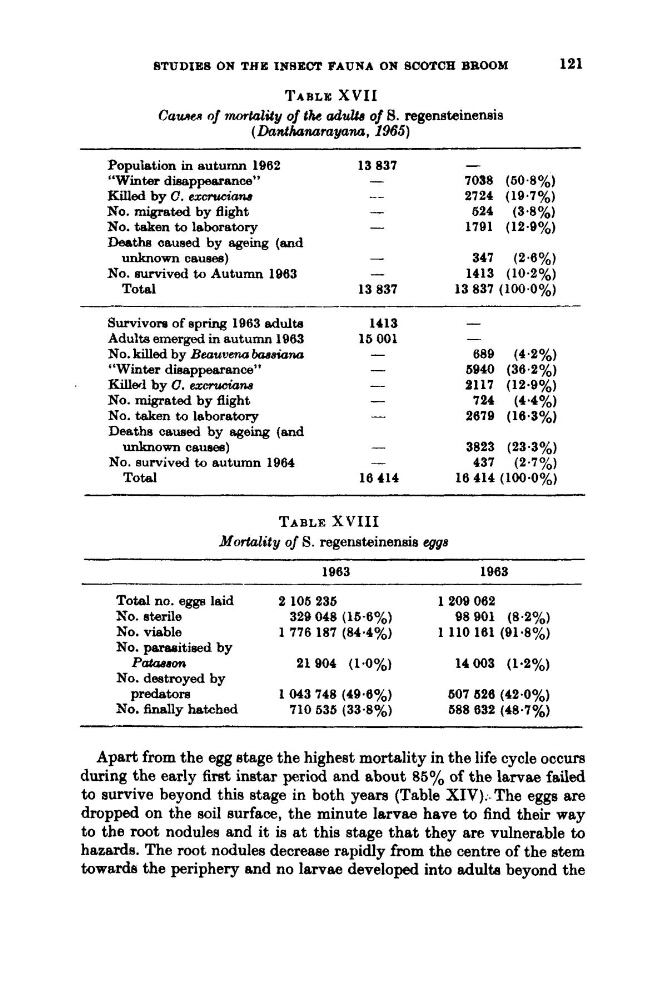
TABLE XVII
CUIWM of mortality of the add& of S. regensteinemis
(Danthanarayana, 1965)
121
PopuIetion in autumn 1962
“Winter diaeppearance”
Killed by 0. excrueiaM
No. migrated by flight
No. taken to laboratory
%the aaused by ageing (and
No. survived to Autumn 1963
unknown causes)
Total
-
13 837
-
7038 (60.8%)
2724 (19.7%)
624 (343%)
1791 (12*0~0)
347 (243%)
1413 (10-2Ok)
13 837 (lOO*O~o)
Survivor0 of spring 1063 adults
Adults emerged in autumn 1963
No. killed by Beauvena h & n a
“Winter dimppearance”
Killed by 0. excnmkam
No. migrated by flight
No. taken to laboratory
Deaths ceused by ageing (and
No. survived to autumn 1904
unknown causes)
Total
1413
16 001
-
-
I6 414
-
689 (4.2%)
6940 (36.2%)
4117 (12.9%)
724 (44%)
26’70 (16.3%)
3823 (23.3%)
437 (2.7%)
16 414 ( 100*O~o)
TABLE XVIII
Mortality of S. regensteinensis eggs
1963
1963
Total no. eggs laid
2 105 236
1 209 062
No. sterile
329 048 ( 16.6y0)
98 901 (8.2y0)
No. viable
1776 187 (84*4y0)
1 110 161 (91.8y0)
No. paseeitised by
Pataeson
21 904 (1.0%)
14003 (1~27’~)
No. destroyed by
predators
1 043 748 (49.6y0)
607 626 (42.0%)
No. finally hatched
710 636 (33.8%)
588 632 (48.7%)
Apart from the egg stage the highest mortality in the life cycle occurs
during the early first instar period and about 86% of the larvae failed
to survive beyond this stage in both years (Table XIV).-The eggs are
dropped on the soil surface, the minute larvae have to find their way
to the root nodules and it is at this stage that they are vulnerable to
hazards. The root nodules decrease rapidly from the centre of the stem
toward8 the periphery and no larvae developed into adulte beyond the
TABLE XVII
CUIWM of mortality of the add& of S. regensteinemis
(Danthanarayana, 1965)
121
PopuIetion in autumn 1962
“Winter diaeppearance”
Killed by 0. excrueiaM
No. migrated by flight
No. taken to laboratory
%the aaused by ageing (and
No. survived to Autumn 1963
unknown causes)
Total
-
13 837
-
7038 (60.8%)
2724 (19.7%)
624 (343%)
1791 (12*0~0)
347 (243%)
1413 (10-2Ok)
13 837 (lOO*O~o)
Survivor0 of spring 1063 adults
Adults emerged in autumn 1963
No. killed by Beauvena h & n a
“Winter dimppearance”
Killed by 0. excnmkam
No. migrated by flight
No. taken to laboratory
Deaths ceused by ageing (and
No. survived to autumn 1904
unknown causes)
Total
1413
16 001
-
-
I6 414
-
689 (4.2%)
6940 (36.2%)
4117 (12.9%)
724 (44%)
26’70 (16.3%)
3823 (23.3%)
437 (2.7%)
16 414 ( 100*O~o)
TABLE XVIII
Mortality of S. regensteinensis eggs
1963
1963
Total no. eggs laid
2 105 236
1 209 062
No. sterile
329 048 ( 16.6y0)
98 901 (8.2y0)
No. viable
1776 187 (84*4y0)
1 110 161 (91.8y0)
No. paseeitised by
Pataeson
21 904 (1.0%)
14003 (1~27’~)
No. destroyed by
predators
1 043 748 (49.6y0)
607 626 (42.0%)
No. finally hatched
710 636 (33.8%)
588 632 (48.7%)
Apart from the egg stage the highest mortality in the life cycle occurs
during the early first instar period and about 86% of the larvae failed
to survive beyond this stage in both years (Table XIV).-The eggs are
dropped on the soil surface, the minute larvae have to find their way
to the root nodules and it is at this stage that they are vulnerable to
hazards. The root nodules decrease rapidly from the centre of the stem
toward8 the periphery and no larvae developed into adulte beyond the