

STUDIES ON THE INSECT FAUNA OW SCOTCH B W O M
119
3. The magnitvde and the mwes of popla&m changea
(a) Natality. Danthanarayane (1966) considered that the moat reliable
estimation of the fecundity of femalea was obtained from mil sampling
(8above). The mean fecundity per female in 1963 was calculated aa
691 eggs and that for 1964 as 262, i.e. it varied in the two years by a
factor of 2.6. In both years regression equations relating the number
of eggs laid in 24 h (y) with temperature during that period (q) and
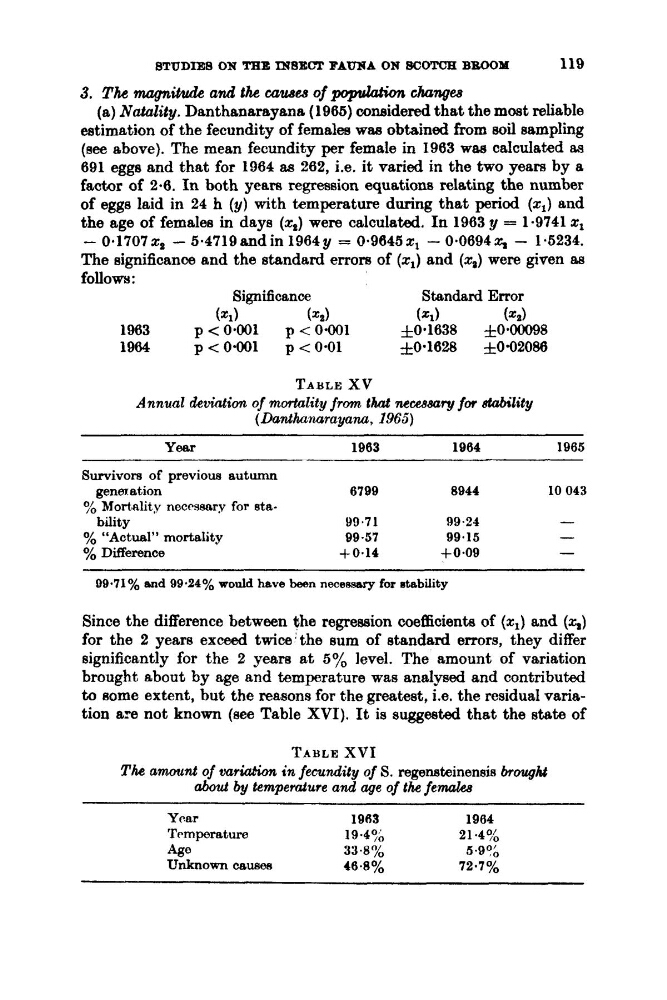
the age of females in days (z2) were calculated. In 1963 y = 1.9741 z1
- 0.1707 - 5.4719 and in 1964 y = 0.9645 z1 - 0.0694 Z, - 1.5234.
The significance and the standard errors of (zl) and (5) were given as
follow:
Significance
Standard Error
(51)
(4
(21)
(%a)
1963
p < 0.001 p < 0.001
f0.1638
f0.00098
1964
p < 0.001 p 4 0.01
f0-1628 *0.02086
TABLE X V
Annual deviation of mortality from thut necessary for M l i t y
(Danthanarayana, 1965)
Year
1963
1964
1965
Survivors of previous autumn
yo Mortality neccseory for stageneration
6799
8944
10 043
bility
99.71
99.24
-
yo “Actual” mortality
99.57
99.15
-
yo DSerence
+ 0.14
t o e 0 9
-
09.71~0 end 99.24% would have been necessary for &ability
Since the difference between the regression coefficients of (q) and (z,)
for the 2 years exceed twice’ the sum of standard errors, they differ
significantly for the 2 years at 5 % level. The amount of variation
brought about by age and temperature was analysed and contributed
to some extent, but the reasons for the greatest, i.e. the residual variation are not known (see Table XVI). It is suggeskd that the state of
TABLE XVI
The amount of varhtion in fecundity of S . regensteinensis b r q &
about by temperature and age of th.e females
Year
1963
1964
Temperature
19.40,X
21*49/,
Age
33.8‘x
5.90;
Unknown WUBBB
46.8Y0
72.7%
119
3. The magnitvde and the mwes of popla&m changea
(a) Natality. Danthanarayane (1966) considered that the moat reliable
estimation of the fecundity of femalea was obtained from mil sampling
(8above). The mean fecundity per female in 1963 was calculated aa
691 eggs and that for 1964 as 262, i.e. it varied in the two years by a
factor of 2.6. In both years regression equations relating the number
of eggs laid in 24 h (y) with temperature during that period (q) and
the age of females in days (z2) were calculated. In 1963 y = 1.9741 z1
- 0.1707 - 5.4719 and in 1964 y = 0.9645 z1 - 0.0694 Z, - 1.5234.
The significance and the standard errors of (zl) and (5) were given as
follow:
Significance
Standard Error
(51)
(4
(21)
(%a)
1963
p < 0.001 p < 0.001
f0.1638
f0.00098
1964
p < 0.001 p 4 0.01
f0-1628 *0.02086
TABLE X V
Annual deviation of mortality from thut necessary for M l i t y
(Danthanarayana, 1965)
Year
1963
1964
1965
Survivors of previous autumn
yo Mortality neccseory for stageneration
6799
8944
10 043
bility
99.71
99.24
-
yo “Actual” mortality
99.57
99.15
-
yo DSerence
+ 0.14
t o e 0 9
-
09.71~0 end 99.24% would have been necessary for &ability
Since the difference between the regression coefficients of (q) and (z,)
for the 2 years exceed twice’ the sum of standard errors, they differ
significantly for the 2 years at 5 % level. The amount of variation
brought about by age and temperature was analysed and contributed
to some extent, but the reasons for the greatest, i.e. the residual variation are not known (see Table XVI). It is suggeskd that the state of
TABLE XVI
The amount of varhtion in fecundity of S . regensteinensis b r q &
about by temperature and age of th.e females
Year
1963
1964
Temperature
19.40,X
21*49/,
Age
33.8‘x
5.90;
Unknown WUBBB
46.8Y0
72.7%