

116
N. WALOFF
1. The life hietory
Many features of this life history resemble those of Phytodecfa. The
weevils are univoltine with an obligatory imaginal diapause and long
lived; some survive and oviposit in two consecutive seaaons. The spring
generation of adults emerges in February or March and begins to oviposit two weeks later. As in Phykdecta, the oviposition period is very
long and may last 4 months. The eggs are dropped on to the soil surface.
The four larval inatars are subterranean and feed on the bacteriacontaining cells of the root nodules of broom. Pupation takes place in
the soil and new adults emerge from September to November. These
immature adults hibernate together with the survivors of the parent
generation in broom litter beneath the bushes.
2. Methods of estimating population size
With minor modifications the methods used for estimating the size
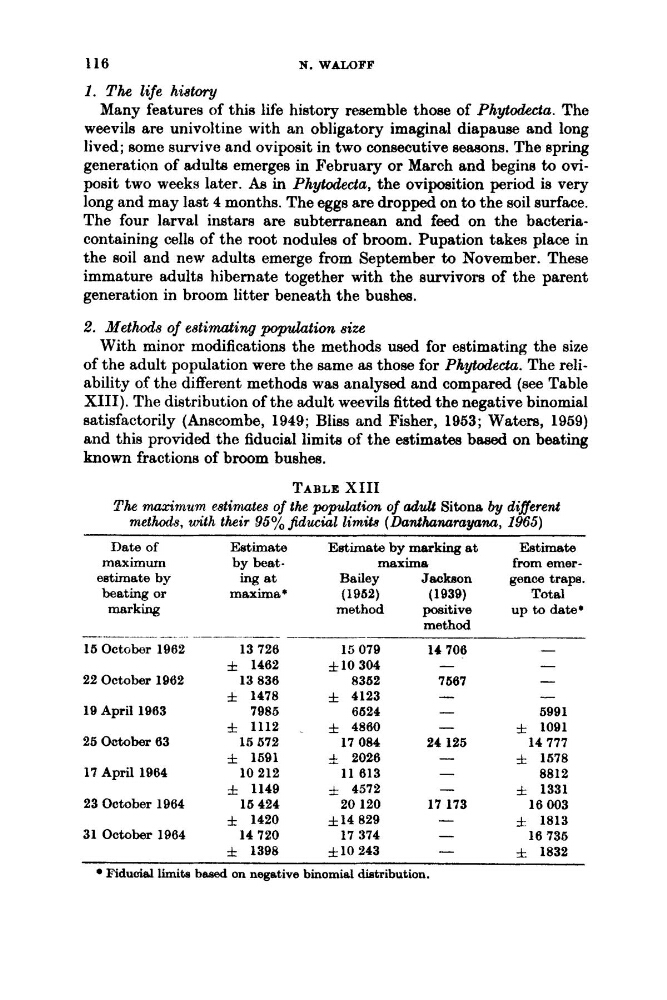
of the adult population were the same as those for Phytodecta. The reliability of the different methods was analysed and compared (see Table
XIII). The distribution of the adult weevils fitted the negative binomial
satisfactorily (Anscombe, 1949; Bliss and Fisher, 1963; Waters, 1969)
and this provided the fiducial limits of the estimates b d on beating
known fractions of broom bushes.
TABLE XI11
The maximum estimates of the population of a d d Sitona by different
methods, with their 95% jiducial l i m h (Dantknurayana, 1965)
Date of
Estimate
Estimate by marking at
Estimate
maximum
by beat -
maxima
from emerestimate by
ing at
Bailey
Jaukeon
gence traps.
beating or
maxima+
(1962)
( 1939)
Total
marking
method
positive
up to date+
method
__ -.
___ -
16 October 1962
13 726
15 079
14 706
-
f 1462
f 10 304
-
-
22 October 1962
13 836
8362
7567
-
f 1478
f 4123
-
I
19 April 1963
7986
6624
-
5991
f 1112 . f 4860
-
f 1091
25 October 63
15 672
17 084
24 126
14 777
f 1691
f 2026
-
f 1578
1'7 April 1964
10 212
11 613
-
8812
f 1149
f 4572
-
f 1331
23 October 1964
16 424
20 120
17 173
16 003
f 1420
f14 829
-
f 1813
31 October 1964
14 720
17 374
-
16 736
f 1832
f 1398
& 10 243
-
Piduoid limits b d on negative binomial distribution.
N. WALOFF
1. The life hietory
Many features of this life history resemble those of Phytodecfa. The
weevils are univoltine with an obligatory imaginal diapause and long
lived; some survive and oviposit in two consecutive seaaons. The spring
generation of adults emerges in February or March and begins to oviposit two weeks later. As in Phykdecta, the oviposition period is very
long and may last 4 months. The eggs are dropped on to the soil surface.
The four larval inatars are subterranean and feed on the bacteriacontaining cells of the root nodules of broom. Pupation takes place in
the soil and new adults emerge from September to November. These
immature adults hibernate together with the survivors of the parent
generation in broom litter beneath the bushes.
2. Methods of estimating population size
With minor modifications the methods used for estimating the size
of the adult population were the same as those for Phytodecta. The reliability of the different methods was analysed and compared (see Table
XIII). The distribution of the adult weevils fitted the negative binomial
satisfactorily (Anscombe, 1949; Bliss and Fisher, 1963; Waters, 1969)
and this provided the fiducial limits of the estimates b d on beating
known fractions of broom bushes.
TABLE XI11
The maximum estimates of the population of a d d Sitona by different
methods, with their 95% jiducial l i m h (Dantknurayana, 1965)
Date of
Estimate
Estimate by marking at
Estimate
maximum
by beat -
maxima
from emerestimate by
ing at
Bailey
Jaukeon
gence traps.
beating or
maxima+
(1962)
( 1939)
Total
marking
method
positive
up to date+
method
__ -.
___ -
16 October 1962
13 726
15 079
14 706
-
f 1462
f 10 304
-
-
22 October 1962
13 836
8362
7567
-
f 1478
f 4123
-
I
19 April 1963
7986
6624
-
5991
f 1112 . f 4860
-
f 1091
25 October 63
15 672
17 084
24 126
14 777
f 1691
f 2026
-
f 1578
1'7 April 1964
10 212
11 613
-
8812
f 1149
f 4572
-
f 1331
23 October 1964
16 424
20 120
17 173
16 003
f 1420
f14 829
-
f 1813
31 October 1964
14 720
17 374
-
16 736
f 1832
f 1398
& 10 243
-
Piduoid limits b d on negative binomial distribution.