

STUDIES ON THE INSECT FAUNA ON SCOTCH BROOM
109
1. The life hiatmy
The univoltine adult beetles are long lived and may survive for three
seasons. They emerge in spring from hibernation in the ~ R W S roots and
litter under the broom bushes and after laying their eggs re-enter the
soil, where one-third to one-fifth of them survive to the next summer.
The ovipition period of the population laets from 86 to 112 days, i.e.
it is long and aa a result all the immature stages overlap. Eggs are laid
on the leaves, on which the larvae feed and thus the immature stages
are fully exposed to natural enemies. Pupation is in the broom litter
and the offspring generation of adults emerges in late summer and in
autumn. After a short period of feeding these beetles join their parents
in hibernation. Their gonads remain immature until the following
spring. Thus the spring adults are a mixture of two generations and
a proportion of adults hibernates in thconsecutive winters and
oviposits in two seasons. I n the laboratory one female oviposited in 3
consecutive years.
2. Methods wed in the population study
The numbers of immature stages (eggs and larvae) were estimated
on cuttings of known weights of broom, while adults were sampled by
beating known proportions of the broom bushes in the field. Whenever
possible the estimates were checked by independent methods for instance the numbers of adults emerging were also estimated in emergence traps, i.e. in enclosures of known area placed under broom bushes.
At times of peak numbers the adult populations were also estimated by
the marking and recapture method (Bailey, 1952). At this stage the adults
showed a degree of aggregation and their distribution was best fitted to
a negative binominal; when numbers were low, distribution of the beetles
was indistinguishable from random. The numbem of the hibernating
beetles in soil were sampled with a sampler taking a 1220 C.C. core.
Weekly samples of all stages were kept to determine viability, parasitism and reproduction. Adult parasites were bred out and their
immature stages identified in dissections. The effects of predators of
the immature stages and of the pupae and adults in the soil were determined serologically (see Dempster et &., 1959; Dempster, 1960).
The data thus collected were analysed and a life table in the form of a
budget was constructed. The characteristic of the population curve of
Phytodecta was that there was no marked peak since recruitment and
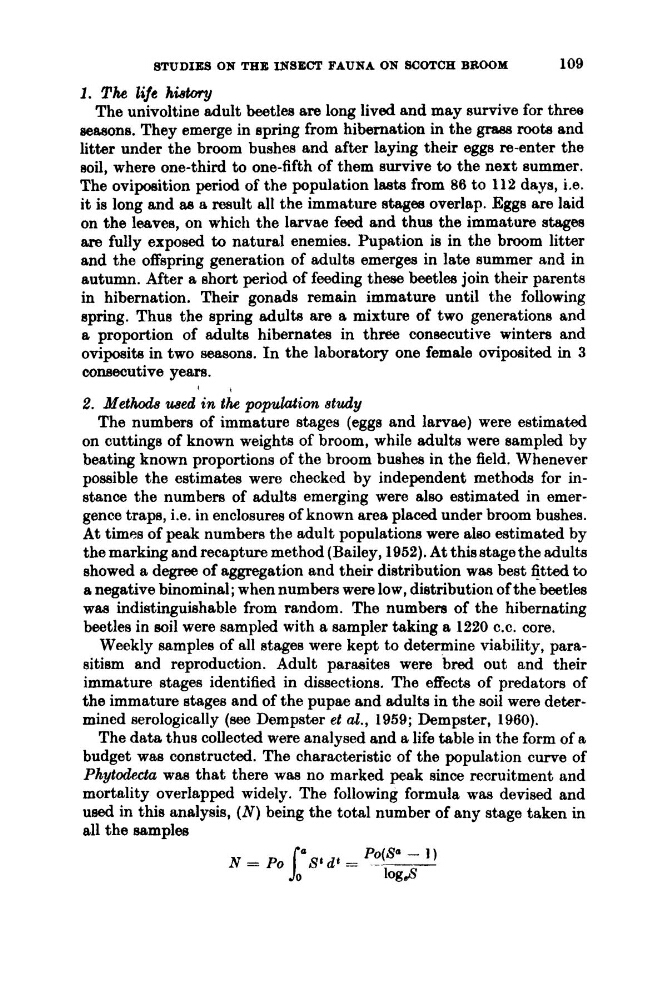
mortality overlapped widely. The following formula was devised and
used in this analysis, (N) being the total number of any stage taken in
all the samples
'
/
109
1. The life hiatmy
The univoltine adult beetles are long lived and may survive for three
seasons. They emerge in spring from hibernation in the ~ R W S roots and
litter under the broom bushes and after laying their eggs re-enter the
soil, where one-third to one-fifth of them survive to the next summer.
The ovipition period of the population laets from 86 to 112 days, i.e.
it is long and aa a result all the immature stages overlap. Eggs are laid
on the leaves, on which the larvae feed and thus the immature stages
are fully exposed to natural enemies. Pupation is in the broom litter
and the offspring generation of adults emerges in late summer and in
autumn. After a short period of feeding these beetles join their parents
in hibernation. Their gonads remain immature until the following
spring. Thus the spring adults are a mixture of two generations and
a proportion of adults hibernates in thconsecutive winters and
oviposits in two seasons. I n the laboratory one female oviposited in 3
consecutive years.
2. Methods wed in the population study
The numbers of immature stages (eggs and larvae) were estimated
on cuttings of known weights of broom, while adults were sampled by
beating known proportions of the broom bushes in the field. Whenever
possible the estimates were checked by independent methods for instance the numbers of adults emerging were also estimated in emergence traps, i.e. in enclosures of known area placed under broom bushes.
At times of peak numbers the adult populations were also estimated by
the marking and recapture method (Bailey, 1952). At this stage the adults
showed a degree of aggregation and their distribution was best fitted to
a negative binominal; when numbers were low, distribution of the beetles
was indistinguishable from random. The numbem of the hibernating
beetles in soil were sampled with a sampler taking a 1220 C.C. core.
Weekly samples of all stages were kept to determine viability, parasitism and reproduction. Adult parasites were bred out and their
immature stages identified in dissections. The effects of predators of
the immature stages and of the pupae and adults in the soil were determined serologically (see Dempster et &., 1959; Dempster, 1960).
The data thus collected were analysed and a life table in the form of a
budget was constructed. The characteristic of the population curve of
Phytodecta was that there was no marked peak since recruitment and
mortality overlapped widely. The following formula was devised and
used in this analysis, (N) being the total number of any stage taken in
all the samples
'
/