

RTUDIES ON THE INSECT FAfJNA ON SCOTCH BROOM
105
p a r u i y d larvae of the inquiline midge. ThuR galls containing up to 4
larvae of each species were occaaionally found.
The other partmites were (b) P s e m u a thoracicua (Walker)
(Pteromalidae), which occurred infrequently as an ectoparaaite of
Asphundylia in the pod galls. (c) Eurytoma dcratata Mayr (Eurytomidae)
was a rare ectoparaaite of Asph~ndylia larvae in both the pod and the
bud galls. Rarely it hyperparmitised Aprostoeetus larvae. (d) Torymus
sp. nr. microstigma (Walker) (Torymidhe) waa an infrequent hyperparasite of Aprostocetus in pod galls only. In two instancea it waa found
developing on Trdteria larvae.
3. The numbers of insects found in Asphondylia g a b and evidence
of inter-epecijic competition amongst them
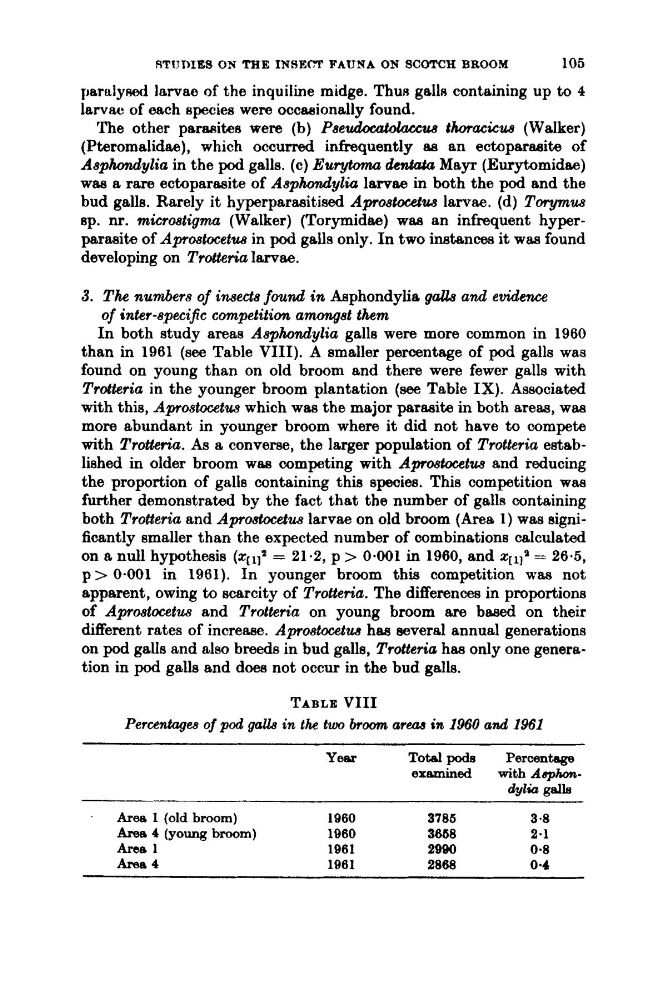
In both study areas A s p W y l i a galls were more common in 1960
than in 1961 (see Table VIII). A smaller percentage of pod galls was
found on young than on old broom and there were fewer galls with
Trdteria in the younger broom plantation (see Table IX). Associated
with this, Aprostocetus which was the major parasite in both areas, wm
more abundant in younger broom where it did not have to compete
with Trotteria. As 8 converse, the larger population of Trotteria established in older broom was competing with Apmstocetus and reducing
the proportion of galls containing this species. This competition was
further demonstrated by the fact that the number of galls containing
both Trotteria and Aprodocetus larvae on old broom (Area 1) was significantly smaller than the expected number of combinations calculated
on a null hypotheais (qIl2 = 21.2, p > 0.001 in 1960, and qIla = 26.5,
p > 0.001 in 1961). In younger broom this competition w w not
apparent, owing to scarcity of Trotteria. The differences in proportions
of Aprmtocetus and Trotteria on young broom are baaed on their
different rates of increase. Aproetocetucl has several annual generations
on pod galls and also breeds in bud galls, Trdteria haa only one generation in pod galls and does not occur in the bud galls.
TABLE VIII
Percentages of pod gaUe in the two b r m area in 1960 and 1961
Year
Totelpods
Percentage
dylia galla
exemined
w i t h A q h -
.
Area 1 (old broom)
1960
3786
3 -8
Area 4 (young broom)
1960
3668
2.1
Areel
1961
2990
0.8
Arefb4
1961
2868
0 4
105
p a r u i y d larvae of the inquiline midge. ThuR galls containing up to 4
larvae of each species were occaaionally found.
The other partmites were (b) P s e m u a thoracicua (Walker)
(Pteromalidae), which occurred infrequently as an ectoparaaite of
Asphundylia in the pod galls. (c) Eurytoma dcratata Mayr (Eurytomidae)
was a rare ectoparaaite of Asph~ndylia larvae in both the pod and the
bud galls. Rarely it hyperparmitised Aprostoeetus larvae. (d) Torymus
sp. nr. microstigma (Walker) (Torymidhe) waa an infrequent hyperparasite of Aprostocetus in pod galls only. In two instancea it waa found
developing on Trdteria larvae.
3. The numbers of insects found in Asphondylia g a b and evidence
of inter-epecijic competition amongst them
In both study areas A s p W y l i a galls were more common in 1960
than in 1961 (see Table VIII). A smaller percentage of pod galls was
found on young than on old broom and there were fewer galls with
Trdteria in the younger broom plantation (see Table IX). Associated
with this, Aprostocetus which was the major parasite in both areas, wm
more abundant in younger broom where it did not have to compete
with Trotteria. As 8 converse, the larger population of Trotteria established in older broom was competing with Apmstocetus and reducing
the proportion of galls containing this species. This competition was
further demonstrated by the fact that the number of galls containing
both Trotteria and Aprodocetus larvae on old broom (Area 1) was significantly smaller than the expected number of combinations calculated
on a null hypotheais (qIl2 = 21.2, p > 0.001 in 1960, and qIla = 26.5,
p > 0.001 in 1961). In younger broom this competition w w not
apparent, owing to scarcity of Trotteria. The differences in proportions
of Aprmtocetus and Trotteria on young broom are baaed on their
different rates of increase. Aproetocetucl has several annual generations
on pod galls and also breeds in bud galls, Trdteria haa only one generation in pod galls and does not occur in the bud galls.
TABLE VIII
Percentages of pod gaUe in the two b r m area in 1960 and 1961
Year
Totelpods
Percentage
dylia galla
exemined
w i t h A q h -
.
Area 1 (old broom)
1960
3786
3 -8
Area 4 (young broom)
1960
3668
2.1
Areel
1961
2990
0.8
Arefb4
1961
2868
0 4