

100
N. WALOFF
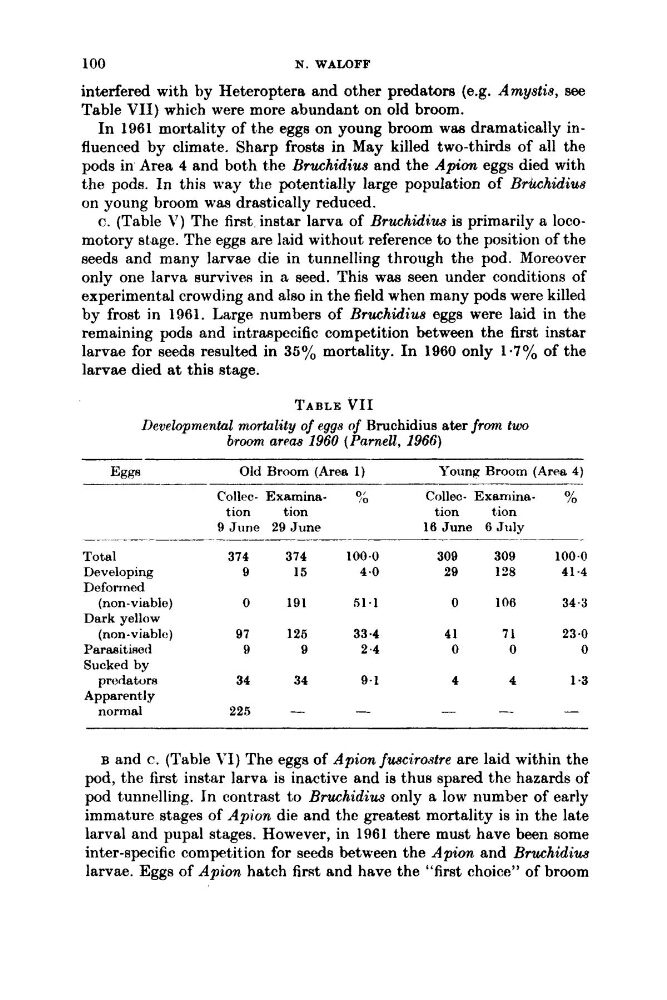
interfered with by Heteroptera and other predators (e.g. Arnystis, see
Table VII) which were more abundant on old broom.
In 1961 mortality of the eggs on young broom wm dramatically influenced by climate. Sharp frosts in May killed two-thirds of all the
pods in Area 4 and both the Bruchidius and the A p i m eggs died with
the pods. In this way the potentially large population of Brhhidiols
on young broom was drastically reduced.
c. (Table 1’) The first instar larva of Bruchidius is primarily a locomotory stage. The eggs are laid without reference to the position of the
seeds and many larvae die in tunnelling through the pod. Moreover
only one larva survivss in a seed. This waa seen under conditions of
experimental crowding and also in the field when many pods were killed
by frost in 1961. Large numbers of Bruchidius eggs were laid in the
remaining pods and intraspecific competition between the first instar
larvae for seeds resulted in 35% mortality. In 1960 only 1.7% of the
larvae died at this stage.
TABLE VII
Developmental mortality of eggs of Bruchidius ater from two
broom arcm 1960 (Parnell, 1966)
Eggs
Old Broom (Area 1)
Young Broom (Area 4)
Collec- Examinayo
Collec- Examinayo
tion
tion
9 June 29 June
tion
tion
16 June 6 July
Total
374
374
1004
309
309
100.0
Developing
9
15
4 .O
29
108
41.4
Deformed
Dark yellow
(non-viablu)
97
126
33 -4
41
71
23 .O
Parmitisod
9
9
2.4
0
0
0
Sucked by
prodaturs
34
34
9-1
4
4
1 -3
Apparently
normal
225
(non-viable)
0
191
51.1
0
106
34.3
-
-
-
-
-
B and c. (Table VI) The eggs of Apion fuscirostre are laid within the
pod, the first inst,ar larva is inactive and ia thus spared the hazards of
pod tunnelling. In contrast to Bruchidius only a low number of early
immature stages of Apion die and the greatest mortality is in the late
larval and pupal stages. However, in 1961 there must have been some
inter-specific competition for seeds between the Apion and Bruchidius
larvae. Eggs of Apion hatch fimt and have the “first choice” of broom
N. WALOFF
interfered with by Heteroptera and other predators (e.g. Arnystis, see
Table VII) which were more abundant on old broom.
In 1961 mortality of the eggs on young broom wm dramatically influenced by climate. Sharp frosts in May killed two-thirds of all the
pods in Area 4 and both the Bruchidius and the A p i m eggs died with
the pods. In this way the potentially large population of Brhhidiols
on young broom was drastically reduced.
c. (Table 1’) The first instar larva of Bruchidius is primarily a locomotory stage. The eggs are laid without reference to the position of the
seeds and many larvae die in tunnelling through the pod. Moreover
only one larva survivss in a seed. This waa seen under conditions of
experimental crowding and also in the field when many pods were killed
by frost in 1961. Large numbers of Bruchidius eggs were laid in the
remaining pods and intraspecific competition between the first instar
larvae for seeds resulted in 35% mortality. In 1960 only 1.7% of the
larvae died at this stage.
TABLE VII
Developmental mortality of eggs of Bruchidius ater from two
broom arcm 1960 (Parnell, 1966)
Eggs
Old Broom (Area 1)
Young Broom (Area 4)
Collec- Examinayo
Collec- Examinayo
tion
tion
9 June 29 June
tion
tion
16 June 6 July
Total
374
374
1004
309
309
100.0
Developing
9
15
4 .O
29
108
41.4
Deformed
Dark yellow
(non-viablu)
97
126
33 -4
41
71
23 .O
Parmitisod
9
9
2.4
0
0
0
Sucked by
prodaturs
34
34
9-1
4
4
1 -3
Apparently
normal
225
(non-viable)
0
191
51.1
0
106
34.3
-
-
-
-
-
B and c. (Table VI) The eggs of Apion fuscirostre are laid within the
pod, the first inst,ar larva is inactive and ia thus spared the hazards of
pod tunnelling. In contrast to Bruchidius only a low number of early
immature stages of Apion die and the greatest mortality is in the late
larval and pupal stages. However, in 1961 there must have been some
inter-specific competition for seeds between the Apion and Bruchidius
larvae. Eggs of Apion hatch fimt and have the “first choice” of broom