

PA'ITERN AND PROCESS IN COMPETITION
59
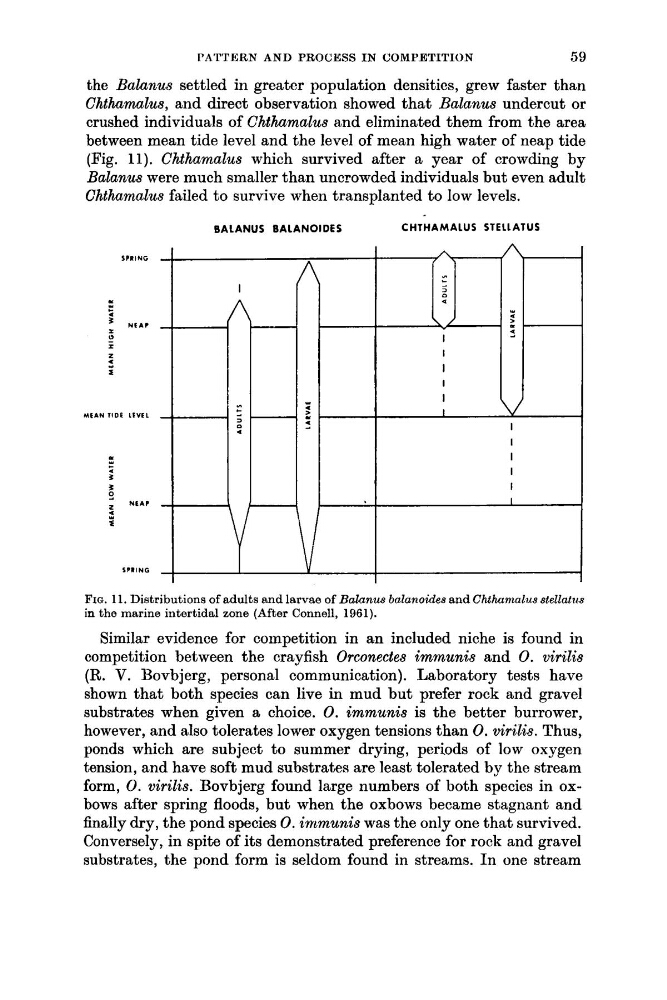
the Balanus settled in greater population densities, grew faster than
Chthamalus, and direct observation showed that Balanus undercut or
crushed individuals of Chthamalus and eliminated them from the area
between mean tide level and the level of mean high water of neap tide
(Fig. 11). Chthamalus which survived after a year of crowding by
Balanus were much smaller than uncrowded individuals but even adult
Chthamalus failed to survive when transplanted to low levels.
BALANUS BALANOIDES
CHTHAMALUS STELLATUS
MtAN
SPRING
=
I L
f N t A l
0
I
2
-
5
1 l D t L l V t l
I
I c
3
I
s
:
N E A P
STRING
FIG. 11. Distributions of adults and larvae of Balanus balanoides and Chthamalus stellatics
in the marine intertidal zone (After Connell, 1961).
Similar evidence for competition in an included niche is found in
competition between the crayfish Orconectes immunis and 0. virilis
(R. V. Bovbjerg, personal communication). Laboratory tests have
shown that both species can live in mud but prefer rock and gravel
substrates when given a choice. 0. immunis is the better burrower,
however, and also tolerates lower oxygen tensions than 0. virilis. Thus,
ponds which are subject to summer drying, periods of low oxygen
tension, and have soft mud substrates are least tolerated by the stream
form, 0. virilis. Bovbjerg found large numbers of both species in oxbows after spring floods, but when the oxbows became stagnant and
finally dry, the pond species 0. immunis was the only one that survived.
Conversely, in spite of its demonstrated preference for rock and gravel
substrates, the pond form is seldom found in streams. In one stream
59
the Balanus settled in greater population densities, grew faster than
Chthamalus, and direct observation showed that Balanus undercut or
crushed individuals of Chthamalus and eliminated them from the area
between mean tide level and the level of mean high water of neap tide
(Fig. 11). Chthamalus which survived after a year of crowding by
Balanus were much smaller than uncrowded individuals but even adult
Chthamalus failed to survive when transplanted to low levels.
BALANUS BALANOIDES
CHTHAMALUS STELLATUS
MtAN
SPRING
=
I L
f N t A l
0
I
2
-
5
1 l D t L l V t l
I
I c
3
I
s
:
N E A P
STRING
FIG. 11. Distributions of adults and larvae of Balanus balanoides and Chthamalus stellatics
in the marine intertidal zone (After Connell, 1961).
Similar evidence for competition in an included niche is found in
competition between the crayfish Orconectes immunis and 0. virilis
(R. V. Bovbjerg, personal communication). Laboratory tests have
shown that both species can live in mud but prefer rock and gravel
substrates when given a choice. 0. immunis is the better burrower,
however, and also tolerates lower oxygen tensions than 0. virilis. Thus,
ponds which are subject to summer drying, periods of low oxygen
tension, and have soft mud substrates are least tolerated by the stream
form, 0. virilis. Bovbjerg found large numbers of both species in oxbows after spring floods, but when the oxbows became stagnant and
finally dry, the pond species 0. immunis was the only one that survived.
Conversely, in spite of its demonstrated preference for rock and gravel
substrates, the pond form is seldom found in streams. In one stream