

50
RICHARD S. MILLER
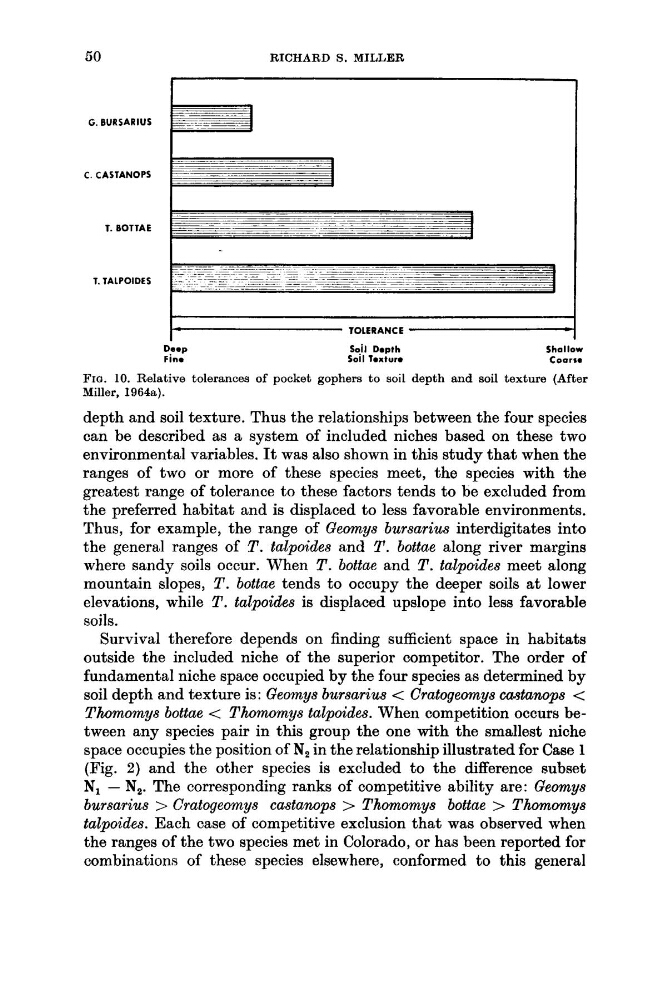
FIQ. 10. Relative tolerances of pocket gophers to soil depth and soil texture (After
Miller, 1964a).
depth and soil texture. Thus the relationships between the four species
can be described as a system of included niches based on these two
environmental variables. It was also shown in this study that when the
ranges of two or more of these species meet, the species with the
greatest range of tolerance to these factors tends to be excluded from
the preferred habitat and is displaced to less favorable environments.
Thus, for example, the range of Geomys bursarius interdigitates into
the general ranges of T . talpoides and T . bottae along river margins
where sandy soils occur. When T . bottae and T . talpoides meet along
mountain slopes, T . bottae tends to occupy the deeper soils at lower
elevations, while T . talpoides is displaced upslope into less favorable
soils.
Survival therefore depends on finding sufficient space in habitats
outside the included niche of the superior competitor. The order of
fundamental niche space occupied by the four species 8.6 determined by
soil depth and texture is: Geomys bursarius < Cratogeomys m t a m p s <
Thomomys bottae < Thomomys talpoides. When competition occurs between any species pair in this group the one with the smallest niche
space occupies the position of N, in the relationship illustrated for Case 1
(Fig. 2) and the other species is excluded to the difference subset
N, - N,. The corresponding ranks of competitive ability are: G e m y s
bursarius > Cratogeomys castamps > Thomomys bottae > Thomomys
talpoides. Each case of competitive exclusion that was observed when
the ranges of the two species met in Colorado, or has been reported for
combinations of these species elsewhere, conformed to this general
RICHARD S. MILLER
FIQ. 10. Relative tolerances of pocket gophers to soil depth and soil texture (After
Miller, 1964a).
depth and soil texture. Thus the relationships between the four species
can be described as a system of included niches based on these two
environmental variables. It was also shown in this study that when the
ranges of two or more of these species meet, the species with the
greatest range of tolerance to these factors tends to be excluded from
the preferred habitat and is displaced to less favorable environments.
Thus, for example, the range of Geomys bursarius interdigitates into
the general ranges of T . talpoides and T . bottae along river margins
where sandy soils occur. When T . bottae and T . talpoides meet along
mountain slopes, T . bottae tends to occupy the deeper soils at lower
elevations, while T . talpoides is displaced upslope into less favorable
soils.
Survival therefore depends on finding sufficient space in habitats
outside the included niche of the superior competitor. The order of
fundamental niche space occupied by the four species 8.6 determined by
soil depth and texture is: Geomys bursarius < Cratogeomys m t a m p s <
Thomomys bottae < Thomomys talpoides. When competition occurs between any species pair in this group the one with the smallest niche
space occupies the position of N, in the relationship illustrated for Case 1
(Fig. 2) and the other species is excluded to the difference subset
N, - N,. The corresponding ranks of competitive ability are: G e m y s
bursarius > Cratogeomys castamps > Thomomys bottae > Thomomys
talpoides. Each case of competitive exclusion that was observed when
the ranges of the two species met in Colorado, or has been reported for
combinations of these species elsewhere, conformed to this general