

PATTERN AND PROCESS IN COMPETITION
47
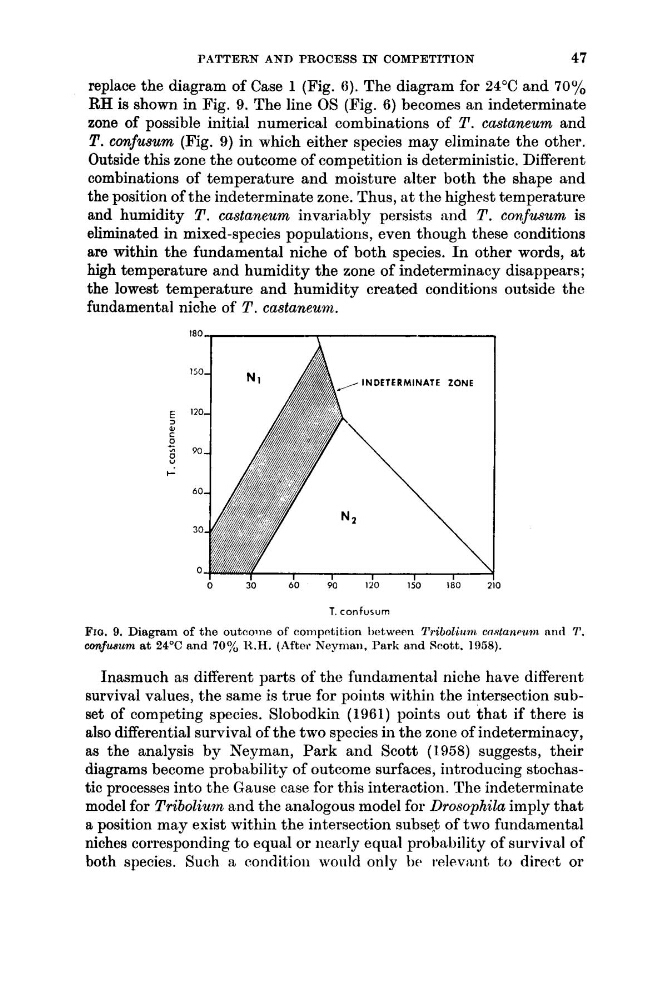
replace the diagram of Case 1 (Fig. 6). The diagram for 24OC and 70%
RH is shown in Fig. 9. The line 0s (Fig. 6) becomes an indeterminate
zone of possible initial numerical combinations of T . castaneum and
T. confusum (Fig. 9) in which either species may eliminate the other.
Outside this zone the outcome of competition is deterministic. Different
combinations of temperature and moisture alter both the shape and
the position of the indeterminate zone. Thus, a t the highest temperature
and humidity T . castaneum invariably persists and T. confusum is
eliminated in mixed-species populations, even though these conditions
are within the fundamental niche of both species. I n other words, at
high temperature and humidity the zone of indeterminacy disappears ;
the lowest temperature and humidity created conditions outside the
fundamental niche of T . castaneum.
T confusum
FIG. 9. Diagram of the outcome of coniprtition between Triboliirm cnslatiruni nnd 7'.
confwum at 24OC and 70% H.H. (After Neyniaii, Park and Rrott. 1958).
Inasmuch as different parts of tho fundamental niche have different
survival values, the same is true for points within the intersection subset of competing species. Slobodkin (1961) points out that if there is
also differential survival of the two species in the zone of indeterminacy,
as the analysis by Neyman, Park and Scott (1958) suggests, their
diagrams become probability of outcome surfaces, introducing stochastic processes into the Gause case for this interaction. The indeterminate
model for Triboliurn and the analogous model for Drosophila imply that
a position may exist within the intersection subset of two fundamental
niches corresponding to equal or nearly equal probability of survival of
both species. Such a conditioii would only be I~elevitnt to direct or
47
replace the diagram of Case 1 (Fig. 6). The diagram for 24OC and 70%
RH is shown in Fig. 9. The line 0s (Fig. 6) becomes an indeterminate
zone of possible initial numerical combinations of T . castaneum and
T. confusum (Fig. 9) in which either species may eliminate the other.
Outside this zone the outcome of competition is deterministic. Different
combinations of temperature and moisture alter both the shape and
the position of the indeterminate zone. Thus, a t the highest temperature
and humidity T . castaneum invariably persists and T. confusum is
eliminated in mixed-species populations, even though these conditions
are within the fundamental niche of both species. I n other words, at
high temperature and humidity the zone of indeterminacy disappears ;
the lowest temperature and humidity created conditions outside the
fundamental niche of T . castaneum.
T confusum
FIG. 9. Diagram of the outcome of coniprtition between Triboliirm cnslatiruni nnd 7'.
confwum at 24OC and 70% H.H. (After Neyniaii, Park and Rrott. 1958).
Inasmuch as different parts of tho fundamental niche have different
survival values, the same is true for points within the intersection subset of competing species. Slobodkin (1961) points out that if there is
also differential survival of the two species in the zone of indeterminacy,
as the analysis by Neyman, Park and Scott (1958) suggests, their
diagrams become probability of outcome surfaces, introducing stochastic processes into the Gause case for this interaction. The indeterminate
model for Triboliurn and the analogous model for Drosophila imply that
a position may exist within the intersection subset of two fundamental
niches corresponding to equal or nearly equal probability of survival of
both species. Such a conditioii would only be I~elevitnt to direct or