

PATTERN AND I’RO(’ESS IN COMPXTITION
45
only reduced to 45% of the total population in one cage after 402 days
at 15OC. I n a similar study of competition between D. melanogaster
and D. funebris in population cages, it was found that fresh medium
favored the production of D. melanogaster while D. funebris was more
successful than D. melanogaster in older food (Merrell, 1951). I n an
otherwise constant environment, periodic renewal of the food cups
introduced environmental fluctuations that were sufficient to allow coexistence of these species for almost 2 years, after which the experiment
was terminated.
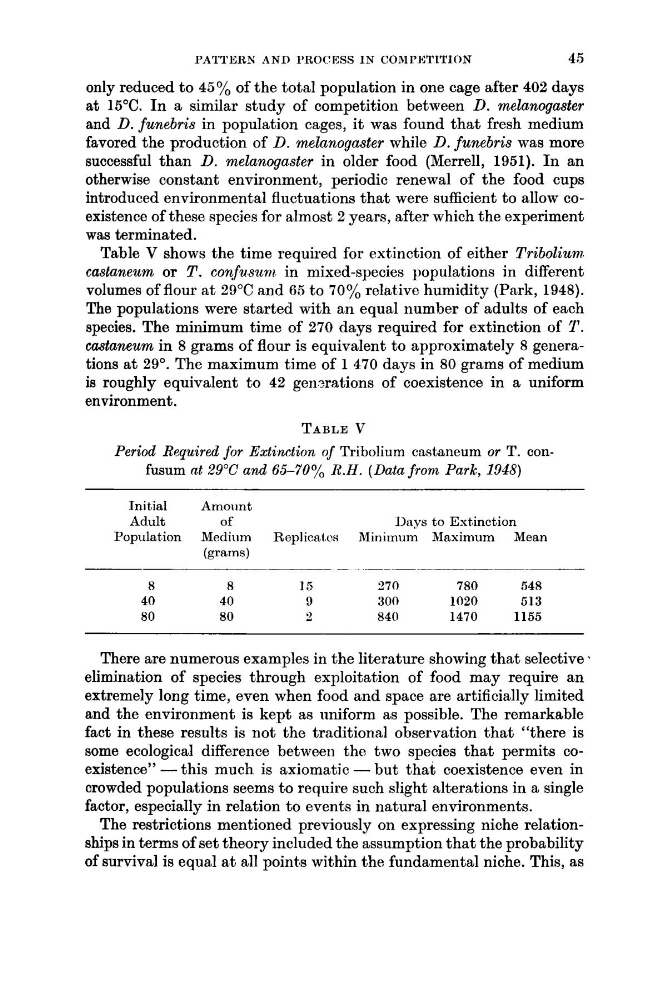
Table V shows the time required for extinction of either Tribolium
castaneum or T . confusum in mixed-species populations in different
volumes of flour a t 29°C and 65 to 70% relative humidity (Park, 1948).
The populations were started with an equal number of adults of each
species. The minimum time of 270 days required for extinction of T .
castaneum in 8 grams of flour is equivalent to approximately 8 generations at 29”. The maximum time of l 470 days in 80 grams of medium
is roughly equivalent to 42 genwitions of coexistence in a uniform
environment.
TABLE V
Period Required for Extinction of Tribolium castaneum or T. confusum at 29°C and 65-70% R.H. (Data from Park, 1948)
Initial
Amoiint
Adult
of
Days to Extinction
Population Medium
ReplicaLcs Minimum Maximum Mean
(grams)
~ _ _ _ _ _ _ ~
8
8
15
270
780
548
40
40
0
300
1020
513
80
80
2
840
1470
1155
There are numerous examples in the literature showing that selective %
elimination of species through exploitation of food may require an
extremely long time, even when food and space are artificially limited
and the environment is kept as uniform as possible. The remarkable
fact in these results is not the traditional observation that “there is
some ecological difference between the two species that permits coexistence” -this much is axiomatic -but that coexistence even in
crowded populations seems t o require such slight alterations in a single
factor, especially in relation to event,s in natural environments.
The restrictions mentioned previously on expressing niche relationships in terms of set theory included the assumption that the probability
of survival is equal at all point,s within the fundamental niche. This, as
45
only reduced to 45% of the total population in one cage after 402 days
at 15OC. I n a similar study of competition between D. melanogaster
and D. funebris in population cages, it was found that fresh medium
favored the production of D. melanogaster while D. funebris was more
successful than D. melanogaster in older food (Merrell, 1951). I n an
otherwise constant environment, periodic renewal of the food cups
introduced environmental fluctuations that were sufficient to allow coexistence of these species for almost 2 years, after which the experiment
was terminated.
Table V shows the time required for extinction of either Tribolium
castaneum or T . confusum in mixed-species populations in different
volumes of flour a t 29°C and 65 to 70% relative humidity (Park, 1948).
The populations were started with an equal number of adults of each
species. The minimum time of 270 days required for extinction of T .
castaneum in 8 grams of flour is equivalent to approximately 8 generations at 29”. The maximum time of l 470 days in 80 grams of medium
is roughly equivalent to 42 genwitions of coexistence in a uniform
environment.
TABLE V
Period Required for Extinction of Tribolium castaneum or T. confusum at 29°C and 65-70% R.H. (Data from Park, 1948)
Initial
Amoiint
Adult
of
Days to Extinction
Population Medium
ReplicaLcs Minimum Maximum Mean
(grams)
~ _ _ _ _ _ _ ~
8
8
15
270
780
548
40
40
0
300
1020
513
80
80
2
840
1470
1155
There are numerous examples in the literature showing that selective %
elimination of species through exploitation of food may require an
extremely long time, even when food and space are artificially limited
and the environment is kept as uniform as possible. The remarkable
fact in these results is not the traditional observation that “there is
some ecological difference between the two species that permits coexistence” -this much is axiomatic -but that coexistence even in
crowded populations seems t o require such slight alterations in a single
factor, especially in relation to event,s in natural environments.
The restrictions mentioned previously on expressing niche relationships in terms of set theory included the assumption that the probability
of survival is equal at all point,s within the fundamental niche. This, as