

42
RICHARD S. MILLER
factor when the population reaches a critical density in relation to the
amount and quality of food. It is evident that species interactions at
this stage need not lead to the selective elimination of one of the competing species. The interactions values ( a = fi = 1) may in fact allow
complete coexistence of both species, except at extremely high densities. The results obtained by Sokoloff (1955) for larval competition
between the sibling species D . pseudoobsczsra and D. persirnilis were
not analysed in this way but suggest an identical relationship. It would
appear therefore that the outcome of competition in this system depends
primarily on genetic and environmental influences affecting fecundity
and fertility of the parental generation.
L
Nc,
NoI
K1.5
a
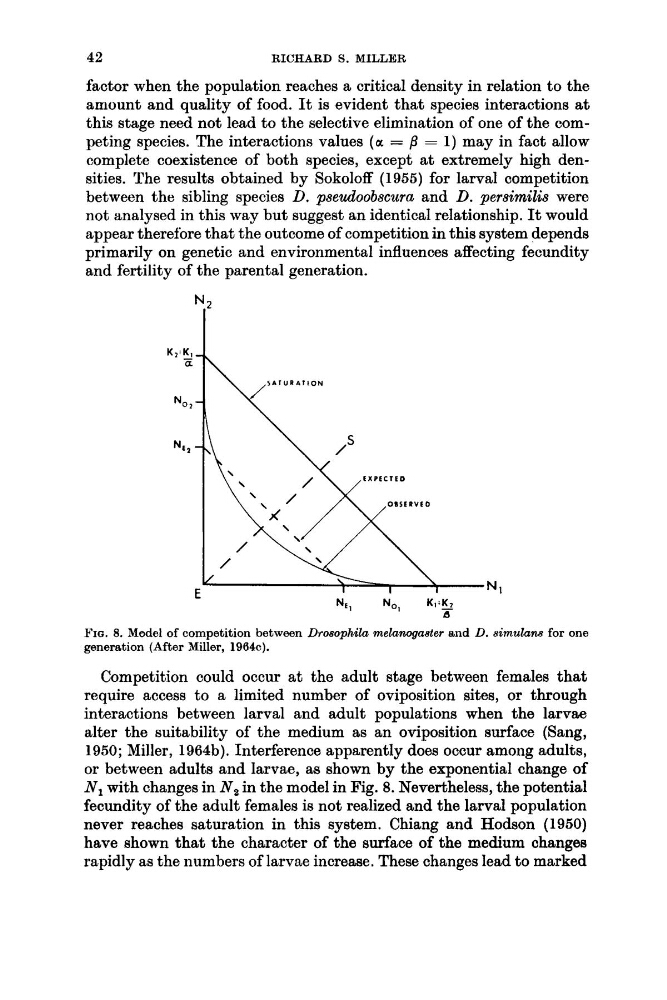
PIO. 8. Model of competition between Drosophila melamqaater and D. tiimulans for one
generation (After Miller, 1964~).
Competition could occur a t the adult stage between females that
require access to a limited number of oviposition sites, or through
interactions between larval and adult populations when the larvae
alter the suitability of the medium as an oviposition surface (Sang,
1950; Miller, 196413). Interference apparently does occur among adults,
or between adults and larvae, as shown by the exponential change of
N , with changes in N , in the model in Fig. 8. Nevertheless, the potential
fecundity of the adult females is not realized and the larval population
never reaches saturation in this system. Chiang and Hodson (1950)
have shown that the character of the surface of the medium changes
rapidly as the numbers of larvae increase. These changes lead to marked
RICHARD S. MILLER
factor when the population reaches a critical density in relation to the
amount and quality of food. It is evident that species interactions at
this stage need not lead to the selective elimination of one of the competing species. The interactions values ( a = fi = 1) may in fact allow
complete coexistence of both species, except at extremely high densities. The results obtained by Sokoloff (1955) for larval competition
between the sibling species D . pseudoobsczsra and D. persirnilis were
not analysed in this way but suggest an identical relationship. It would
appear therefore that the outcome of competition in this system depends
primarily on genetic and environmental influences affecting fecundity
and fertility of the parental generation.
L
Nc,
NoI
K1.5
a
PIO. 8. Model of competition between Drosophila melamqaater and D. tiimulans for one
generation (After Miller, 1964~).
Competition could occur a t the adult stage between females that
require access to a limited number of oviposition sites, or through
interactions between larval and adult populations when the larvae
alter the suitability of the medium as an oviposition surface (Sang,
1950; Miller, 196413). Interference apparently does occur among adults,
or between adults and larvae, as shown by the exponential change of
N , with changes in N , in the model in Fig. 8. Nevertheless, the potential
fecundity of the adult females is not realized and the larval population
never reaches saturation in this system. Chiang and Hodson (1950)
have shown that the character of the surface of the medium changes
rapidly as the numbers of larvae increase. These changes lead to marked