

36
RICHARD S . MILLER
have similar geographic distributions and occupy similar niches in
nature, but are also more likely than most species to have competitive
interactions which are comparable. We might logically expect that the
more nearly the ecological requirements of two species are alike and
the greater the amount of intersection in their fundamental niches, the
higher the probability their species interaction values will be the same.
The experiments consisted of placing early first instar larvae in vials
containing 5 cc of a standard medium to which was added 1/20 cc of a
15% yeast solution (Miller, 1964b). The cultures were allowed to develop
a t 25OC and the production of pupae and larvae was recorded. In singlespecies cultures the larvae responded to increased crowding by extending the larval period and by progressive reductions in the final adult
body size without significant increases in mortality. As noted earlier,
this compensatory mechanism seems to occur in species which live in
their food medium and compete mainly through direct exploitation of
their food resources. There is, however, a minimum survival size which
marks the limit of compensation for the effects of crowding, and both
species showed a pronounced increase in mortality between formation
of the pupa and emergence of the adult when the initial larval densities
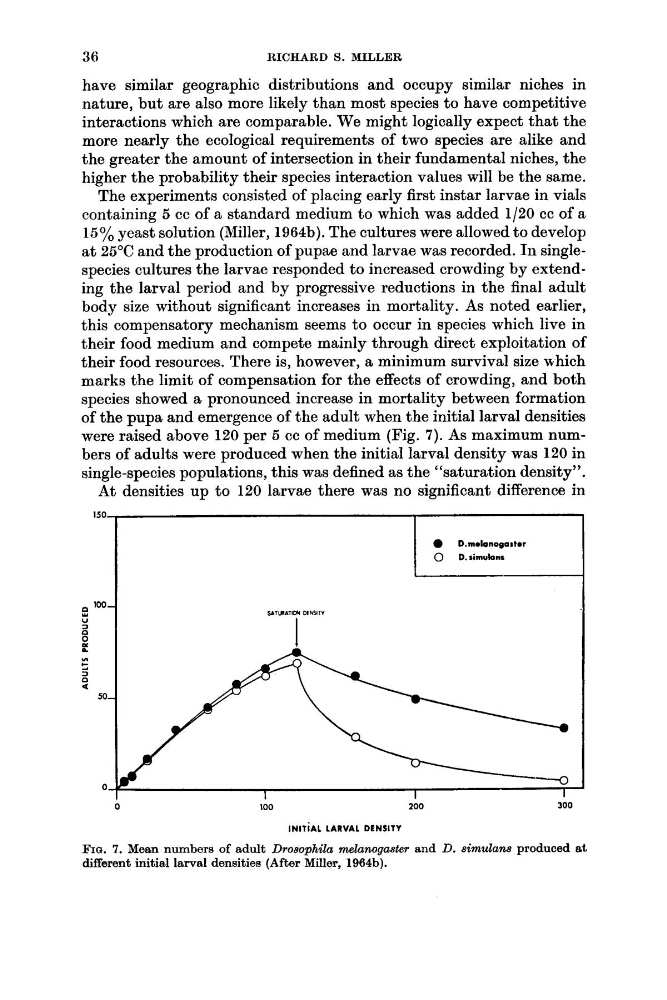
were raised above 120 per 5 cc of medium (Fig. 7). As maximum numbers of adults were produced when the initial larval density was 120 in
single-species populations, this was defined as the “saturation density”.
At densities up to 120 larvae there was no significant difference in
IS0
100
0
a
a
;
“3
5
a
0
50
0
0 D.mdonogartbr
0 D.rimulans
0 D.mdonogartbr
0 D.rimulans
I
I
100
200
300
I
100
200
300
lNlTiA1 LARVAL DENSITY
FIQ. I. Mean numbers of adult Drosophila melanogaster and D. sirnulam produced at
different initial larval densities (After Miller, 1964b).
RICHARD S . MILLER
have similar geographic distributions and occupy similar niches in
nature, but are also more likely than most species to have competitive
interactions which are comparable. We might logically expect that the
more nearly the ecological requirements of two species are alike and
the greater the amount of intersection in their fundamental niches, the
higher the probability their species interaction values will be the same.
The experiments consisted of placing early first instar larvae in vials
containing 5 cc of a standard medium to which was added 1/20 cc of a
15% yeast solution (Miller, 1964b). The cultures were allowed to develop
a t 25OC and the production of pupae and larvae was recorded. In singlespecies cultures the larvae responded to increased crowding by extending the larval period and by progressive reductions in the final adult
body size without significant increases in mortality. As noted earlier,
this compensatory mechanism seems to occur in species which live in
their food medium and compete mainly through direct exploitation of
their food resources. There is, however, a minimum survival size which
marks the limit of compensation for the effects of crowding, and both
species showed a pronounced increase in mortality between formation
of the pupa and emergence of the adult when the initial larval densities
were raised above 120 per 5 cc of medium (Fig. 7). As maximum numbers of adults were produced when the initial larval density was 120 in
single-species populations, this was defined as the “saturation density”.
At densities up to 120 larvae there was no significant difference in
IS0
100
0
a
a
;
“3
5
a
0
50
0
0 D.mdonogartbr
0 D.rimulans
0 D.mdonogartbr
0 D.rimulans
I
I
100
200
300
I
100
200
300
lNlTiA1 LARVAL DENSITY
FIQ. I. Mean numbers of adult Drosophila melanogaster and D. sirnulam produced at
different initial larval densities (After Miller, 1964b).