

34
RICHARD S. MILLER
two-species population; disturbance of the balance in numbers will. lead
automatically to re-establishment of the stable combination.
Lotka (1932) and Windsor (1934) also recognized the theoretical
possibility of infinite survival of both species in a mixed population.
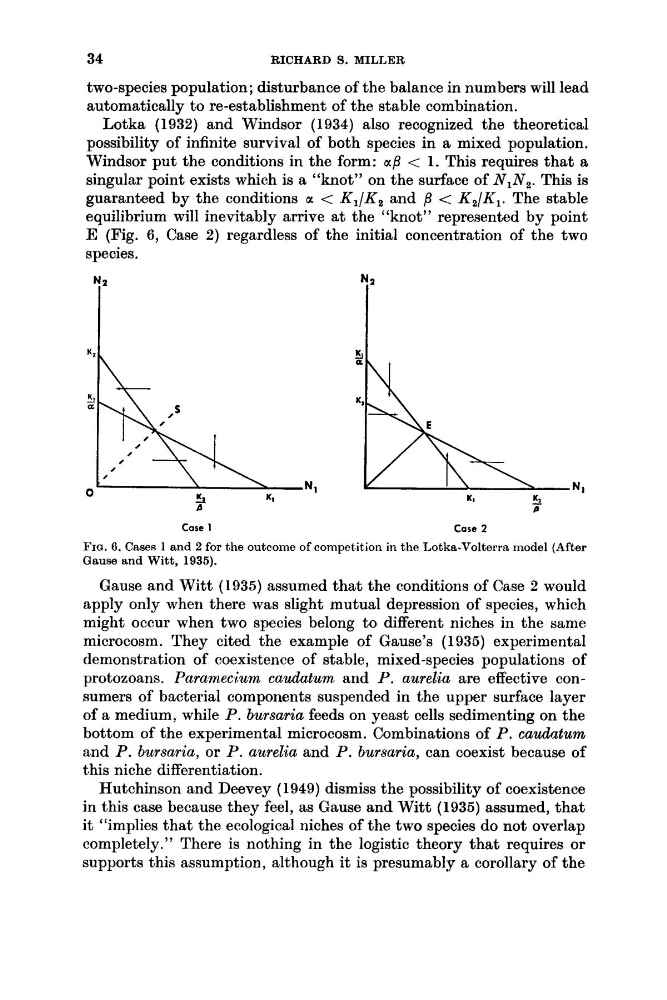
Windsor put the conditions in the form: up < 1. This requires that a
singular point exists which is a “knot” on the surface of N,N,. This is
guaranteed by the conditions u < K , / K , and p < K , / K , . The stable
equilibrium will inevitably arrive a t the “knot” represented by point
E (Fig. 6, Case 2) regardless of the initial concentration of the two
species.
Care 1
Core 2
FIQ. 6. Casen 1 and 2 for the outcoine of competition in the TAotke-Volterra model (After
Gause and Witt, 1935).
Gause and Witt (1935) assumed that the conditions of Case 2 would
apply only when there was slight mutual depression of species, which
might occur when two species belong to different niches in the same
microcosm. They cited the example of Gause’s (1935) experimental
demonstration of coexistence of stable, mixed-species populations of
protozoans. Paramecium caudatum and P. aurelia are effective consumers of bacterial components suspended in the upper surface layer
of a medium, while P. bursaria feeds on yeast cells sedimenting on the
bottom of the experimental microcosm. Combinations of P. caudntum
and P. bursaria, or P. aurelia and P. bursaria, can coexist because of
this niche differentiation.
Hutchinson and Deevey (1949) dismiss the possibility of coexistence
in this case because they feel, as Gause and Witt (1935) assumed, that
it “implies that the ecological niches of the two species do not overlap
completely.” There is nothing in the logistic theory that requires or
supports this assumption, although it is presumably a corollary of the
RICHARD S. MILLER
two-species population; disturbance of the balance in numbers will. lead
automatically to re-establishment of the stable combination.
Lotka (1932) and Windsor (1934) also recognized the theoretical
possibility of infinite survival of both species in a mixed population.
Windsor put the conditions in the form: up < 1. This requires that a
singular point exists which is a “knot” on the surface of N,N,. This is
guaranteed by the conditions u < K , / K , and p < K , / K , . The stable
equilibrium will inevitably arrive a t the “knot” represented by point
E (Fig. 6, Case 2) regardless of the initial concentration of the two
species.
Care 1
Core 2
FIQ. 6. Casen 1 and 2 for the outcoine of competition in the TAotke-Volterra model (After
Gause and Witt, 1935).
Gause and Witt (1935) assumed that the conditions of Case 2 would
apply only when there was slight mutual depression of species, which
might occur when two species belong to different niches in the same
microcosm. They cited the example of Gause’s (1935) experimental
demonstration of coexistence of stable, mixed-species populations of
protozoans. Paramecium caudatum and P. aurelia are effective consumers of bacterial components suspended in the upper surface layer
of a medium, while P. bursaria feeds on yeast cells sedimenting on the
bottom of the experimental microcosm. Combinations of P. caudntum
and P. bursaria, or P. aurelia and P. bursaria, can coexist because of
this niche differentiation.
Hutchinson and Deevey (1949) dismiss the possibility of coexistence
in this case because they feel, as Gause and Witt (1935) assumed, that
it “implies that the ecological niches of the two species do not overlap
completely.” There is nothing in the logistic theory that requires or
supports this assumption, although it is presumably a corollary of the