

26
RICHARD S. MILLER
B. C O M M U N I T Y C O M P O S I T I O N
Elton (1946) analysed published ecological surveys of 55 animal
communities and 27 plant communities and concluded that the number
of species present in any given community is less than would be expected from chance. He found a constantly high percentage of genera
represented by only one species (86% for animal and 84% for plant
communities) and average numbers of species per genus of 1.38 in
STREAM FLOW
t
MONT€N€GRINA
I
4
I
GONOCEPRALA
- I
6.5-8.5
16-17’
23’
u_
z
D! c
5
w
MONTENEGIINA
t
4
GONOCEWALA
I -
-I
11 14”
I
I
I
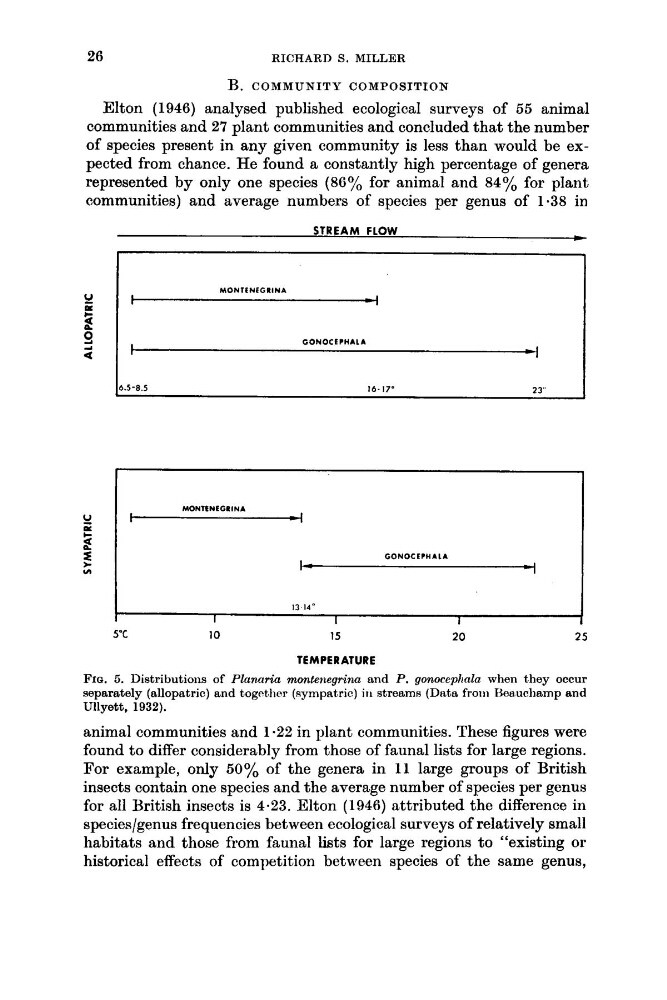
FIQ. 5. Distributions of Planaria montenegrina and P . gonocepknla when they occur
separately (allopatric) and together (sympatrir) in streams (Data froin Beauchamp and
Ullyett. 1932).
animal communities and 1.22 in plant communities. These figures were
found to differ considerably from those of faunal lists for large regions.
For example, only 50% of the genera in 11 large groups of British
insects contain one species and the average number of species per genus
for all British insects is 4.23. Elton (1946) attributed the difference in
species/genus frequencies between ecological surveys of relatively small
habitats and those from faunal lists for large regions to “existing or
historical effects of competition between species of the same genus,
RICHARD S. MILLER
B. C O M M U N I T Y C O M P O S I T I O N
Elton (1946) analysed published ecological surveys of 55 animal
communities and 27 plant communities and concluded that the number
of species present in any given community is less than would be expected from chance. He found a constantly high percentage of genera
represented by only one species (86% for animal and 84% for plant
communities) and average numbers of species per genus of 1.38 in
STREAM FLOW
t
MONT€N€GRINA
I
4
I
GONOCEPRALA
- I
6.5-8.5
16-17’
23’
u_
z
D! c
5
w
MONTENEGIINA
t
4
GONOCEWALA
I -
-I
11 14”
I
I
I
FIQ. 5. Distributions of Planaria montenegrina and P . gonocepknla when they occur
separately (allopatric) and together (sympatrir) in streams (Data froin Beauchamp and
Ullyett. 1932).
animal communities and 1.22 in plant communities. These figures were
found to differ considerably from those of faunal lists for large regions.
For example, only 50% of the genera in 11 large groups of British
insects contain one species and the average number of species per genus
for all British insects is 4.23. Elton (1946) attributed the difference in
species/genus frequencies between ecological surveys of relatively small
habitats and those from faunal lists for large regions to “existing or
historical effects of competition between species of the same genus,