

PATTERN AND PROCESS IN COMPETITION
19
ordered, even though this is obviously not possible with our present
state of knowledge.
(3) The model refers to a single instant in time.
(4) Only a few species can be considered at once, even though all other
species in the community are regarded as part of the coordinate system.
As Hutchinson (1957) points out and earlier discussions have also
shown, some of the confusion surrounding the “Volterra-Gause Principle” has arisen from the concept of two species not being able to
co-occur when they occupy identical niches. This problem was dealt
with in detail by Gilbert et al. (1952). According to the set-theoretic
formulation of niches, identity of fundamental niche would imply
N, = N,, that is every point of N, is a member of N, and vice versa.
It is axiomatic that this is impossible (Hardin, 1960; Cole, 1960).
Omitting this quasi-tautological case, Hutchinson ( 1957) distinguished
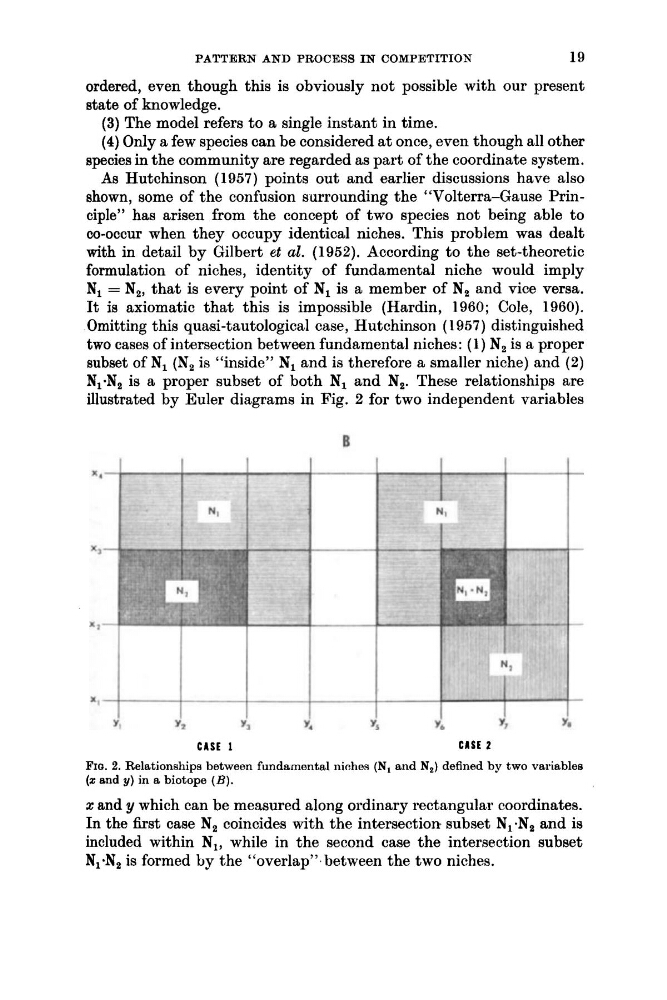
two cases of intersection between fundamental niches: (1) N, is a proper
subset of N, (N, is “inside” N, and is therefore a smaller niche) and (2)
N,-N, is a proper subset of both N, and N,. These relationships are
illustrated by Euler diagrams in Fig. 2 for two independent variables
C A S E 1
CASE 2
FIQ. 2. Relationships between fundamental niohes (N, and N,) defined by two variables
(z and y) in a biotope ( B ) .
x and y which can be measured along ordinary rectangular coordinates.
In the first case N, coincides with the intersection subset N,.N, and is
included within N,, while in the second case the intersection subset
N,.N, is formed by the “overlap”. between the two niches.
19
ordered, even though this is obviously not possible with our present
state of knowledge.
(3) The model refers to a single instant in time.
(4) Only a few species can be considered at once, even though all other
species in the community are regarded as part of the coordinate system.
As Hutchinson (1957) points out and earlier discussions have also
shown, some of the confusion surrounding the “Volterra-Gause Principle” has arisen from the concept of two species not being able to
co-occur when they occupy identical niches. This problem was dealt
with in detail by Gilbert et al. (1952). According to the set-theoretic
formulation of niches, identity of fundamental niche would imply
N, = N,, that is every point of N, is a member of N, and vice versa.
It is axiomatic that this is impossible (Hardin, 1960; Cole, 1960).
Omitting this quasi-tautological case, Hutchinson ( 1957) distinguished
two cases of intersection between fundamental niches: (1) N, is a proper
subset of N, (N, is “inside” N, and is therefore a smaller niche) and (2)
N,-N, is a proper subset of both N, and N,. These relationships are
illustrated by Euler diagrams in Fig. 2 for two independent variables
C A S E 1
CASE 2
FIQ. 2. Relationships between fundamental niohes (N, and N,) defined by two variables
(z and y) in a biotope ( B ) .
x and y which can be measured along ordinary rectangular coordinates.
In the first case N, coincides with the intersection subset N,.N, and is
included within N,, while in the second case the intersection subset
N,.N, is formed by the “overlap”. between the two niches.