

280
J. A. KITCHING AND F. J. EBLING
Curlew Bay (Fig. 69), in an area densely covered with algae. On 15 July
the Paracentrotus occupied an irregular area about 6 x 2 n ~ ,
with the
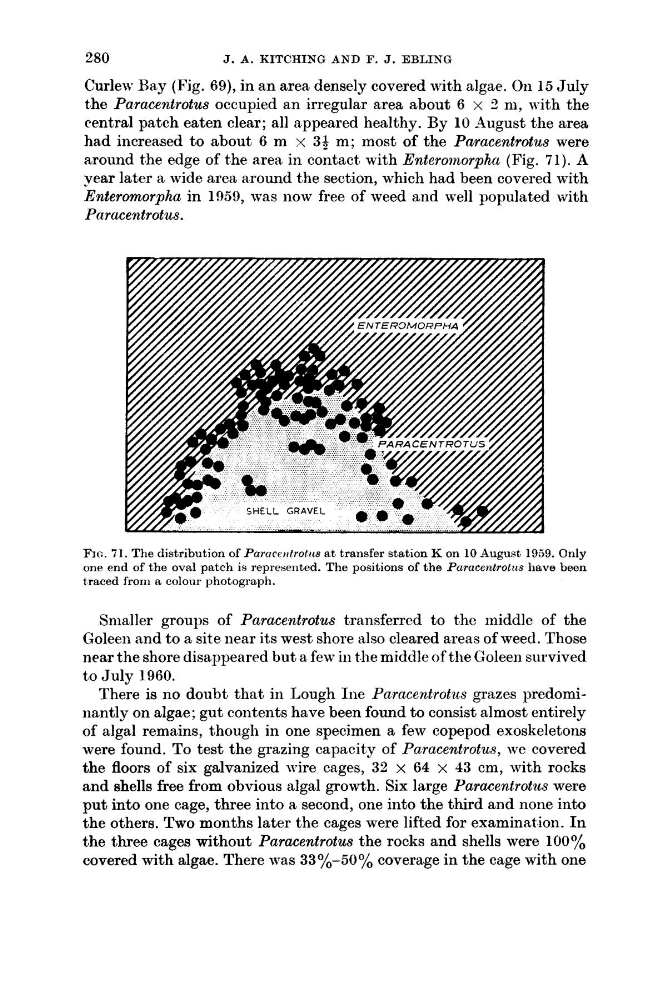
central patch eaten clear; all appeared healthy. By 10 dugust the area
had increased to about 6 m x 33 m; most of the Paracentrotus were
around the edge of the area in contact with Enteromorphu (Fig. 71). A
year later a wide area around the section, which had been covered with
Enteromorpha in 1959, mas now free of weed and well populated with
Pnrucentrotus.
FIG. 71. The distribution of Parace,rtro/its at transfer station K on 10 August 1959. Only
one end of the oval patch is reprewnted. The positions of the Paracent+-ott~s have been
traced from a colour photograph.
Smaller groups of Paracentrotus transferred to the middle of the
Goleeii and to a site near its west shore also cleared areas of weed. Those
near the shore disappeared but a few in the middle of the Goleen survived
to July 1960.
There is no doubt that in Lough Ine Paracentrotus grazes predominantly on algae; gut contents have been found to consist almost entirely
of algal remains, though in one specimen a few copepod exoskeletons
were found. To test the grazing capacity of Paracentrotus, we covered
the floors of six galvanized wire cages, 32 x 64 x 43 em, with rocks
and shells free from obvious algal growth. Six large Paracentrotus were
put into one cage, three into a second, one into the third and none into
the others. Two months later the cages were lifted for examination. In
the three cages without Paracentrotus the rocks and shells were l OOyo
covered with algae. There was 33%-50y0 coverage in the cage with one
J. A. KITCHING AND F. J. EBLING
Curlew Bay (Fig. 69), in an area densely covered with algae. On 15 July
the Paracentrotus occupied an irregular area about 6 x 2 n ~ ,
with the
central patch eaten clear; all appeared healthy. By 10 dugust the area
had increased to about 6 m x 33 m; most of the Paracentrotus were
around the edge of the area in contact with Enteromorphu (Fig. 71). A
year later a wide area around the section, which had been covered with
Enteromorpha in 1959, mas now free of weed and well populated with
Pnrucentrotus.
FIG. 71. The distribution of Parace,rtro/its at transfer station K on 10 August 1959. Only
one end of the oval patch is reprewnted. The positions of the Paracent+-ott~s have been
traced from a colour photograph.
Smaller groups of Paracentrotus transferred to the middle of the
Goleeii and to a site near its west shore also cleared areas of weed. Those
near the shore disappeared but a few in the middle of the Goleen survived
to July 1960.
There is no doubt that in Lough Ine Paracentrotus grazes predominantly on algae; gut contents have been found to consist almost entirely
of algal remains, though in one specimen a few copepod exoskeletons
were found. To test the grazing capacity of Paracentrotus, we covered
the floors of six galvanized wire cages, 32 x 64 x 43 em, with rocks
and shells free from obvious algal growth. Six large Paracentrotus were
put into one cage, three into a second, one into the third and none into
the others. Two months later the cages were lifted for examination. In
the three cages without Paracentrotus the rocks and shells were l OOyo
covered with algae. There was 33%-50y0 coverage in the cage with one