

276
J. A. KITCHINC; AND F. J. KBLINC
possible explanation of this distribution is that larvae settle over the
whole lough and that small Paracentrotus are able to survive as long as
they are sheltered from predators underneath boulders. According to
this view, emergence and subsequent growth were only possible in the
North Basin, because in the South Basin the urchins were subject t o
predation. We must admit, however, that there is another possibility,
namely that the numerous small Paracentrotus resulted from an unusually successful settlement.
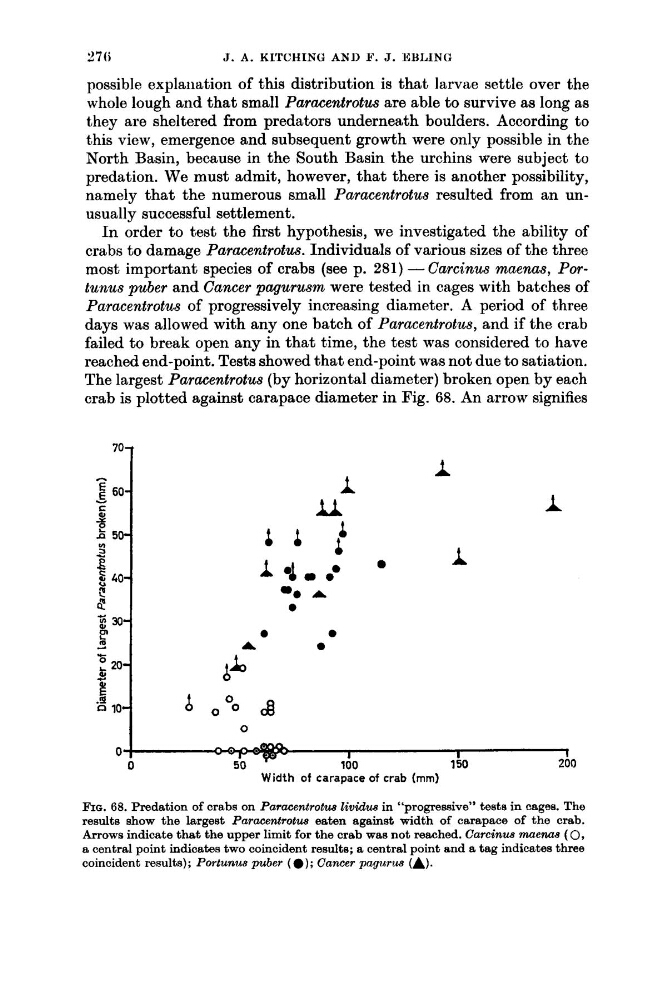
In order to test the first hypothesis, we investigated the ability of
crabs to damage Paracentrotus. Individuals of various sizes of the three
most important species of crabs (see p. 281) - Carcinus maenas, Portunus puber and Cancer pagurusm were tested in cages with batches of
Paracentrotus of progressively increasing diameter. A period of three
days was allowed with any one batch of Paracentrotus, and if the crab
failed to break open any in that time, the test was considered to have
reached end-point. Tests showed that end-point was not due to satiation.
The largest Parmentrotus (by horizontal diameter) broken open by each
crab is plotted against carapace diameter in Fig. 68. An arrow signifies
-
60v
C
d
E
k 50II)
5 40c
4“
0
t
A
A
O !
I
I
i
0
100
150
200
Width of carapace of crab (rnm)
FIG. 68. Predation of crabs on Paraoentrotw, lividw in “progressive” tests in cages. The
results show the largest Paracentrotw eaten against width of carapace of the crab.
Arrows indicate thet the upper limit for the crab was not reached. Carcinus m e n a 8 ( 0 ,
a central point indicates two coincident results; a central point end a tag indicates three
coincident results); Pmtunus puber (a); Cancer pagurus (A).
J. A. KITCHINC; AND F. J. KBLINC
possible explanation of this distribution is that larvae settle over the
whole lough and that small Paracentrotus are able to survive as long as
they are sheltered from predators underneath boulders. According to
this view, emergence and subsequent growth were only possible in the
North Basin, because in the South Basin the urchins were subject t o
predation. We must admit, however, that there is another possibility,
namely that the numerous small Paracentrotus resulted from an unusually successful settlement.
In order to test the first hypothesis, we investigated the ability of
crabs to damage Paracentrotus. Individuals of various sizes of the three
most important species of crabs (see p. 281) - Carcinus maenas, Portunus puber and Cancer pagurusm were tested in cages with batches of
Paracentrotus of progressively increasing diameter. A period of three
days was allowed with any one batch of Paracentrotus, and if the crab
failed to break open any in that time, the test was considered to have
reached end-point. Tests showed that end-point was not due to satiation.
The largest Parmentrotus (by horizontal diameter) broken open by each
crab is plotted against carapace diameter in Fig. 68. An arrow signifies
-
60v
C
d
E
k 50II)
5 40c
4“
0
t
A
A
O !
I
I
i
0
100
150
200
Width of carapace of crab (rnm)
FIG. 68. Predation of crabs on Paraoentrotw, lividw in “progressive” tests in cages. The
results show the largest Paracentrotw eaten against width of carapace of the crab.
Arrows indicate thet the upper limit for the crab was not reached. Carcinus m e n a 8 ( 0 ,
a central point indicates two coincident results; a central point end a tag indicates three
coincident results); Pmtunus puber (a); Cancer pagurus (A).