

ECOLOGICAL STUDIES AT LOUGH INE
273
first 24 h. Again most of the survivors moved upwards; heavy rain
occurred in the last days of the experiment and the survivors started to
swell and died.
I n a third experiment a large number of Thais from Carrigathorna
were placed in the shallow sublittoral a t East Goleen and a t Glannafeen
Quay for observation of possible predators. During the evening and the
hours of darkness, many Carcinus emerged from cover and attacked the
Thais, and some crabs were seen to damage the foot; on the following
morning many damaged empty shells were found in the experimental area.
I n order to determine whether Thais would survive the local water
conditions in Lough Ine when protected from crabs and other predators, Thais and Mytilus, both from the open coast, were placed together
in cages in various parts of the lough. Twelve to fifteen Thais were put
in each cage with a number of pieces of rock covered with small Mytilus
and barnacles, and the cages were placed in the shallow sublittoral or
in the lower littoral. Mussels survived a t stations in the North Basin,
the South Basin and the Goleen, but a number of them were drilled,
evidently by Thais. Fifty out of sixty-four Thais survived over a period
of about six weeks, equally well at each station.
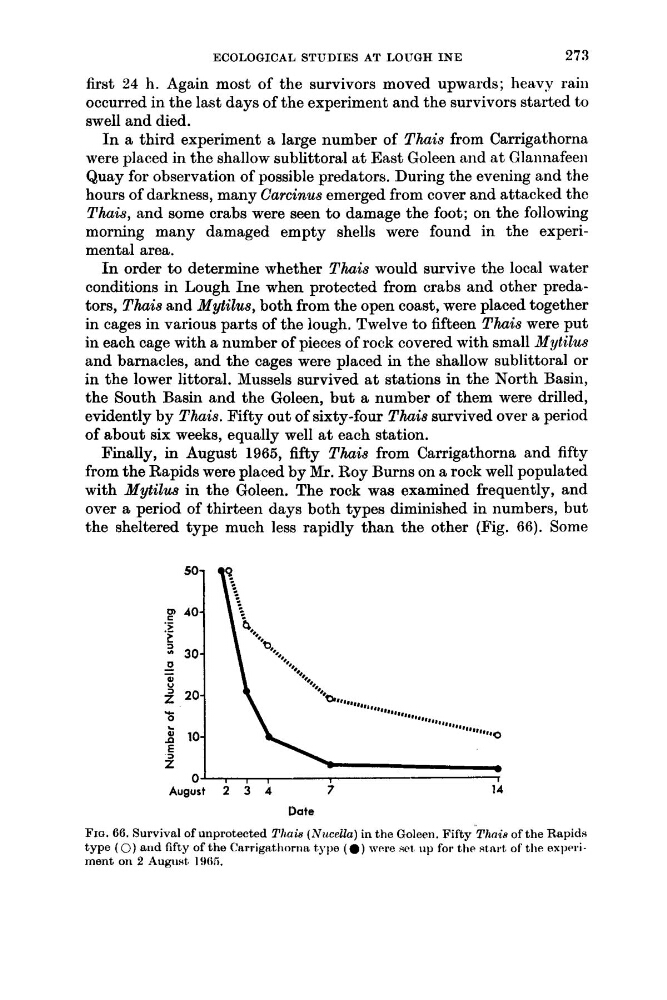
Finally, in August 1965, fifty Thais from Carrigathorna and fifty
from the Rapids were placed by Mr. Roy Burns on a rock well populated
with Mytilus in the Goleen. The rock was examined frequently, and
over a period of thirteen days both types diminished in numbers, but
the sheltered type much less rapidly than the other (Fig. 66). Some
p 40?
.- >
30- -
0
5 20B 10i ?
Y
E
O J , , ,
i
August 2 3 4
7
14
Date
FIG. 66. Survival of unprotected Thais ( N u c d l a ) in the Goleen. Fifty Thai8 of the Rapids
type (0) and fifty of the Carrigathorna type ( 0 ) mere .irt up for the start. of the experiment on 2 August, 1965.
273
first 24 h. Again most of the survivors moved upwards; heavy rain
occurred in the last days of the experiment and the survivors started to
swell and died.
I n a third experiment a large number of Thais from Carrigathorna
were placed in the shallow sublittoral a t East Goleen and a t Glannafeen
Quay for observation of possible predators. During the evening and the
hours of darkness, many Carcinus emerged from cover and attacked the
Thais, and some crabs were seen to damage the foot; on the following
morning many damaged empty shells were found in the experimental area.
I n order to determine whether Thais would survive the local water
conditions in Lough Ine when protected from crabs and other predators, Thais and Mytilus, both from the open coast, were placed together
in cages in various parts of the lough. Twelve to fifteen Thais were put
in each cage with a number of pieces of rock covered with small Mytilus
and barnacles, and the cages were placed in the shallow sublittoral or
in the lower littoral. Mussels survived a t stations in the North Basin,
the South Basin and the Goleen, but a number of them were drilled,
evidently by Thais. Fifty out of sixty-four Thais survived over a period
of about six weeks, equally well at each station.
Finally, in August 1965, fifty Thais from Carrigathorna and fifty
from the Rapids were placed by Mr. Roy Burns on a rock well populated
with Mytilus in the Goleen. The rock was examined frequently, and
over a period of thirteen days both types diminished in numbers, but
the sheltered type much less rapidly than the other (Fig. 66). Some
p 40?
.- >
30- -
0
5 20B 10i ?
Y
E
O J , , ,
i
August 2 3 4
7
14
Date
FIG. 66. Survival of unprotected Thais ( N u c d l a ) in the Goleen. Fifty Thai8 of the Rapids
type (0) and fifty of the Carrigathorna type ( 0 ) mere .irt up for the start. of the experiment on 2 August, 1965.