

264
J. A. KITCHINO AND F. J. EBLING
well. It is found also in small numbers in a few places in the North Basin
of Lough Ine, and it is fairly plentiful in the Rapids, where it occurs
both littorally and sublittorally (Fig. 36). We have not found it in the
Goleen, in spite of the abundance of Mytilus.
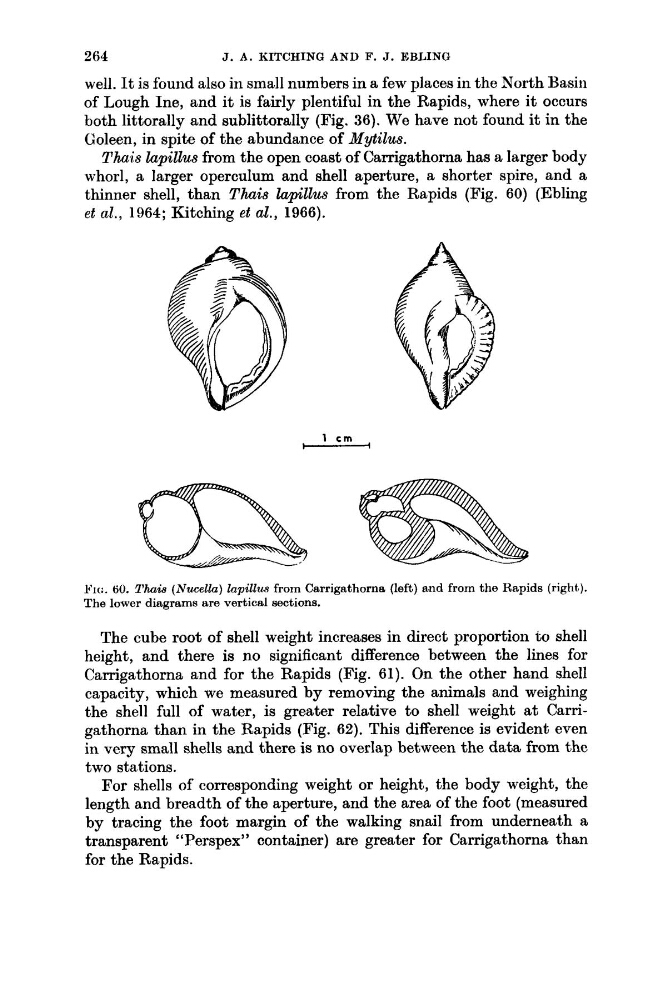
Thais lapillus from the open coast of Carrigathorna has a larger body
whorl, a larger operculum and shell aperture, a shorter spire, and a
thinner shell, than Thais hpillus from the Rapids (Fig. 60) (Ebling
et al., 1964; Kitching et al., 1966).
1 cm
-
FIG. 60. Thais (Nucella) lupillua from Carrigathorna (left) and from the Rapids (right).
The lower diagrams are vertical sections.
The cube root of shell weight increases in direct proportion to shell
height, and there is no significant difference between the lines for
Carrigathorna and for the Rapids (Fig. 61). On the other hand shell
capacity, which we measured by removing the animals and weighing
the shell full of water, is greater relative to shell weight at Carrigathorna than in the Rapids (Fig. 62). This difference is evident even
in very small shells and there is no overlap between the data from the
two stations.
For shells of corresponding weight or height, the body weight, the
length and breadth of the aperture, and the area of the foot (measured
by tracing the foot margin of the walking snail from underneath a
transparent “Perspex” container) are greater for Carrigathorna than
for the Rapids.
J. A. KITCHINO AND F. J. EBLING
well. It is found also in small numbers in a few places in the North Basin
of Lough Ine, and it is fairly plentiful in the Rapids, where it occurs
both littorally and sublittorally (Fig. 36). We have not found it in the
Goleen, in spite of the abundance of Mytilus.
Thais lapillus from the open coast of Carrigathorna has a larger body
whorl, a larger operculum and shell aperture, a shorter spire, and a
thinner shell, than Thais hpillus from the Rapids (Fig. 60) (Ebling
et al., 1964; Kitching et al., 1966).
1 cm
-
FIG. 60. Thais (Nucella) lupillua from Carrigathorna (left) and from the Rapids (right).
The lower diagrams are vertical sections.
The cube root of shell weight increases in direct proportion to shell
height, and there is no significant difference between the lines for
Carrigathorna and for the Rapids (Fig. 61). On the other hand shell
capacity, which we measured by removing the animals and weighing
the shell full of water, is greater relative to shell weight at Carrigathorna than in the Rapids (Fig. 62). This difference is evident even
in very small shells and there is no overlap between the data from the
two stations.
For shells of corresponding weight or height, the body weight, the
length and breadth of the aperture, and the area of the foot (measured
by tracing the foot margin of the walking snail from underneath a
transparent “Perspex” container) are greater for Carrigathorna than
for the Rapids.