

ECOLOGICAL STUDIES AT LOUGH INE
261
....... ..... . . . . . . . . . . . . . . . . . . . . . . .
........... ..--........ . . . .
CARRIGATHORNA
50
I50
Hours from transplantation
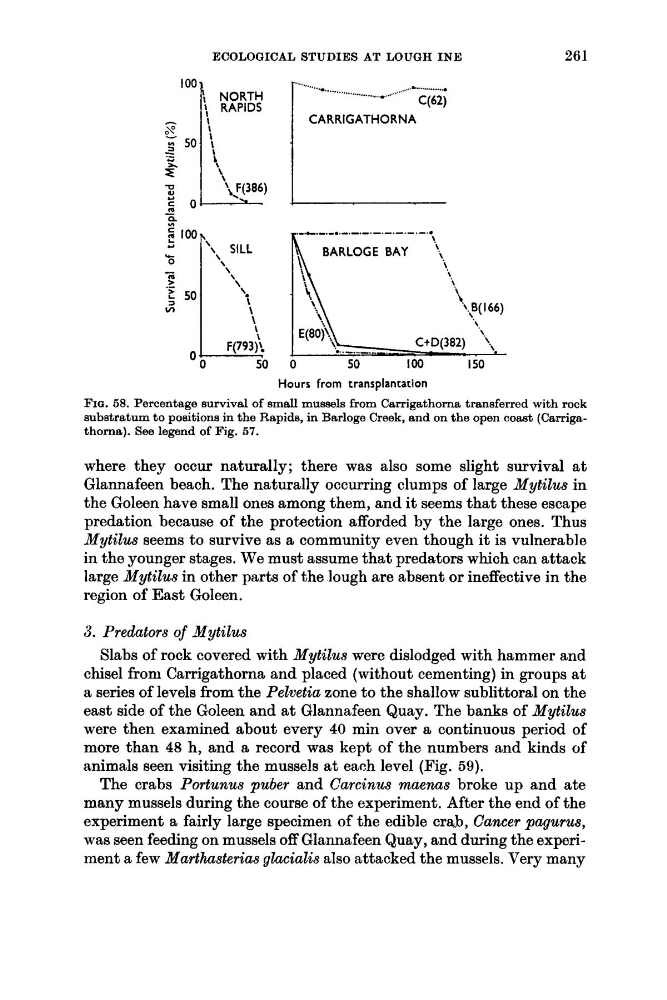
FIG. 58. Percentage survival of small mussels from Carrigathorna transferred with rock
substratum to positions in the Rapids, in Barloge Creek, and on the open coast (Carrigathorna). See legend of Fig. 57.
where they occur naturally; there was also some slight survival a t
Glannafeen beach. The naturally occurring clumps of large Mytilus in
the Goleen have small ones among them, and it seems that these escape
predation because of the protection afforded by the large ones. Thus
Mytilus seems to survive as a community even though it is vulnerable
in the younger stages. We must assume that predators which can attack
large Mytilus in other parts of the lough are absent or ineffective in the
region of East Goleen.
3. Predators of Nytilus
Slabs of rock covered with Mytilus were dislodged with hammer and
chisel from Carrigathorna and placed (without cementing) in groups a t
a series of levels from the Peloetia zone to the shallow sublittoral on the
east side of the Goleen and a t Glannafeen Quay. The banks of Mytilus
were then examined about every 40 min over a continuous period of
more than 48 h, and a record was kept of the numbers and kinds of
animals seen visiting the mussels at each level (Fig. 59).
The crabs Portunus puber and Carcinus maems broke up and ate
many mussels during the course of the experiment. After the end of the
experiment a fairly large specimen of the edible crab, Cancer pagurus,
was seen feeding on mussels off Glannafeen Quay, and during the experiment a few Marthasterias glacialis also attacked the mussels. Very many
261
....... ..... . . . . . . . . . . . . . . . . . . . . . . .
........... ..--........ . . . .
CARRIGATHORNA
50
I50
Hours from transplantation
FIG. 58. Percentage survival of small mussels from Carrigathorna transferred with rock
substratum to positions in the Rapids, in Barloge Creek, and on the open coast (Carrigathorna). See legend of Fig. 57.
where they occur naturally; there was also some slight survival a t
Glannafeen beach. The naturally occurring clumps of large Mytilus in
the Goleen have small ones among them, and it seems that these escape
predation because of the protection afforded by the large ones. Thus
Mytilus seems to survive as a community even though it is vulnerable
in the younger stages. We must assume that predators which can attack
large Mytilus in other parts of the lough are absent or ineffective in the
region of East Goleen.
3. Predators of Nytilus
Slabs of rock covered with Mytilus were dislodged with hammer and
chisel from Carrigathorna and placed (without cementing) in groups a t
a series of levels from the Peloetia zone to the shallow sublittoral on the
east side of the Goleen and a t Glannafeen Quay. The banks of Mytilus
were then examined about every 40 min over a continuous period of
more than 48 h, and a record was kept of the numbers and kinds of
animals seen visiting the mussels at each level (Fig. 59).
The crabs Portunus puber and Carcinus maems broke up and ate
many mussels during the course of the experiment. After the end of the
experiment a fairly large specimen of the edible crab, Cancer pagurus,
was seen feeding on mussels off Glannafeen Quay, and during the experiment a few Marthasterias glacialis also attacked the mussels. Very many