

250
J. A. KITCHING AND F. J. EBLING
intertidally and sublittorally within Lough Ine, namely Asterina gibbosa,
CaEium fragile, and Gibbula cineraria, appear to be restricted to the
littoral region in the Rapids. Thus to a great extent, in the sublittoral
region, the Rapids provide conditions similar to those on the open
coast; in both places there is powerful water movement which not only
exerts a direct mechanical effect but also prevents settlement of sediment and the establishment of local extremes of temperature and
oxygen tension.
F. THE F A U N A O F LAMINARIAN ALGAE
The laminarian algae which occur on the open coast and in the Rapids
provide a substrate for several epiphytic algae and a number of sedentary animals. The distribution and abundance of the animals, especially
Patina pellucida, within the Rapids area have been shown to be related
to current (Section 111). In order to make a comparison of the relative
effects of wave action and current, the faunas of laminarian algae at six
stations (Fig. 2) on the open coast, within Barloge Creek and in the
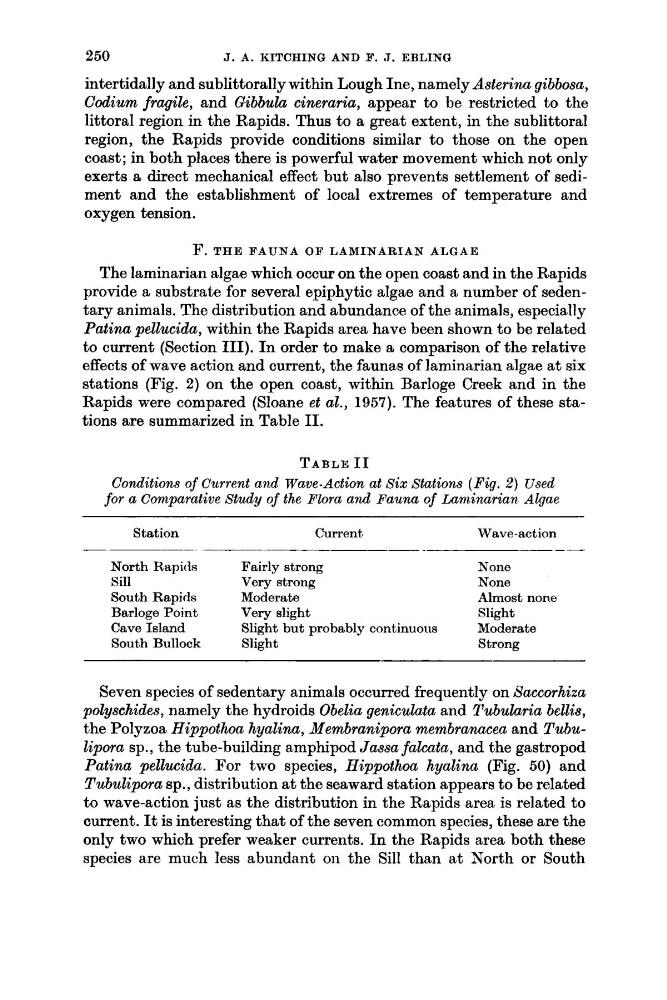
Rapids were compared (Sloane et al., 1957). The features of these stations are summarized in Table 11.
TABLE I1
Conditions of Current and Wave-Action at Six Stations (Fig. 2 ) Used
for a Comparative Study of the Flora and Fauna of Luminarian. Algae
Station
Current.
Wave-action
North Rapids
Fairly strong
None
Sill
Very strong
None
South Rapids
Moderate
Almost n0n.e
Barloge Point
Very slight
Slight
Cave Island
Slight but probably continuous
Moderate
South Bullock
Slight
Strong
Seven species of sedentary animals occurred frequently on Baccorhiza
polyschides, namely the hydroids Obelia geniculuta and Tubularia bellis,
the Polyzoa Hippothoa hyalinu, Membranipora membranacea and Tubulipora sp., the tube-building amphipod Jassa falcata, and the gastropod
Patina pellucida. For two species, Hippothoa hyalina (Fig. 50) and
Tubulipora sp., distribution at the seaward station appears to be related
to wave-action just as the distribution in the Rapids area is related to
current. It is interesting that of the seven common species, these are the
only two which prefer weaker currents. In the Rapids area both these
species are much less abundant on the Sill than at North or South
J. A. KITCHING AND F. J. EBLING
intertidally and sublittorally within Lough Ine, namely Asterina gibbosa,
CaEium fragile, and Gibbula cineraria, appear to be restricted to the
littoral region in the Rapids. Thus to a great extent, in the sublittoral
region, the Rapids provide conditions similar to those on the open
coast; in both places there is powerful water movement which not only
exerts a direct mechanical effect but also prevents settlement of sediment and the establishment of local extremes of temperature and
oxygen tension.
F. THE F A U N A O F LAMINARIAN ALGAE
The laminarian algae which occur on the open coast and in the Rapids
provide a substrate for several epiphytic algae and a number of sedentary animals. The distribution and abundance of the animals, especially
Patina pellucida, within the Rapids area have been shown to be related
to current (Section 111). In order to make a comparison of the relative
effects of wave action and current, the faunas of laminarian algae at six
stations (Fig. 2) on the open coast, within Barloge Creek and in the
Rapids were compared (Sloane et al., 1957). The features of these stations are summarized in Table 11.
TABLE I1
Conditions of Current and Wave-Action at Six Stations (Fig. 2 ) Used
for a Comparative Study of the Flora and Fauna of Luminarian. Algae
Station
Current.
Wave-action
North Rapids
Fairly strong
None
Sill
Very strong
None
South Rapids
Moderate
Almost n0n.e
Barloge Point
Very slight
Slight
Cave Island
Slight but probably continuous
Moderate
South Bullock
Slight
Strong
Seven species of sedentary animals occurred frequently on Baccorhiza
polyschides, namely the hydroids Obelia geniculuta and Tubularia bellis,
the Polyzoa Hippothoa hyalinu, Membranipora membranacea and Tubulipora sp., the tube-building amphipod Jassa falcata, and the gastropod
Patina pellucida. For two species, Hippothoa hyalina (Fig. 50) and
Tubulipora sp., distribution at the seaward station appears to be related
to wave-action just as the distribution in the Rapids area is related to
current. It is interesting that of the seven common species, these are the
only two which prefer weaker currents. In the Rapids area both these
species are much less abundant on the Sill than at North or South