

218
J. A. KITCHING AND F. J. EBLINO
through the Rapids is often much colder than the general body of water
in the lough, and can thus be distinguished. In these circumstances the
strong thermal stratification which can be observed in the area north
of Whirlpool Cliff during outflow becomes completely broken down
during inflow, and the whole of the water along the route of inflow
becomes uniformly chilled from surface to bottom (Fig. 15). The conclusion that water movement extends right down to the bottom is confirmed by the nature of the bottom itself - rocks and gravel rather
than the mud which covers the rest of the lough bottom.
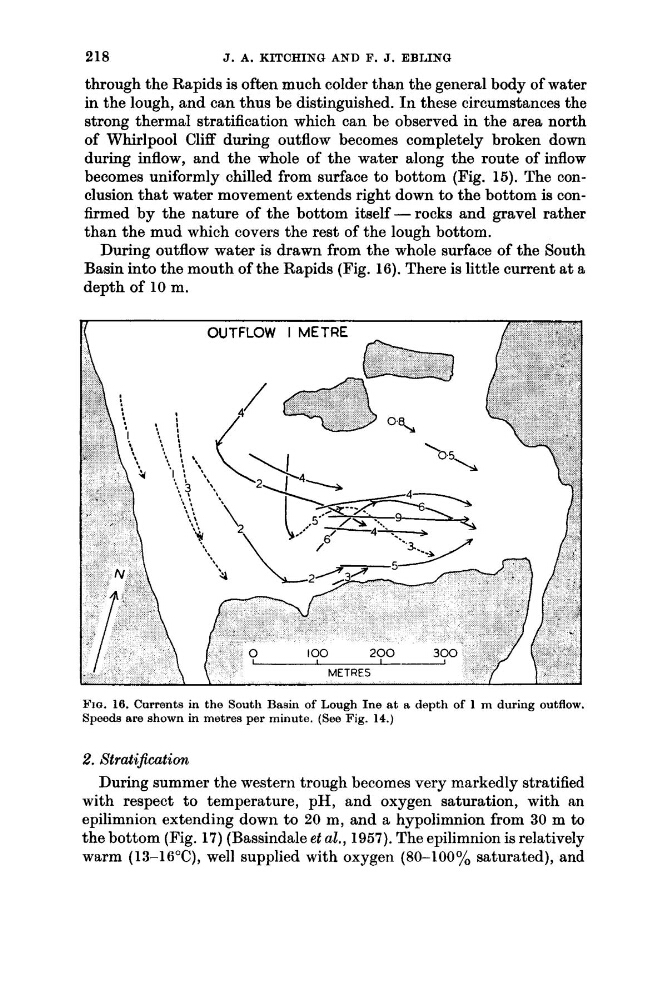
During outflow water is drawn from the whole surface of the South
Basin into the mouth of the Rapids (Fig. 16). There is little current at a
depth of 10 m.
FIQ. 16. Currents i n the South Basin of Lough Ine at a depth of 1 m during outflow.
Speeds are shown in metres per minute. (See Fig. 14.)
2. Stratijcution
During summer the western trough becomes very markedly stratified
with respect to temperature, pH, and oxygen saturation, with an
epilimnion extending down to 20 m, and a hypolimnion from 30 m to
the bottom (Fig. 17) (Bassindale et al., 1957). The epilimnion is relatively
warm (13-16"C), well supplied with oxygen (80-100~0 saturated), and
J. A. KITCHING AND F. J. EBLINO
through the Rapids is often much colder than the general body of water
in the lough, and can thus be distinguished. In these circumstances the
strong thermal stratification which can be observed in the area north
of Whirlpool Cliff during outflow becomes completely broken down
during inflow, and the whole of the water along the route of inflow
becomes uniformly chilled from surface to bottom (Fig. 15). The conclusion that water movement extends right down to the bottom is confirmed by the nature of the bottom itself - rocks and gravel rather
than the mud which covers the rest of the lough bottom.
During outflow water is drawn from the whole surface of the South
Basin into the mouth of the Rapids (Fig. 16). There is little current at a
depth of 10 m.
FIQ. 16. Currents i n the South Basin of Lough Ine at a depth of 1 m during outflow.
Speeds are shown in metres per minute. (See Fig. 14.)
2. Stratijcution
During summer the western trough becomes very markedly stratified
with respect to temperature, pH, and oxygen saturation, with an
epilimnion extending down to 20 m, and a hypolimnion from 30 m to
the bottom (Fig. 17) (Bassindale et al., 1957). The epilimnion is relatively
warm (13-16"C), well supplied with oxygen (80-100~0 saturated), and