

THE GENERAL BIOLOGY OF PENGUINS
189
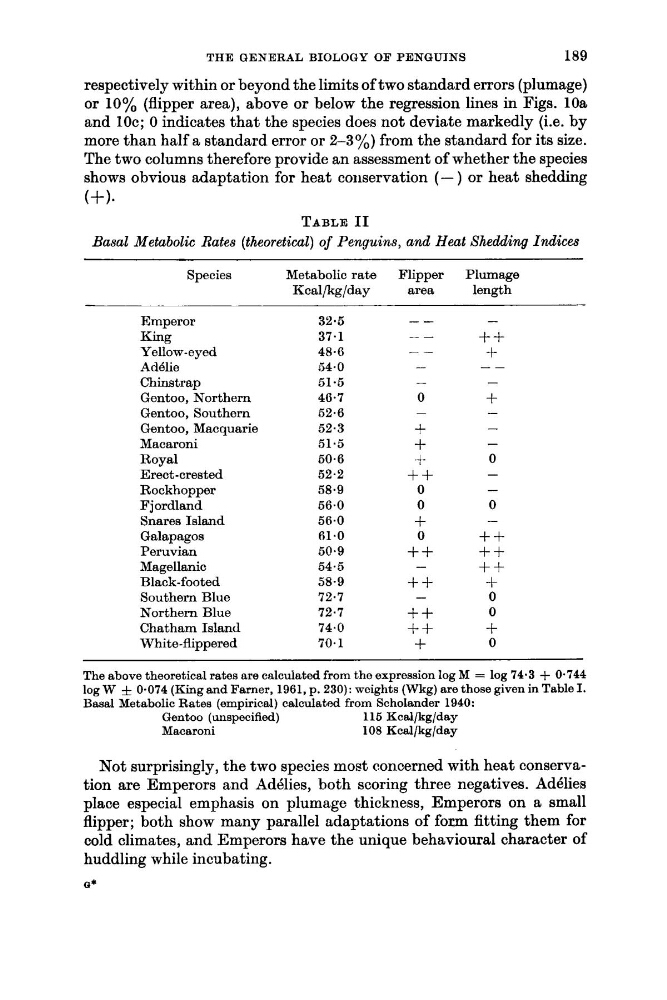
respectively within or beyond the limits of two standard errors (plumage)
or 10% (flipper area), above or below the regression lines in Figs. 10a
and 1Oc; 0 indicates that the species does not deviate markedly (i.e. by
more than half a standard error or 2-3%) from the standard for its size.
The two columns therefore provide an assessment of whether the species
shows obvious adaptation for heat conservation (- ) or heat shedding
(+I.
TABLE I1
Basal Metabolic Rates (theoretical) of Penguins, and Heat Shedding Indices
Species
Metabolic rate
Kcal/kg/day
Flipper
Plumage
area
length
Emperor
King
Yellow-eyed
Ad6lie
Chinstrap
Gentoo, Northern
Gentoo, Southern
Gentoo, Macquarie
Macaroni
Royal
Erect-crested
Rockhopper
Fjordland
Snares Island
Galapagos
Peruvian
Magellanic
Black-footed
Southern Blue
Northern Blue
Chatham Island
White-flippered
32.5
37.1
48.6
64.0
51.5
46-7
52.6
52.3
51.5
50.6
52.2
58-9
56.0
56.0
61.0
50.9
54.5
58-9
72.7
72.7
74.0
70.1
-
+ +
0
++
0
0
0
+
0
++
++
++
++
++
+
0
++
0
++
+
+
0
-
-
-
-
-
The above theoretical rates are calculated from the expression log M = log '74.3 + 0.744
log W f 0-074 (King and Farner, 1961, p. 230): weights (Wkg) are those given in Table I.
Basal Metabolic Rates (empirical) calculated from Scholander 1940:
Gentoo (unspecified)
116 Kcal/kg/day
Macaroni
108 Kcal/kg/day
Not surprisingly, the two species most concerned with heat conservation are Emperors and AdAlies, both scoring three negatives. Ad6lies
place especial emphasis on plumage thickness, Emperors on a small
flipper; both show many parallel adaptations of form fitting them for
cold climates, and Emperors have the unique behavioural character of
huddling while incubating.
Q*
189
respectively within or beyond the limits of two standard errors (plumage)
or 10% (flipper area), above or below the regression lines in Figs. 10a
and 1Oc; 0 indicates that the species does not deviate markedly (i.e. by
more than half a standard error or 2-3%) from the standard for its size.
The two columns therefore provide an assessment of whether the species
shows obvious adaptation for heat conservation (- ) or heat shedding
(+I.
TABLE I1
Basal Metabolic Rates (theoretical) of Penguins, and Heat Shedding Indices
Species
Metabolic rate
Kcal/kg/day
Flipper
Plumage
area
length
Emperor
King
Yellow-eyed
Ad6lie
Chinstrap
Gentoo, Northern
Gentoo, Southern
Gentoo, Macquarie
Macaroni
Royal
Erect-crested
Rockhopper
Fjordland
Snares Island
Galapagos
Peruvian
Magellanic
Black-footed
Southern Blue
Northern Blue
Chatham Island
White-flippered
32.5
37.1
48.6
64.0
51.5
46-7
52.6
52.3
51.5
50.6
52.2
58-9
56.0
56.0
61.0
50.9
54.5
58-9
72.7
72.7
74.0
70.1
-
+ +
0
++
0
0
0
+
0
++
++
++
++
++
+
0
++
0
++
+
+
0
-
-
-
-
-
The above theoretical rates are calculated from the expression log M = log '74.3 + 0.744
log W f 0-074 (King and Farner, 1961, p. 230): weights (Wkg) are those given in Table I.
Basal Metabolic Rates (empirical) calculated from Scholander 1940:
Gentoo (unspecified)
116 Kcal/kg/day
Macaroni
108 Kcal/kg/day
Not surprisingly, the two species most concerned with heat conservation are Emperors and AdAlies, both scoring three negatives. Ad6lies
place especial emphasis on plumage thickness, Emperors on a small
flipper; both show many parallel adaptations of form fitting them for
cold climates, and Emperors have the unique behavioural character of
huddling while incubating.
Q*