

Z 82
B. STONEHOUSE
c
. E
I
I
I
I
I
1 0
20
Flipper length cm
3 0
01
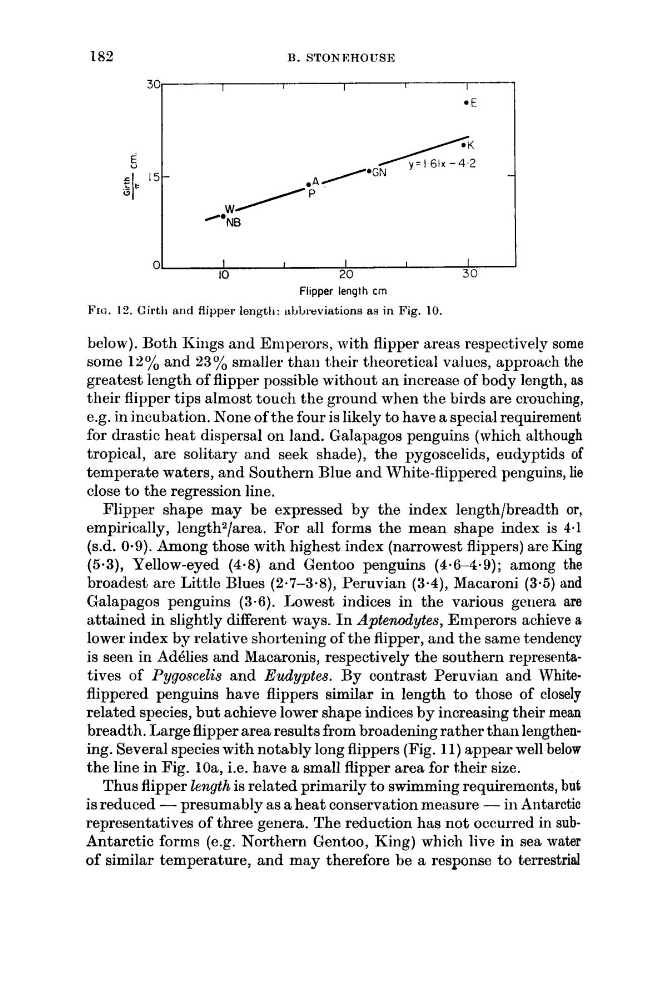
Fro. 18. Girth and flipper lengtli: abbreviations as in Fig. 10.
below). Both Kings and Emperors, with flipper areas respectively some
some 12% and 23% smaller than their theoretical values, approach the
greatest length of flipper possible without an increase of body length, as
their flipper tips almost touch the ground when the birds are crouching,
e.g. in incubation. None of the four is likely to have a special requirement
for drastic heat dispersal on land. Galapagos penguins (which although
tropical, are solitary and seek shade), the pygoscelids, eudyptids of
temperate waters, and Southern Blue and White-flippered penguins, lie
close to the regression line.
Flipper shape may be expressed by the index length/breadth or,
empirically, length2/area. For all forms the mean shape index is 4.1
(s.d. 0.9). Among those with highest index (narrowest flippers) are King
(5-3), Yellow-eyed (4.8) and Gentoo penguins (4.6-4-9); among the
broadest are Little Blues (2.7-3.8), Peruvian (3-4), Macaroni (3.5) and
Galapagos penguins (3-6). Lowest indices in the various genera are
attained in slightly different ways. In Aptenodytes, Emperors achieve a
lower index by relative shortening of the flipper, and the same tendency
is seen in Addies and Macaronis, respectively the southern represcntatives of Pygoscelis and Eudyptes. By contrast Peruvian and Whiteflippered penguins have flippers similar in length to those of closely
related species, but achieve lower shape indices by increasing their mean
breadth. Large flipper area results from broadening rather than lengthening. Several species with notably long flippers (Fig. 11) appear well below
the line in Fig. 10a, i.e. have a small flipper area for their size.
Thus flipper length is related primarily to swimming requirements, but
is reduced - presumably as a heat conservation measure - in Antarctic
representatives of three genera. The reduction has not occurred in subAntarctic forms (e.g. Northern Gentoo, King) which live in sea water
of similar temperature, and may therefore be a response to terrestrial
B. STONEHOUSE
c
. E
I
I
I
I
I
1 0
20
Flipper length cm
3 0
01
Fro. 18. Girth and flipper lengtli: abbreviations as in Fig. 10.
below). Both Kings and Emperors, with flipper areas respectively some
some 12% and 23% smaller than their theoretical values, approach the
greatest length of flipper possible without an increase of body length, as
their flipper tips almost touch the ground when the birds are crouching,
e.g. in incubation. None of the four is likely to have a special requirement
for drastic heat dispersal on land. Galapagos penguins (which although
tropical, are solitary and seek shade), the pygoscelids, eudyptids of
temperate waters, and Southern Blue and White-flippered penguins, lie
close to the regression line.
Flipper shape may be expressed by the index length/breadth or,
empirically, length2/area. For all forms the mean shape index is 4.1
(s.d. 0.9). Among those with highest index (narrowest flippers) are King
(5-3), Yellow-eyed (4.8) and Gentoo penguins (4.6-4-9); among the
broadest are Little Blues (2.7-3.8), Peruvian (3-4), Macaroni (3.5) and
Galapagos penguins (3-6). Lowest indices in the various genera are
attained in slightly different ways. In Aptenodytes, Emperors achieve a
lower index by relative shortening of the flipper, and the same tendency
is seen in Addies and Macaronis, respectively the southern represcntatives of Pygoscelis and Eudyptes. By contrast Peruvian and Whiteflippered penguins have flippers similar in length to those of closely
related species, but achieve lower shape indices by increasing their mean
breadth. Large flipper area results from broadening rather than lengthening. Several species with notably long flippers (Fig. 11) appear well below
the line in Fig. 10a, i.e. have a small flipper area for their size.
Thus flipper length is related primarily to swimming requirements, but
is reduced - presumably as a heat conservation measure - in Antarctic
representatives of three genera. The reduction has not occurred in subAntarctic forms (e.g. Northern Gentoo, King) which live in sea water
of similar temperature, and may therefore be a response to terrestrial