

A SYNOPSIS O F THE PESTICIDE PROBLEM
105
section is to provide an ecological classification to help in assessing the
literature.
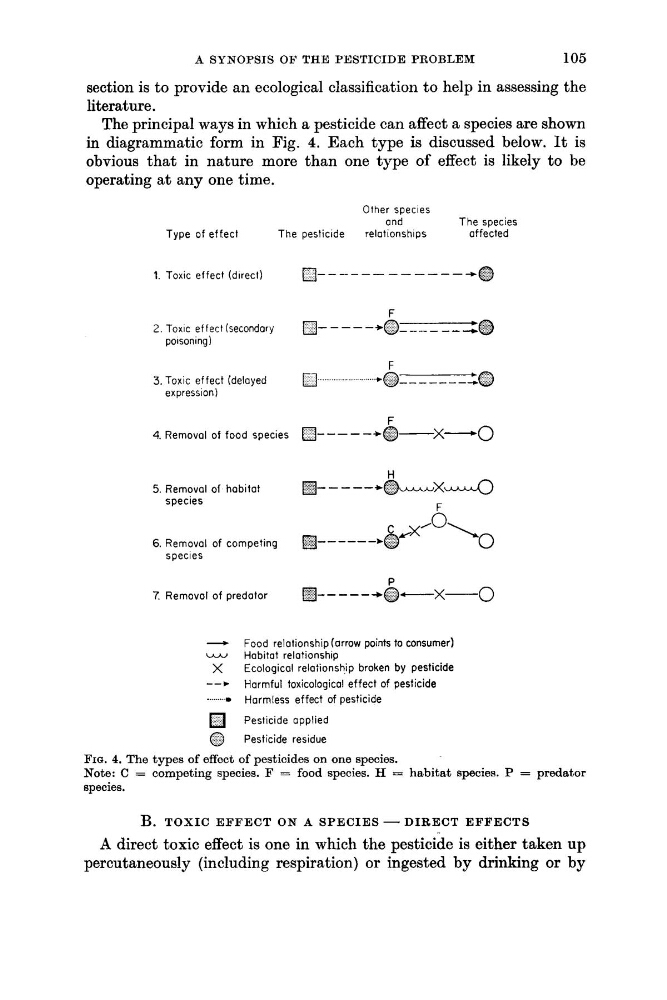
The principal ways in which a pesticide can affect a species are shown
in diagrammatic form in Fig. 4. Each type is discussed below. It is
obvious that in nature more than one type of effect is likely to be
operating at any one time.
Other species
and
The species
Type of effect
The pesticide
relationships
affected
1 Toxic effect (direct)
0- - - - - - - - - - - - -0
F
2 Toxic effect (secondary
m- - - - - +Q- _ _ - __
poisoning)
F
3. Toxic effect (delayed
u
4-J--- ---expression)
F
4. Removal of food species ~-----+o-X-o
5 Removal of habitat
m-----+
F
n
species
6. Removal of competing
a------b
species
P
7 Removal of predotor
0-- - - - -+~---x---O
+
UAJ
Habitat relationship
X
---t
.
Harmless effect of pesticide
Pesticide applied
0 Pesticide residue
Food relotionship (orrow paints to consumer)
Ecological relationship broken by pesticide
Harmful toxicological effect of pesticide
FIQ. 4. The types of effect of pesticides on one species.
Note: C = competing species. F = food species. H = habitat species. P = predator
species.
B. TOXIC EFFECT O N A SPECIES - DIRECT EFFECTS
A direct toxic effect is one in which the pesticide is either taken up
percutaneously (including respiration) or ingested by drinking or by
105
section is to provide an ecological classification to help in assessing the
literature.
The principal ways in which a pesticide can affect a species are shown
in diagrammatic form in Fig. 4. Each type is discussed below. It is
obvious that in nature more than one type of effect is likely to be
operating at any one time.
Other species
and
The species
Type of effect
The pesticide
relationships
affected
1 Toxic effect (direct)
0- - - - - - - - - - - - -0
F
2 Toxic effect (secondary
m- - - - - +Q- _ _ - __
poisoning)
F
3. Toxic effect (delayed
u
4-J--- ---expression)
F
4. Removal of food species ~-----+o-X-o
5 Removal of habitat
m-----+
F
n
species
6. Removal of competing
a------b
species
P
7 Removal of predotor
0-- - - - -+~---x---O
+
UAJ
Habitat relationship
X
---t
.
Harmless effect of pesticide
Pesticide applied
0 Pesticide residue
Food relotionship (orrow paints to consumer)
Ecological relationship broken by pesticide
Harmful toxicological effect of pesticide
FIQ. 4. The types of effect of pesticides on one species.
Note: C = competing species. F = food species. H = habitat species. P = predator
species.
B. TOXIC EFFECT O N A SPECIES - DIRECT EFFECTS
A direct toxic effect is one in which the pesticide is either taken up
percutaneously (including respiration) or ingested by drinking or by