

A SYNOPSIS OF THE PESTICIDE PROBLEM
87
properties were not known until very much later. Development of new
pesticides and the increase in treated acreage was slow between the
wars. The modern pesticide era began during and immediately following
the Second World War with the invention of the organochlorine and
organophosphorus insecticides and of the phenoxyacetic acid (growth
regulator) weed killers. The development of herbicide use in cereal
crops in Britain is shown in Fig. 1, and changes in the production of
various pesticides in the United States is shown in Fig. 2. The two
graphs demonstrate the rapid rise of modern synthetic pesticides. The
gradual decline in the use of the inorganic insecticide lead arsenate and
of the naturally occurring insecticide pyrethrum is shown in Fig. 2. It
can be assumed that the amounts of pesticide used will continue to
increase until nearly all crop land is treated.
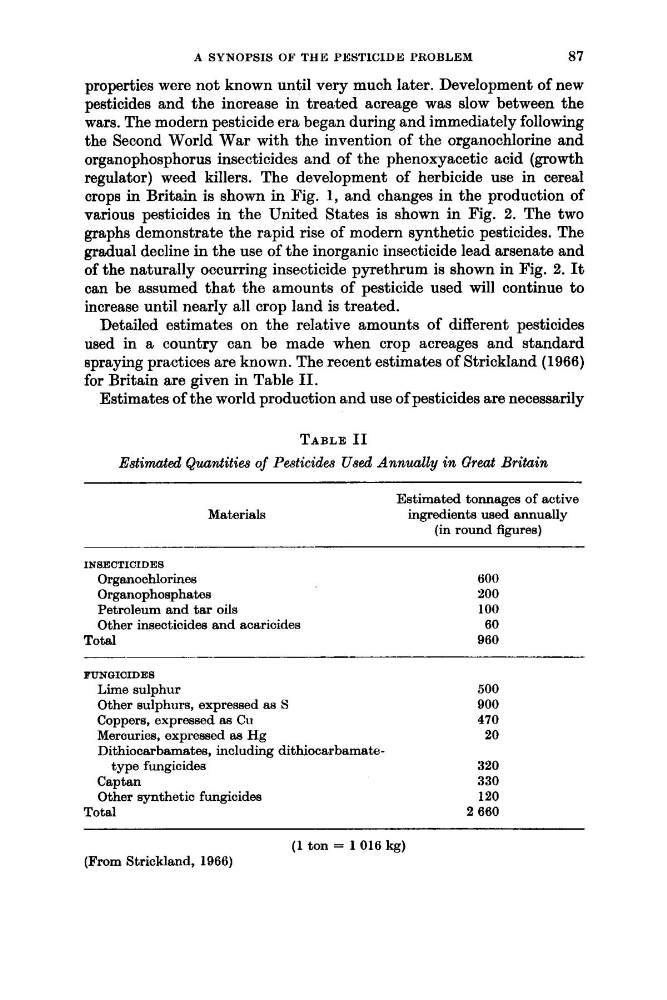
Detailed estimates on the relative amounts of different pesticides
used in a country can be made when crop acreages and standard
spraying practices are known. The recent estimates of Strickland (1966)
for Britain are given in Table 11.
Estimates of the world production and use of pesticides are necessarily
TABLE I1
Estimattd Quantities of Pesticides Used Annually in Great Britain
Materials
Estimated tonnages of active
ingredients used annually
(in round figures)
INSECTICIDES
Organochlorines
Organophosphates
Petroleum and tar oils
Other insecticides and actlricides
TOM
600
a00
100
60
960
FUNQIOIDES
Lime sulphur
Other sulphurs, expressed as S
Coppers, expressed IM Cu
Mercuries, expressed as Hg
Dithiocarbamates, including dithiocarbamatetype fungicides
captan
Other synthetic fungicides
Total
500
900
470
20
320
330
120
2 660
(1 ton = 1 016 kg)
(From Strickland, 1966)
87
properties were not known until very much later. Development of new
pesticides and the increase in treated acreage was slow between the
wars. The modern pesticide era began during and immediately following
the Second World War with the invention of the organochlorine and
organophosphorus insecticides and of the phenoxyacetic acid (growth
regulator) weed killers. The development of herbicide use in cereal
crops in Britain is shown in Fig. 1, and changes in the production of
various pesticides in the United States is shown in Fig. 2. The two
graphs demonstrate the rapid rise of modern synthetic pesticides. The
gradual decline in the use of the inorganic insecticide lead arsenate and
of the naturally occurring insecticide pyrethrum is shown in Fig. 2. It
can be assumed that the amounts of pesticide used will continue to
increase until nearly all crop land is treated.
Detailed estimates on the relative amounts of different pesticides
used in a country can be made when crop acreages and standard
spraying practices are known. The recent estimates of Strickland (1966)
for Britain are given in Table 11.
Estimates of the world production and use of pesticides are necessarily
TABLE I1
Estimattd Quantities of Pesticides Used Annually in Great Britain
Materials
Estimated tonnages of active
ingredients used annually
(in round figures)
INSECTICIDES
Organochlorines
Organophosphates
Petroleum and tar oils
Other insecticides and actlricides
TOM
600
a00
100
60
960
FUNQIOIDES
Lime sulphur
Other sulphurs, expressed as S
Coppers, expressed IM Cu
Mercuries, expressed as Hg
Dithiocarbamates, including dithiocarbamatetype fungicides
captan
Other synthetic fungicides
Total
500
900
470
20
320
330
120
2 660
(1 ton = 1 016 kg)
(From Strickland, 1966)