

48
T A B L E XlV
a. The Size of Polycelis nigra Populatioiis i/i the Absence (Anglesey
Lakes) and Presence (Mainland Lakes) of P . tenuis
Ca mg/litre
t5.0
5*1-10*0 10.1-20.0 20.1-40.0
>40*0
_
_
~
~- -
. . -
__
-
P . nigra alone
17
140
173
179
P. nigra i n presence
of P. tenuio
42
49
76
40
38
P. n e r a + P. tenitis
53
136
226
209
322
b. Size of Polycelis nigra Populutiori in Two Anglesey Lakes C'ontaining also P . tenuis
~
__
.
~
-
_ . . -~
-
86
234
P. nigra
-
-
-
P. n e r a + P . tenuis
-
-_
-
I P. nigra + P. tenuis - -
_ _
213
-
2 j P. nigra
-
-
-.
-
35
-
_ _
Triclad populations recorded as number collected per hour averaged for lakos in each
calcium category; a dash means no lakes in that rategory.
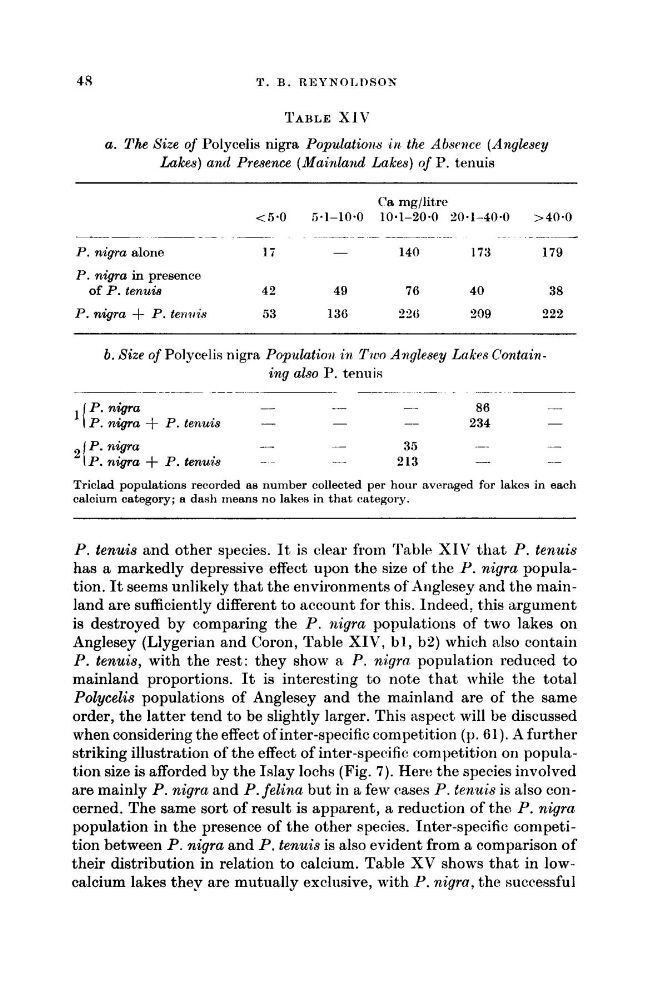
P . tenuis and other species. It, is clear froin 'Fable XIV that P . tenuis
has a markedly depressive effect upon the size of the P . nigra population. It seems unlikely that the environments of Anglesey and the niainland are sufficiently different to account for this. Indeed, this argument
is destroyed by comparing the P . nigra populations of two lakes on
Anglesey (Llygerian and Coron, Table XIV, b l , b2) which a!so contain
P . tenuis, with the rest: they show a P. nigrn population reduced to
mainland proportions. It is interesting to note that while the total
Polycelis populations of Anglesey and the mainland are of the same
order, the latter tend to be slightly larger. This aspect will be discussed
when considering the effect of inter-specific competition (p. 61). A further
striking illustration of the effect of inter-specific competition on population size is afforded by the Ialay lochs (Fig. 7). Here the species involved
are mainly P. nigra and P . felina but in a few cases P. teriuis is also concerned. The same sort of result is apparent, a reduction of t
their distribution in relation to calcium. Table XV shows that in lowcalcium lakes they are mutually exclusive, with Y. nigra, the successful
T A B L E XlV
a. The Size of Polycelis nigra Populatioiis i/i the Absence (Anglesey
Lakes) and Presence (Mainland Lakes) of P . tenuis
Ca mg/litre
t5.0
5*1-10*0 10.1-20.0 20.1-40.0
>40*0
_
_
~
~- -
. . -
__
-
P . nigra alone
17
140
173
179
P. nigra i n presence
of P. tenuio
42
49
76
40
38
P. n e r a + P. tenitis
53
136
226
209
322
b. Size of Polycelis nigra Populutiori in Two Anglesey Lakes C'ontaining also P . tenuis
~
__
.
~
-
_ . . -~
-
86
234
P. nigra
-
-
-
P. n e r a + P . tenuis
-
-_
-
I P. nigra + P. tenuis - -
_ _
213
-
2 j P. nigra
-
-
-.
-
35
-
_ _
Triclad populations recorded as number collected per hour averaged for lakos in each
calcium category; a dash means no lakes in that rategory.
P . tenuis and other species. It, is clear froin 'Fable XIV that P . tenuis
has a markedly depressive effect upon the size of the P . nigra population. It seems unlikely that the environments of Anglesey and the niainland are sufficiently different to account for this. Indeed, this argument
is destroyed by comparing the P . nigra populations of two lakes on
Anglesey (Llygerian and Coron, Table XIV, b l , b2) which a!so contain
P . tenuis, with the rest: they show a P. nigrn population reduced to
mainland proportions. It is interesting to note that while the total
Polycelis populations of Anglesey and the mainland are of the same
order, the latter tend to be slightly larger. This aspect will be discussed
when considering the effect of inter-specific competition (p. 61). A further
striking illustration of the effect of inter-specific competition on population size is afforded by the Ialay lochs (Fig. 7). Here the species involved
are mainly P. nigra and P . felina but in a few cases P. teriuis is also concerned. The same sort of result is apparent, a reduction of t
their distribution in relation to calcium. Table XV shows that in lowcalcium lakes they are mutually exclusive, with Y. nigra, the successful