

38
T. B . REYNOLDSON
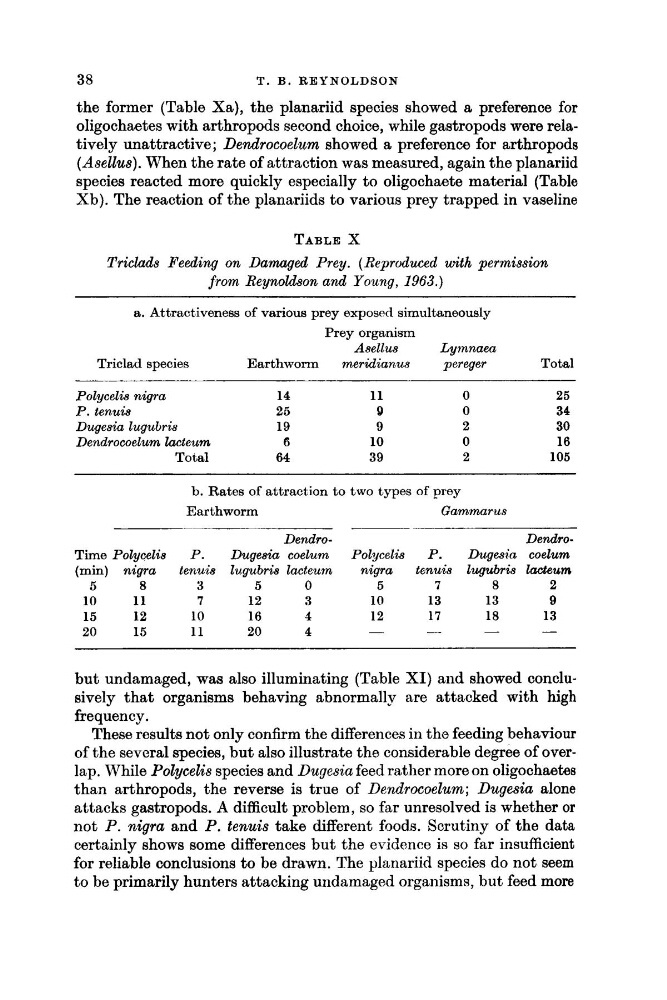
the former (Table Xa), the planariid species showed a preference for
oligochaetes with arthropods second choice, while gastropods were relatively unattractive ; Dendrocoelum showed a preference for arthropods
(Asellus). When the rate of attraction was measured, again the planariid
species reacted more quickly especially to oligochaete material (Table
Xb). The reaction of the planariids to various prey trapped in vaseline
TABLE X
Triclads Feeding on Damaged Prey. (Reproduced with permission
f r o m Reynoldson and Young, 1963.)
a. Attractiveness of various prey exposed simultaneously
Prey organism
Asellus
L y in n a e a
Triclad species
Earthworm
meridianus
pereger
Total
Polycelis nigra
14
11
0
25
P. tenuis
25
9
0
34
Dugesia lugubris
19
9
2
30
Dendrocoelum lacteum
6
10
0
16
Total
64
39
2
105
b. Rates of attraction t o t w o types of prey
Earthworm
G a m m r u s
-
DendroTime Polycelis
P.
Dugesia coelum
Polycelis
P.
Dugesia
( m i n ) nigra
tenuia lugubris lacteum
n@ra
tsnuis lugubris
5
8
3
5
0
5
7
8
10
11
7
12
3
10
13
13
15
12
10
16
4
12
17
18
20
15
11
20
4
-
-
-
Dendrocoelum
laoteurn
2
9
13
but undamaged, was also illuminating (Table XI) and showed conclusively that organisms behaving abnormally are attacked with high
frequency .
These results not only confirm the differences in tho feeding behaviour
of the several species, but also illustrate the considerable degree of overlap. While Polycelis species and Dugesia feed rather more on oligochaetes
than arthropods, the reverse is true of Dendrocoelum; Dugesia alone
attacks gastropods. A difficult problem, so far unresolved is whether or
not P. nigra and P. tenuis take different foods. Scrut,iny of the data
certainly shows some differences but the evidence is so far insufficient
for reliable conclusions to be drawn, The planariid species do not seem
to be primarily hunters attacking undamaged organisms, but feed more
T. B . REYNOLDSON
the former (Table Xa), the planariid species showed a preference for
oligochaetes with arthropods second choice, while gastropods were relatively unattractive ; Dendrocoelum showed a preference for arthropods
(Asellus). When the rate of attraction was measured, again the planariid
species reacted more quickly especially to oligochaete material (Table
Xb). The reaction of the planariids to various prey trapped in vaseline
TABLE X
Triclads Feeding on Damaged Prey. (Reproduced with permission
f r o m Reynoldson and Young, 1963.)
a. Attractiveness of various prey exposed simultaneously
Prey organism
Asellus
L y in n a e a
Triclad species
Earthworm
meridianus
pereger
Total
Polycelis nigra
14
11
0
25
P. tenuis
25
9
0
34
Dugesia lugubris
19
9
2
30
Dendrocoelum lacteum
6
10
0
16
Total
64
39
2
105
b. Rates of attraction t o t w o types of prey
Earthworm
G a m m r u s
-
DendroTime Polycelis
P.
Dugesia coelum
Polycelis
P.
Dugesia
( m i n ) nigra
tenuia lugubris lacteum
n@ra
tsnuis lugubris
5
8
3
5
0
5
7
8
10
11
7
12
3
10
13
13
15
12
10
16
4
12
17
18
20
15
11
20
4
-
-
-
Dendrocoelum
laoteurn
2
9
13
but undamaged, was also illuminating (Table XI) and showed conclusively that organisms behaving abnormally are attacked with high
frequency .
These results not only confirm the differences in tho feeding behaviour
of the several species, but also illustrate the considerable degree of overlap. While Polycelis species and Dugesia feed rather more on oligochaetes
than arthropods, the reverse is true of Dendrocoelum; Dugesia alone
attacks gastropods. A difficult problem, so far unresolved is whether or
not P. nigra and P. tenuis take different foods. Scrut,iny of the data
certainly shows some differences but the evidence is so far insufficient
for reliable conclusions to be drawn, The planariid species do not seem
to be primarily hunters attacking undamaged organisms, but feed more