

L A K E DWELLING TRICLADS
33
One further aspect of the habitat suggested itself as a possible determinant of distribution, namely the biological quality of water, which
may also differ as shown by Wilson (1051) for sea water. Were Dugesia
and Dendrocoelum in the course of dispersal selecting water characteristic of productive lakes and avoiding that of unproductive lakes? This
possibility was tested by choice experiments in an apparatus which
allowed waters of different origin to be tested (for details; Young, 1963).
Usually fifty triclads of each species collected from a calcium-rich
habitat were used in each test. Observation showed that the triclads
explored the experimental habitat before settling down. Eight such
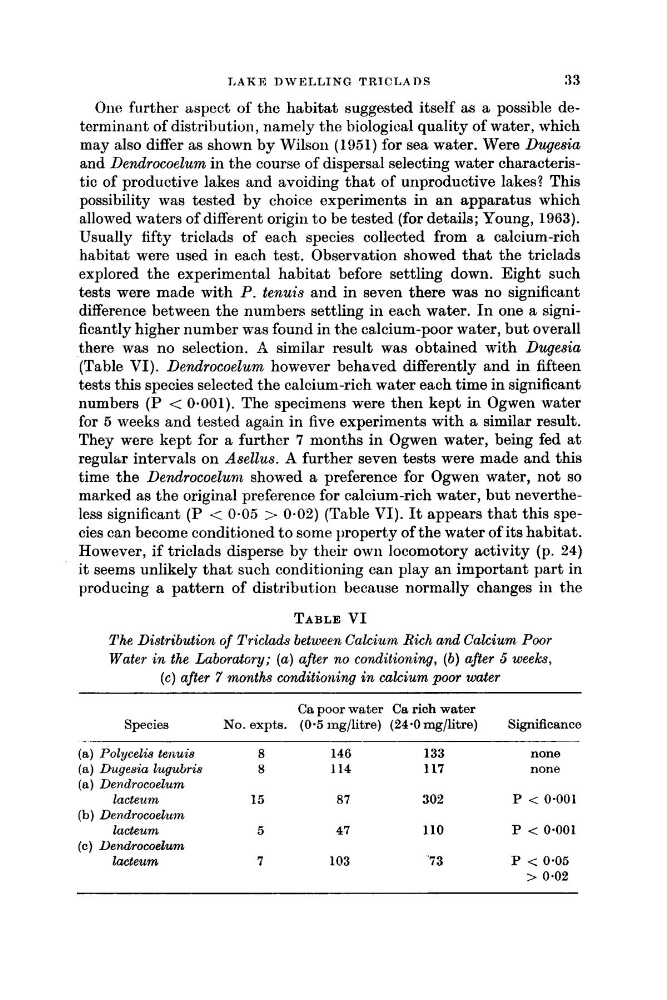
tests were made with P. tenuis and in seven there was no significant
difference between the numbers settling in each water. I n one a significantly higher number was found in the calcium-poor water, but overall
there was no selection. A similar result was obtained with Dugesia
(Table VI). Dendrocoelum however behaved differently and in fifteen
tests this species selected the calcium-rich water each time in significant
numbers (P < 0.001). The specimens were then kept in Ogwen water
for 5 weeks and tested again in five experiments with a similar result.
They were kept for a further 7 months in Ogwen water, being fed a t
regular intervals on Asellus. A further seven tests were made and this
time the Dendrocoelunz showed a preference for Ogwen water, not so
marked as the original preference for calcium-rich water, but nevertheless significant (P .= 0.05 > 0.02) (Table VI). It appears that this species can become conditioned to some property of the water of its habitat.
However, if triclads disperse by their own locomotory activity (p. 24)
it seems unlikely that such conditioning can play an important part in
producing a pattern of distribution because normally changes in the
TABLE VI
The Distribution of Triclads between Calcium Rich and Calcium Poor
Water in the Laboratory; (a) after no conditioning, (b) after 5 weeks,
(c) after 7 m o n t h conditioning in calcium poor water
Species
(a) Polycelis tenuis
( a ) Dugesia lugubris
( a ) Dendrocoelum
lacteum
(b) Dendrocoelum
lacteum
(c) Dendrocoelum
lacteum
Ca poor water CE rich water
No. expts. (0.5 mng/litre) (24.0 mg/litre)
Significance
8
146
133
none
8
114
117
none
15
87
302
P < 0.001
5
47
110
P < 0.001
7
103
'73
P < 0.05
> 0.02
33
One further aspect of the habitat suggested itself as a possible determinant of distribution, namely the biological quality of water, which
may also differ as shown by Wilson (1051) for sea water. Were Dugesia
and Dendrocoelum in the course of dispersal selecting water characteristic of productive lakes and avoiding that of unproductive lakes? This
possibility was tested by choice experiments in an apparatus which
allowed waters of different origin to be tested (for details; Young, 1963).
Usually fifty triclads of each species collected from a calcium-rich
habitat were used in each test. Observation showed that the triclads
explored the experimental habitat before settling down. Eight such
tests were made with P. tenuis and in seven there was no significant
difference between the numbers settling in each water. I n one a significantly higher number was found in the calcium-poor water, but overall
there was no selection. A similar result was obtained with Dugesia
(Table VI). Dendrocoelum however behaved differently and in fifteen
tests this species selected the calcium-rich water each time in significant
numbers (P < 0.001). The specimens were then kept in Ogwen water
for 5 weeks and tested again in five experiments with a similar result.
They were kept for a further 7 months in Ogwen water, being fed a t
regular intervals on Asellus. A further seven tests were made and this
time the Dendrocoelunz showed a preference for Ogwen water, not so
marked as the original preference for calcium-rich water, but nevertheless significant (P .= 0.05 > 0.02) (Table VI). It appears that this species can become conditioned to some property of the water of its habitat.
However, if triclads disperse by their own locomotory activity (p. 24)
it seems unlikely that such conditioning can play an important part in
producing a pattern of distribution because normally changes in the
TABLE VI
The Distribution of Triclads between Calcium Rich and Calcium Poor
Water in the Laboratory; (a) after no conditioning, (b) after 5 weeks,
(c) after 7 m o n t h conditioning in calcium poor water
Species
(a) Polycelis tenuis
( a ) Dugesia lugubris
( a ) Dendrocoelum
lacteum
(b) Dendrocoelum
lacteum
(c) Dendrocoelum
lacteum
Ca poor water CE rich water
No. expts. (0.5 mng/litre) (24.0 mg/litre)
Significance
8
146
133
none
8
114
117
none
15
87
302
P < 0.001
5
47
110
P < 0.001
7
103
'73
P < 0.05
> 0.02