

LAKE DWELLING TRICLADS
31
litre) and supports only Phagocata vitta, although it had the disadvantages of being popular with summer visitors and of suffering rapid
changes of water level from time to time by withdrawal of water for
local industry. Ten adults of each species collected from habitats with
a moderately high calcium content were kept in separate cages and
fed on earthworm slices a t approximately fortnightly intervals; the
water temperature was read at each visit. Three experiments of this
type were made, the first lasted 54 days from 30 October to 9 December
1957, when a sudden fall in water level killed all species except P. tenuis.
A second using the original P. tenuis, ran for 113 days from 23 December
to 22 April 1958, when visitors wrecked the cages; a third with new
specimens lasted 112 days from 22 October 1958, to 10 February 1959.
The experiments ran through two winters and temperatures were below
5" C and the lake ice-covered for long periods.
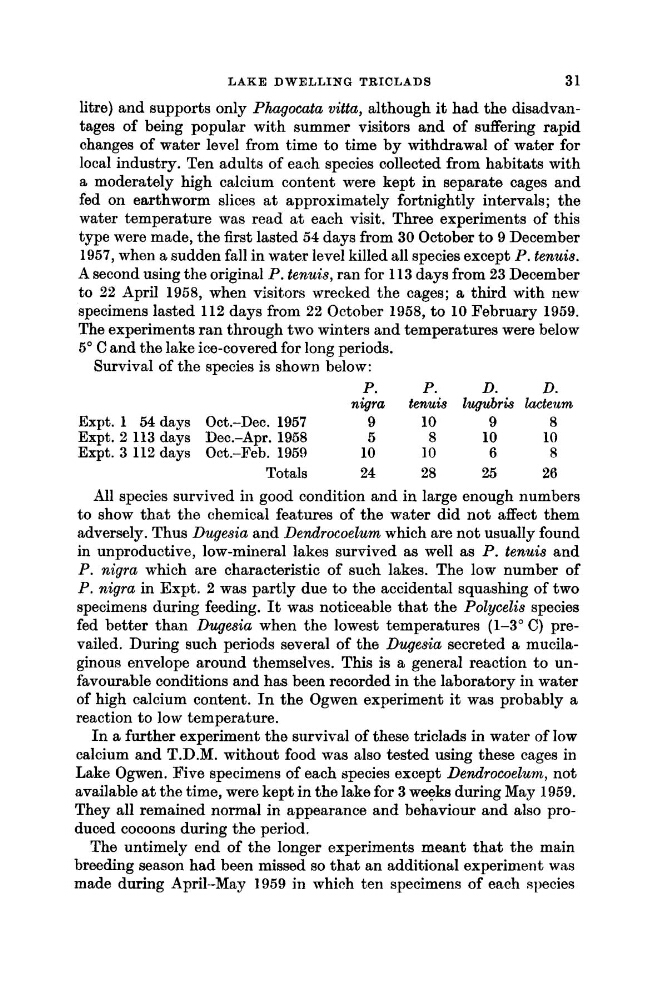
Survival of the species is shown below:
P.
P.
D.
D.
nigra tenuis lugubris lacteum
Expt. 1 54 days 0ct.-Dec. 1957
9
10
9
8
Expt. 2 113 days Dec.-Apr. 1958
5
8
10
10
Expt. 3 112 days 0ct.-Feb. 1959
10
10
6
8
Totals
24
28
25
26
All species survived in good condition and in large enough numbers
to show that the chemical features of the water did not affect them
adversely. Thus Dugesia and Dendrocoelum which are not usually found
in unproductive, low-mineral lakes survived as well as P. tenuis and
P. nigra which are characteristic of such lakes. The low number of
P. nigra in Expt. 2 was partly due to the accidental squashing of two
specimens during feeding. It was noticeable that the Polycelis species
fed better than Dugesia when the lowest temperatures (1-3" C) prevailed. During such periods several of the Dugesia secreted a mucilaginous envelope around themselves. This is a general reaction to unfavourable conditions and has been recorded in the laboratory in water
of high calcium content. I n the Ogwen experiment it was probably a
reaction to low temperature.
In a further experiment the survival of these triclads in water of low
calcium and T.D.M. without food was also tested using these cages in
Lake Ogwen. Five specimens of each species except Dendrocoelum, not
available at the time, were kept in the lake for 3 w ~ k a
during May 1959.
They all remained normal in appearance and behaviour and also produced cocoons during the period.
The untimely end of the longer experiments meant that the main
breeding season had been missed so that an additional experiment was
made during April-May 1959 in which ten specimens of each species
31
litre) and supports only Phagocata vitta, although it had the disadvantages of being popular with summer visitors and of suffering rapid
changes of water level from time to time by withdrawal of water for
local industry. Ten adults of each species collected from habitats with
a moderately high calcium content were kept in separate cages and
fed on earthworm slices a t approximately fortnightly intervals; the
water temperature was read at each visit. Three experiments of this
type were made, the first lasted 54 days from 30 October to 9 December
1957, when a sudden fall in water level killed all species except P. tenuis.
A second using the original P. tenuis, ran for 113 days from 23 December
to 22 April 1958, when visitors wrecked the cages; a third with new
specimens lasted 112 days from 22 October 1958, to 10 February 1959.
The experiments ran through two winters and temperatures were below
5" C and the lake ice-covered for long periods.
Survival of the species is shown below:
P.
P.
D.
D.
nigra tenuis lugubris lacteum
Expt. 1 54 days 0ct.-Dec. 1957
9
10
9
8
Expt. 2 113 days Dec.-Apr. 1958
5
8
10
10
Expt. 3 112 days 0ct.-Feb. 1959
10
10
6
8
Totals
24
28
25
26
All species survived in good condition and in large enough numbers
to show that the chemical features of the water did not affect them
adversely. Thus Dugesia and Dendrocoelum which are not usually found
in unproductive, low-mineral lakes survived as well as P. tenuis and
P. nigra which are characteristic of such lakes. The low number of
P. nigra in Expt. 2 was partly due to the accidental squashing of two
specimens during feeding. It was noticeable that the Polycelis species
fed better than Dugesia when the lowest temperatures (1-3" C) prevailed. During such periods several of the Dugesia secreted a mucilaginous envelope around themselves. This is a general reaction to unfavourable conditions and has been recorded in the laboratory in water
of high calcium content. I n the Ogwen experiment it was probably a
reaction to low temperature.
In a further experiment the survival of these triclads in water of low
calcium and T.D.M. without food was also tested using these cages in
Lake Ogwen. Five specimens of each species except Dendrocoelum, not
available at the time, were kept in the lake for 3 w ~ k a
during May 1959.
They all remained normal in appearance and behaviour and also produced cocoons during the period.
The untimely end of the longer experiments meant that the main
breeding season had been missed so that an additional experiment was
made during April-May 1959 in which ten specimens of each species