

LAKE DWELLING TRICLADS
If)
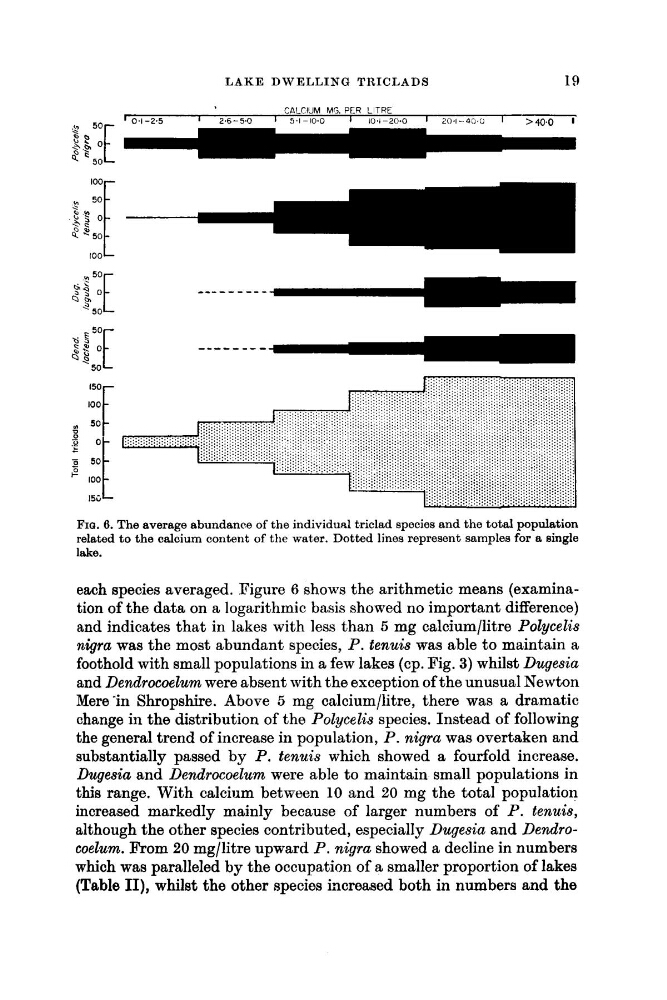
FIG. 6. The average abundance of the individual triclad species and the total population
related to the calcium content of the water. Dotted lines represent samples for a single
lake.
each species averaged. Figure 6 shows the arithmetic means (examination of the data on a logarithmic basis showed no important difference)
and indicates that in lakes with less than 5 mg calcium/litre Polycelis
nigra was the most abundant species, P. tenuis was able to maintain a
foothold with small populations in a few lakes (cp. Fig. 3) whilst Dugesia
and Dendrocoelum were absent with the exception of the unusual Newton
Mere”in Shropshire. Above 5 mg calcium/litre, there was a dramatic
change in the distribution of the Polycelis species. Instead of following
the general trend of increase in population, P. nigra was overtaken and
substantially passed by P. tenuis which showed a fourfold increase.
Dugesia and Dendrocoelum were able to maintain small populations in
this range. With calcium between 10 and 20 mg the total population
increased markedly mainly because of larger numbers of P. tenuis,
although the other species contributed, especially Dugesia and Dendrocoelum. F’rom 20 mg/litre upward P. nigra showed a decline in numbers
which was paralleled by the occupation of a smaller proportion of lakes
(Table 11), whilst the other species increased both in numbers and the
If)
FIG. 6. The average abundance of the individual triclad species and the total population
related to the calcium content of the water. Dotted lines represent samples for a single
lake.
each species averaged. Figure 6 shows the arithmetic means (examination of the data on a logarithmic basis showed no important difference)
and indicates that in lakes with less than 5 mg calcium/litre Polycelis
nigra was the most abundant species, P. tenuis was able to maintain a
foothold with small populations in a few lakes (cp. Fig. 3) whilst Dugesia
and Dendrocoelum were absent with the exception of the unusual Newton
Mere”in Shropshire. Above 5 mg calcium/litre, there was a dramatic
change in the distribution of the Polycelis species. Instead of following
the general trend of increase in population, P. nigra was overtaken and
substantially passed by P. tenuis which showed a fourfold increase.
Dugesia and Dendrocoelum were able to maintain small populations in
this range. With calcium between 10 and 20 mg the total population
increased markedly mainly because of larger numbers of P. tenuis,
although the other species contributed, especially Dugesia and Dendrocoelum. F’rom 20 mg/litre upward P. nigra showed a decline in numbers
which was paralleled by the occupation of a smaller proportion of lakes
(Table 11), whilst the other species increased both in numbers and the