

296
H . KLOMP
The other species, all infecting host larvae, are most probably all
synchronized with the pine looper. Two of these, Heteropelma and
Anomalon, are so rare that they do not occur in the extensive samples
in several years (Table XV), and hence can be left out of consideration.
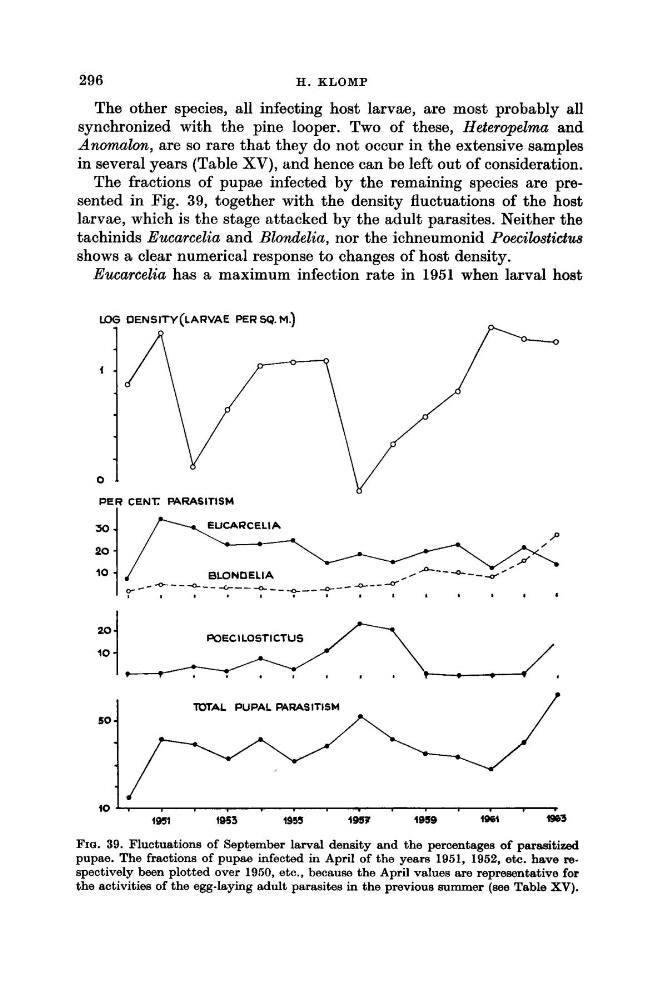
The fractions of pupae infected by the remaining species are presented in Fig. 39, together with the density fluctuations of the host
larvae, which is the stage attacked by the adult parasites. Neither the
tachinids Eucarcelia and Blondelia, nor the ichneumonid Poecilostictus
shows a clear numerical response to changes of host density.
Eucarcelia has a maximum infection rate in 1951 when larval host
-
PER CENT: PARASITISM
I
TOTAL PUPAL PARASITISM
.- .
a
.
. . . -
is51
1953
195s
49s
1959
1961
3%3
FIG. 39. Fluctuations of September larval density and the percentages of parasitized
pupae. The fractions of pupae infected in April of the years 1951, 1952, etc. have respectively been plotted over 1950, etc., because the April values are representative for
the activities of the egg-laying adult parasites in the previous summer (see Table XV).
H . KLOMP
The other species, all infecting host larvae, are most probably all
synchronized with the pine looper. Two of these, Heteropelma and
Anomalon, are so rare that they do not occur in the extensive samples
in several years (Table XV), and hence can be left out of consideration.
The fractions of pupae infected by the remaining species are presented in Fig. 39, together with the density fluctuations of the host
larvae, which is the stage attacked by the adult parasites. Neither the
tachinids Eucarcelia and Blondelia, nor the ichneumonid Poecilostictus
shows a clear numerical response to changes of host density.
Eucarcelia has a maximum infection rate in 1951 when larval host
-
PER CENT: PARASITISM
I
TOTAL PUPAL PARASITISM
.- .
a
.
. . . -
is51
1953
195s
49s
1959
1961
3%3
FIG. 39. Fluctuations of September larval density and the percentages of parasitized
pupae. The fractions of pupae infected in April of the years 1951, 1952, etc. have respectively been plotted over 1950, etc., because the April values are representative for
the activities of the egg-laying adult parasites in the previous summer (see Table XV).