

DYNAMICS OF FIELD POPULATION OF PINE LOOPER
279
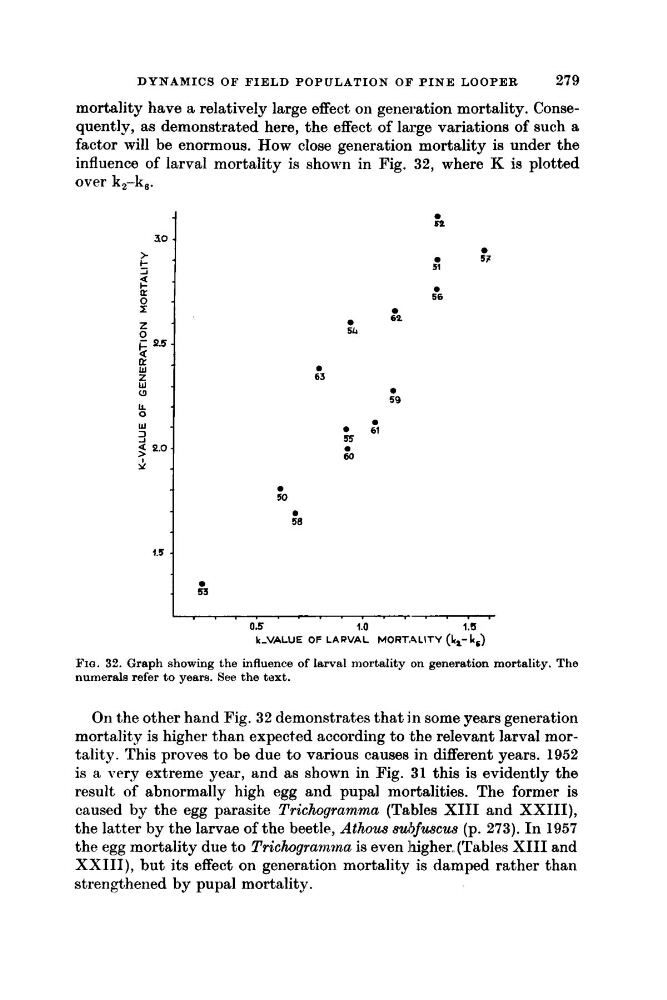
mortality have a relatively large effect on generation mortality. Consequently, as demonstrated here, the effect of large variations of such a
factor will be enormous. How close generation mortality is under the
influence of larval mortality is shown in Fig. 32, where K is plotted
over k,-k,.
0
b 2
0
0
53
51
0
66
0
0
6z
51r
0
63
0
59
0
0
61
*i
0
60
0
50
0
58
L
I
0.5
1.0
1.1
k-VALUE OF LARVAL MORTALITY (k%- k6)
FIQ. 32. Graph showing the influence of larval mortality on generation mortality. The
numerals refer to years. See the text.
On the other hand Fig. 32 demonstrates that in some years generation
mortality is higher than expected according to the relevant larval mortality. This proves to be due to various causes in different years. 1952
is a very extreme year, and as shown in Fig. 31 this is evidently the
result of abnormally high egg and pupal mortalities. The former is
caused by the egg parasite Trichogramma (Tables XI11 and XXIII),
the latter by the larvae of the beetle, Athous suhfwcus (p. 273). In 1957
the egg mortality due to Trichogranaina is even Ihigher, (Tables XI11 and
XXIII), but its effect on generation mortality is damped rather than
strengthened by pupal mortality.
279
mortality have a relatively large effect on generation mortality. Consequently, as demonstrated here, the effect of large variations of such a
factor will be enormous. How close generation mortality is under the
influence of larval mortality is shown in Fig. 32, where K is plotted
over k,-k,.
0
b 2
0
0
53
51
0
66
0
0
6z
51r
0
63
0
59
0
0
61
*i
0
60
0
50
0
58
L
I
0.5
1.0
1.1
k-VALUE OF LARVAL MORTALITY (k%- k6)
FIQ. 32. Graph showing the influence of larval mortality on generation mortality. The
numerals refer to years. See the text.
On the other hand Fig. 32 demonstrates that in some years generation
mortality is higher than expected according to the relevant larval mortality. This proves to be due to various causes in different years. 1952
is a very extreme year, and as shown in Fig. 31 this is evidently the
result of abnormally high egg and pupal mortalities. The former is
caused by the egg parasite Trichogramma (Tables XI11 and XXIII),
the latter by the larvae of the beetle, Athous suhfwcus (p. 273). In 1957
the egg mortality due to Trichogranaina is even Ihigher, (Tables XI11 and
XXIII), but its effect on generation mortality is damped rather than
strengthened by pupal mortality.