

252
H . KLOMP
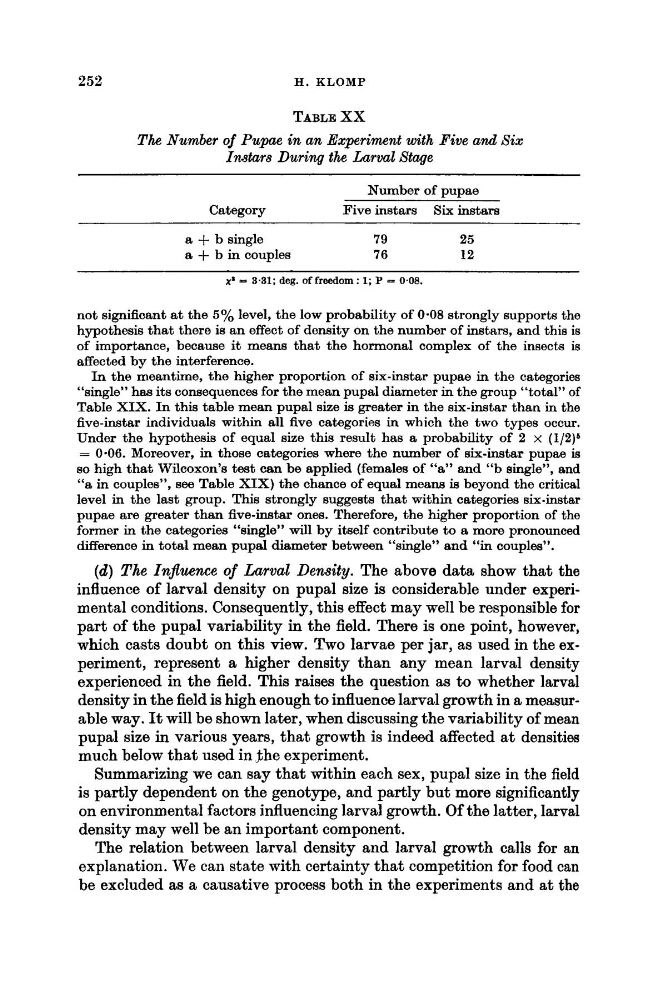
TABLE XX
The Number of Pupae in an Experiment with Five and Six
Instars During the Larval Stage
~~
~
Number of pupae
Category
Five instars Six instars
a + b single
79
25
a + b in couples
76
12
x’ = 3.31; deg. of freedom : 1; P = 0.08.
not significant a t the 5% level, the low probability of 0-08 strongly supports the
hypothesis that there is an effect of density on the number of instars, and this is
of importance, because it means that the hormonal complex of the insects is
affected by the interference.
In the meantime, the higher proportion of six-instar pupae in the categories
“single” has its consequences for the mean pupal diameter in the group “total” of
Table XIX. I n this table mean pupal size is greater in the six-instar than in the
five-instar individuals within all five categories in which the two types occur.
Under the hypothesis of equal size this result has a probability of 2 x (1/2)5
= 0.06. Moreover, in those categories where the number of six-instar pupae is
so high that Wilcoxon’s test can be applied (females of “a” and “b single”, and
“a in couples”, see Table XIX) the chance of equal meane is beyond the critical
level in the last group. This strongly suggests that within categories six-instar
pupae are greater than five-instar ones. Therefore, the higher proportion of the
former in the categories “single” will by itself contribute to a more pronounced
difference in total mean pupal diameter between “single” and “in couples”.
( d ) The In$uence of Larval Density. The above data show that the
influence of larval density on pupal size is considerable under experimental conditions. Consequently, this effect may well be responsible for
part of the pupal variability in the field. There is one point, however,
which casts doubt on this view. Two larvae per jar, as used in the experiment, represent a higher density than any mean larval density
experienced in the field. This raises the question as to whether larval
density in the field is high enough to influence larval growth in a measurable way. It will be shown later, when discussing the variability of mean
pupal size in various years, that growth is indeed affected at densities
much below that used in $he experiment.
Summarizing we can say that within each sex, pupal size in the field
is partly dependent on the genotype, and partly but more significantly
on environmental factors influencing larval growth. Of the latter, larval
density may well be an important component.
The relation between larval density and larval growth calls for an
explanation. We can state with certainty that competition for food can
be excluded as a causative process both in the experiments and at the
H . KLOMP
TABLE XX
The Number of Pupae in an Experiment with Five and Six
Instars During the Larval Stage
~~
~
Number of pupae
Category
Five instars Six instars
a + b single
79
25
a + b in couples
76
12
x’ = 3.31; deg. of freedom : 1; P = 0.08.
not significant a t the 5% level, the low probability of 0-08 strongly supports the
hypothesis that there is an effect of density on the number of instars, and this is
of importance, because it means that the hormonal complex of the insects is
affected by the interference.
In the meantime, the higher proportion of six-instar pupae in the categories
“single” has its consequences for the mean pupal diameter in the group “total” of
Table XIX. I n this table mean pupal size is greater in the six-instar than in the
five-instar individuals within all five categories in which the two types occur.
Under the hypothesis of equal size this result has a probability of 2 x (1/2)5
= 0.06. Moreover, in those categories where the number of six-instar pupae is
so high that Wilcoxon’s test can be applied (females of “a” and “b single”, and
“a in couples”, see Table XIX) the chance of equal meane is beyond the critical
level in the last group. This strongly suggests that within categories six-instar
pupae are greater than five-instar ones. Therefore, the higher proportion of the
former in the categories “single” will by itself contribute to a more pronounced
difference in total mean pupal diameter between “single” and “in couples”.
( d ) The In$uence of Larval Density. The above data show that the
influence of larval density on pupal size is considerable under experimental conditions. Consequently, this effect may well be responsible for
part of the pupal variability in the field. There is one point, however,
which casts doubt on this view. Two larvae per jar, as used in the experiment, represent a higher density than any mean larval density
experienced in the field. This raises the question as to whether larval
density in the field is high enough to influence larval growth in a measurable way. It will be shown later, when discussing the variability of mean
pupal size in various years, that growth is indeed affected at densities
much below that used in $he experiment.
Summarizing we can say that within each sex, pupal size in the field
is partly dependent on the genotype, and partly but more significantly
on environmental factors influencing larval growth. Of the latter, larval
density may well be an important component.
The relation between larval density and larval growth calls for an
explanation. We can state with certainty that competition for food can
be excluded as a causative process both in the experiments and at the