

250
H . KLOMP
number of instars. Where one larva with five and one with six instars
occurred, as it did four times in category “b in couples” pupal diameter could not be identified with the larval growth type because the
individuals were not marked (see Table XIX). Moreover, it must be
realized that the first instar larvae in the second and fourth category
were coupled independently of sex. Thus part of the 22 males occurring
in “a in couples” have grown up with males, the others with females.
The sexes could not be distinguished before the pupal stage.
It is suggested in Table XIX that the fraction of la,rvae passing through six
instars is greater in the females than in the males. This has been tested with the
XP-method by pooling the data of the first three categories. In the category “b
in couples”, half of the eight individuals with an unknown number of instars had
five, but it cannot be ascertained how these four individuals are distributed
among the sexes.
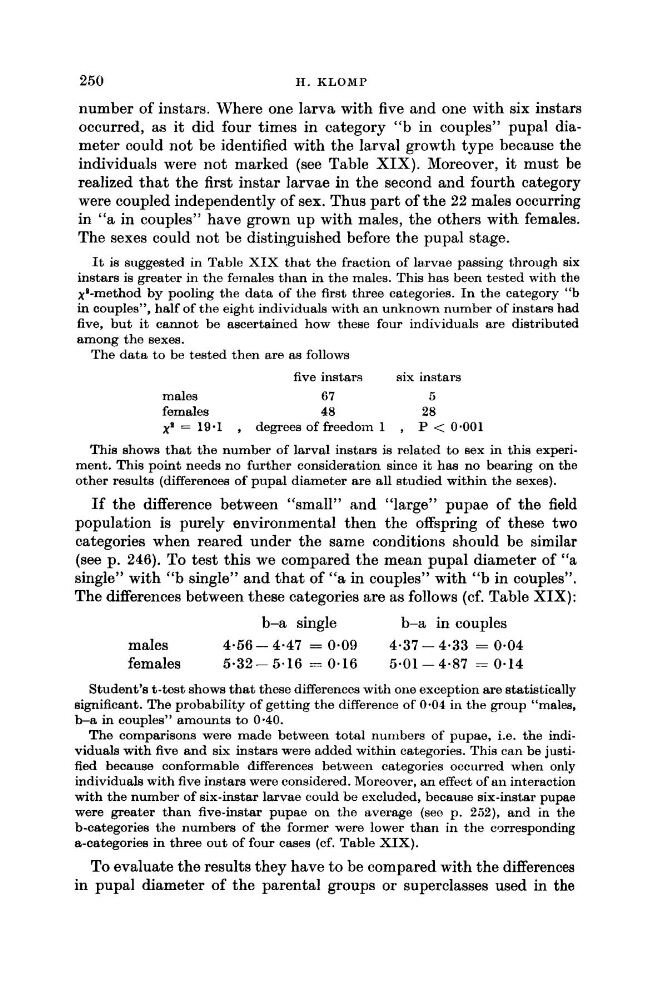
The data to be tested then are as follows
five instars
six instars
males
67
5
females
48
28
X* = 19.1 , degrees of freedom 1 , P < 0.001
This shows that the number of larval instars is related to sex in this experiment. This point needs no further consideration since it has no bearing on the
other results (differences of pupal diameter are all studied within the sexes).
If the difference between “small” and “large” pupae of the field
population is purely environmental then the offspring of these two
categories when reared under the same conditions should be similar
(see p. 246). To test this we compared the mean pupal diameter of “a
single” with “b single” and that of “a in couples” with “b in couples”.
The differences between these categories are as follows (cf. Table XIX):
b-a single
b-a in couples
males
4.56- 4.47 = 0.09
4.37 - 4.33 z= 0.04
females
5.32- 5.16 = 0.16
5.01 - 4.87 = 0.14
Student’s t-test shows that these differences with one exception are statistically
significant. The probability of getting the difference of 0.04 in the group “males,
b-a in couples” amounts to 0.40.
The comparisons were made between total numbers of pupae, i.e. the individuals with five and six instars were added within categories. This can be justified because conformable differences between categories occurred when only
individuals with five instars were considered. Moreover, an effect of an interaction
with the number of six-instar larvae could be excluded, because six-instar pupae
were greater than five-instar pupae on the average (see p. 252), and in the
b-categories the numbers of the former were lower than in the corresponding
a-categories in three out of four cases (cf. Table XIX).
To evaluate the results they have to be compared with the differences
in pupal diameter of the parental groups or superclasses used in the
H . KLOMP
number of instars. Where one larva with five and one with six instars
occurred, as it did four times in category “b in couples” pupal diameter could not be identified with the larval growth type because the
individuals were not marked (see Table XIX). Moreover, it must be
realized that the first instar larvae in the second and fourth category
were coupled independently of sex. Thus part of the 22 males occurring
in “a in couples” have grown up with males, the others with females.
The sexes could not be distinguished before the pupal stage.
It is suggested in Table XIX that the fraction of la,rvae passing through six
instars is greater in the females than in the males. This has been tested with the
XP-method by pooling the data of the first three categories. In the category “b
in couples”, half of the eight individuals with an unknown number of instars had
five, but it cannot be ascertained how these four individuals are distributed
among the sexes.
The data to be tested then are as follows
five instars
six instars
males
67
5
females
48
28
X* = 19.1 , degrees of freedom 1 , P < 0.001
This shows that the number of larval instars is related to sex in this experiment. This point needs no further consideration since it has no bearing on the
other results (differences of pupal diameter are all studied within the sexes).
If the difference between “small” and “large” pupae of the field
population is purely environmental then the offspring of these two
categories when reared under the same conditions should be similar
(see p. 246). To test this we compared the mean pupal diameter of “a
single” with “b single” and that of “a in couples” with “b in couples”.
The differences between these categories are as follows (cf. Table XIX):
b-a single
b-a in couples
males
4.56- 4.47 = 0.09
4.37 - 4.33 z= 0.04
females
5.32- 5.16 = 0.16
5.01 - 4.87 = 0.14
Student’s t-test shows that these differences with one exception are statistically
significant. The probability of getting the difference of 0.04 in the group “males,
b-a in couples” amounts to 0.40.
The comparisons were made between total numbers of pupae, i.e. the individuals with five and six instars were added within categories. This can be justified because conformable differences between categories occurred when only
individuals with five instars were considered. Moreover, an effect of an interaction
with the number of six-instar larvae could be excluded, because six-instar pupae
were greater than five-instar pupae on the average (see p. 252), and in the
b-categories the numbers of the former were lower than in the corresponding
a-categories in three out of four cases (cf. Table XIX).
To evaluate the results they have to be compared with the differences
in pupal diameter of the parental groups or superclasses used in the