

L A K E DWELLING TRICLADS
9
For these several reasons data from large lakes are not included in
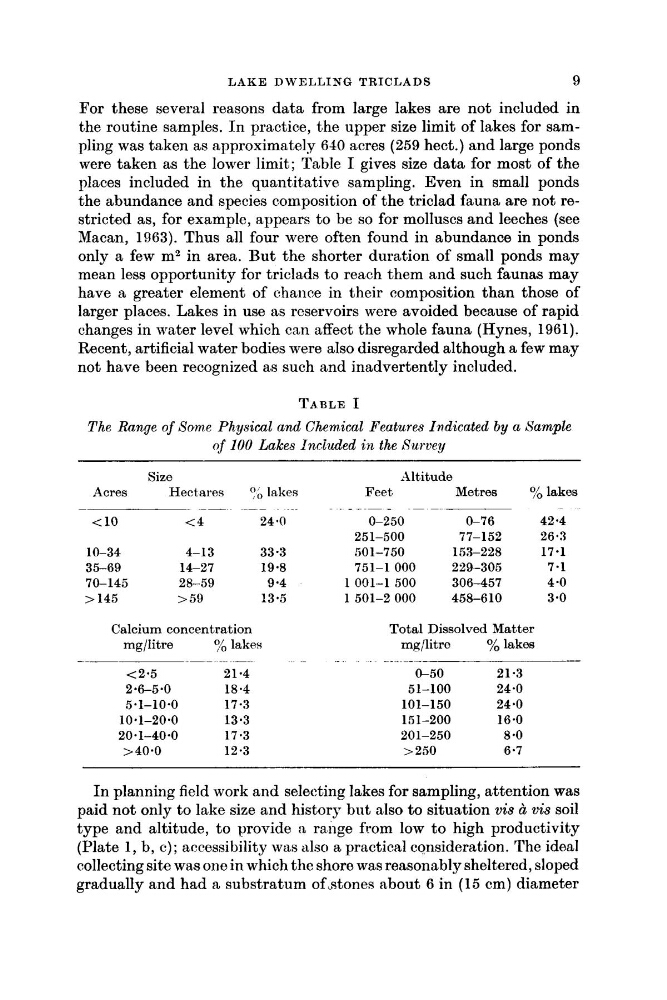
the routine samples. In practice, the upper size limit of lakes for sampling was taken as approximately 640 acres (259 hect.) and large ponds
were taken as the lower limit; Table I gives size data for most of the
places included in the quaiit>itative sampling. Even in small ponds
the abundance and species composition of the triclad fauna are not restricted as, for example, appears to be so for molluscs and leeches (see
Macan, 1963). Thus all four were often found in abundance in ponds
only a few m2 in area. But the shorter duration of small ponds may
mean less opportunity for triclads to reach them and such faunas may
have a greater element of chance in their composition than those of
larger places. Lakes in use as reservoirs were avoided because of rapid
changes in water level which can affect the whole fauna (Hynes, 1961).
Recent, artificial water bodies were also disregarded although a few may
not have been recognized as such and inadvertently included.
TABLE I
The Range of Some Physical and Chemical Features Indicated by a Sample
of 100 Lakes Included in the ~Yurve~y
Size
Altitude
Acres
Hectares
lakes
Feet
Metres
yo lakes
< 10
< 4
2 4 4
0-250
0-76
42.4
251-500
77-152
26.8
10-34
4-13
33 -3
501-750
153-228
17.1
35-69
14-27
19.8
751-1000
229-305
7.1
70-145
28-59
9 -4
1001-1500
3 0 6 4 5 7
4 -0
> 145
> 59
13.5
1 501-2 000
458-610
3.0
~- ~~
~~
Calcium concentration
mg/litre
:& lakes
Total Dissolved Matter
mg/litre
yo lakes
- _ _
~~
-
-.
<2.5
21.4
&50
21.3
2-6-5.0
18.4
51-100
24.0
5.1-10.0
17.3
101-150
24.0
10*1-20.0
13.3
151-200
16.0
20.1-40.0
17.3
201-250
8 -0
>40-0
12.3
> 250
6.7
In planning field work and selecting lakes for sampling, attention was
paid not only to lake size and history but also to situation vis it vis soil
type and altitude, to provide n range from low to high productivity
(Plate 1, b, c); accessibility wits also a practical consideration. The ideal
collecting site was one in which the shore was reasonably sheltered, sloped
gradually and had a substratum ofstones about 6 in (15 cm) diameter
9
For these several reasons data from large lakes are not included in
the routine samples. In practice, the upper size limit of lakes for sampling was taken as approximately 640 acres (259 hect.) and large ponds
were taken as the lower limit; Table I gives size data for most of the
places included in the quaiit>itative sampling. Even in small ponds
the abundance and species composition of the triclad fauna are not restricted as, for example, appears to be so for molluscs and leeches (see
Macan, 1963). Thus all four were often found in abundance in ponds
only a few m2 in area. But the shorter duration of small ponds may
mean less opportunity for triclads to reach them and such faunas may
have a greater element of chance in their composition than those of
larger places. Lakes in use as reservoirs were avoided because of rapid
changes in water level which can affect the whole fauna (Hynes, 1961).
Recent, artificial water bodies were also disregarded although a few may
not have been recognized as such and inadvertently included.
TABLE I
The Range of Some Physical and Chemical Features Indicated by a Sample
of 100 Lakes Included in the ~Yurve~y
Size
Altitude
Acres
Hectares
lakes
Feet
Metres
yo lakes
< 10
< 4
2 4 4
0-250
0-76
42.4
251-500
77-152
26.8
10-34
4-13
33 -3
501-750
153-228
17.1
35-69
14-27
19.8
751-1000
229-305
7.1
70-145
28-59
9 -4
1001-1500
3 0 6 4 5 7
4 -0
> 145
> 59
13.5
1 501-2 000
458-610
3.0
~- ~~
~~
Calcium concentration
mg/litre
:& lakes
Total Dissolved Matter
mg/litre
yo lakes
- _ _
~~
-
-.
<2.5
21.4
&50
21.3
2-6-5.0
18.4
51-100
24.0
5.1-10.0
17.3
101-150
24.0
10*1-20.0
13.3
151-200
16.0
20.1-40.0
17.3
201-250
8 -0
>40-0
12.3
> 250
6.7
In planning field work and selecting lakes for sampling, attention was
paid not only to lake size and history but also to situation vis it vis soil
type and altitude, to provide n range from low to high productivity
(Plate 1, b, c); accessibility wits also a practical consideration. The ideal
collecting site was one in which the shore was reasonably sheltered, sloped
gradually and had a substratum ofstones about 6 in (15 cm) diameter