

T H E PRODUCTION O F MARINE F’LANKTON
179
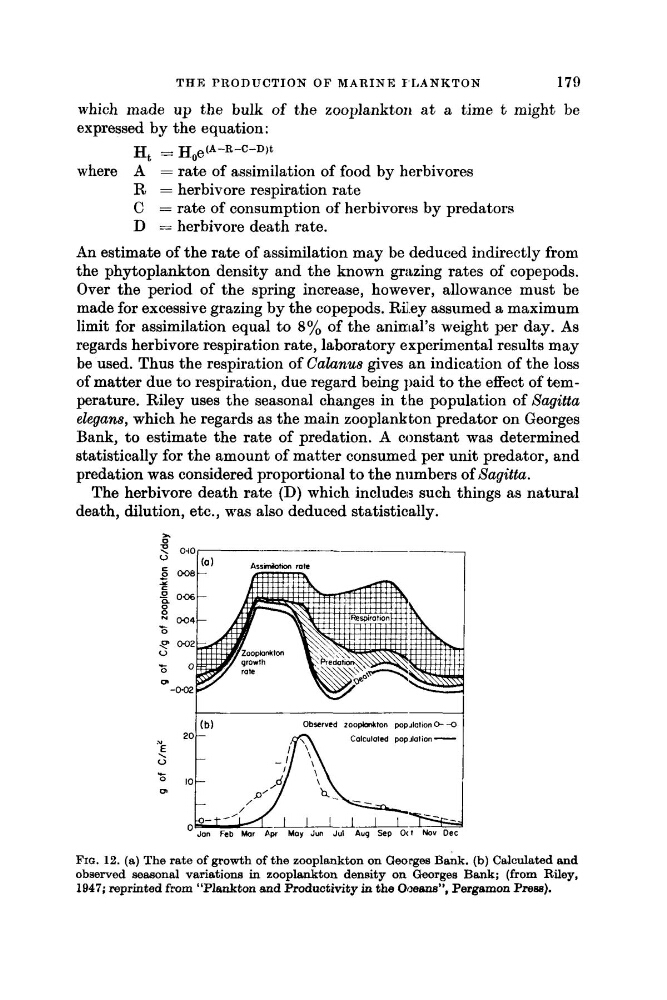
which made up the bulk of the zooplankton a t a time t might be
expressed by the equation:
where A = rate of assimilation of food by herbivores
H - H e(A-R-C-D)t
t -
0
R = herbivore respiration rate
C = rate of consumption of herbivores by predators
D = herbivore death rate.
An estimate of the rate of assimilation may be deduced indirectly from
the phytoplankton density and the known grazing rates of copepods.
Over the period of the spring increase, however, allowance must be
made for excessive grazing by the copepods. Riley assumed a maximum
limit for assimilation equal to 8% of the animal’s weight per day. As
regards herbivore respiration rate, laboratory experimental results may
be used. Thus the respiration of Calanus gives an indication of the loss
of matter due to respiration, due regard being paid to the effect of temperature. Riley uses the seasonal changes in the population of Sagitta
elegans, which he regards as the main zooplankton predator on Georges
Bank, to estimate the rate of predation. A constant was determined
statistically for the amount of matter consumed per unit predator, and
predation was considered proportional to the niimbers of Sagitta.
The herbivore death rate (D) which includes such things as natural
death, dilution, etc., was also deduced statistically.
v
E
\
V
Observed zoopbmkton popJlalion 0- 4
Colculaled popdolion -
-
(b)
20 -
10 -
-
P’
/’
‘%n
+Feb Mnr Apr May dun Jul plug k p Oct Nov Dec
FIG. 12. (a) The rate of growth of the zooplankton on Georges Bank. (b) Calculated end
observed seasonal variations in zooplankton demity on Georges Bank; (from Riley,
1947; reprinted from “Plankton 5nd Productivity in the Ooeene”, Pergemon Press).
179
which made up the bulk of the zooplankton a t a time t might be
expressed by the equation:
where A = rate of assimilation of food by herbivores
H - H e(A-R-C-D)t
t -
0
R = herbivore respiration rate
C = rate of consumption of herbivores by predators
D = herbivore death rate.
An estimate of the rate of assimilation may be deduced indirectly from
the phytoplankton density and the known grazing rates of copepods.
Over the period of the spring increase, however, allowance must be
made for excessive grazing by the copepods. Riley assumed a maximum
limit for assimilation equal to 8% of the animal’s weight per day. As
regards herbivore respiration rate, laboratory experimental results may
be used. Thus the respiration of Calanus gives an indication of the loss
of matter due to respiration, due regard being paid to the effect of temperature. Riley uses the seasonal changes in the population of Sagitta
elegans, which he regards as the main zooplankton predator on Georges
Bank, to estimate the rate of predation. A constant was determined
statistically for the amount of matter consumed per unit predator, and
predation was considered proportional to the niimbers of Sagitta.
The herbivore death rate (D) which includes such things as natural
death, dilution, etc., was also deduced statistically.
v
E
\
V
Observed zoopbmkton popJlalion 0- 4
Colculaled popdolion -
-
(b)
20 -
10 -
-
P’
/’
‘%n
+Feb Mnr Apr May dun Jul plug k p Oct Nov Dec
FIG. 12. (a) The rate of growth of the zooplankton on Georges Bank. (b) Calculated end
observed seasonal variations in zooplankton demity on Georges Bank; (from Riley,
1947; reprinted from “Plankton 5nd Productivity in the Ooeene”, Pergemon Press).