

126
J. E. a. RAYMONT
production based on the production of particulate phosphorus. A
discrepancy between the 14C and oxygen bottle estimations was believed
to be due largely to the 14C method measuring net production whereas
the oxygen method measured gross production.
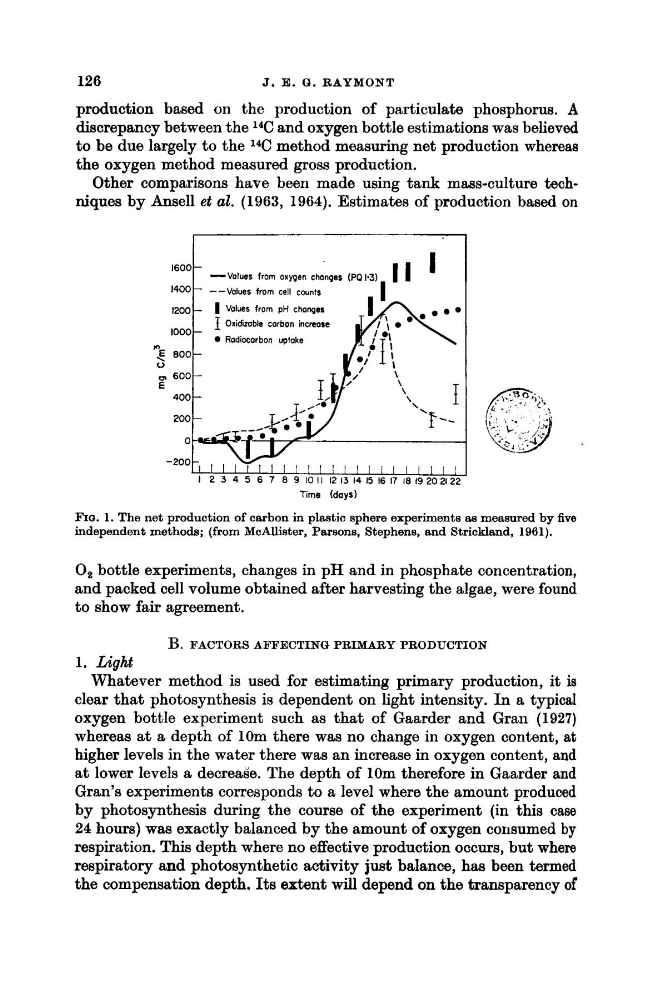
Other comparisons have been made using tank mass-culture techniques by Ansell et al. (1963, 1964). Estimates of production based on
I
1400 - --Values from cell counts
1200 - 1 values from PH
1 Oxidizable carbon increase
0 Radiocarbon uptake
600400 -
E
I 2 3 4 5 6 7 8 9 1 0 i 1 1 2 1 3 1 4 1 5 1 6 1 7 1 8 1 9 2 0 2 1 2 2
Time (days)
FIG. 1. The net production of carbon in plastic sphere experiments as measured by five
independent methods; (from MoAllister, Paraons, Stephens, and Strickland, 1961).
0, bottle experiments, changes in pH and in phosphate concentration,
and packed cell volume obtained after harvesting the algae, were found
to show fair agreement.
B. FACTORS AFFECTING PRIMARY PRODUCTION
1. Light
Whatever method is used for estimating primary production, it is
clear that photosynthesis is dependent on light intensity. In a typical
oxygen bottle experiment such as that of Gaarder and Gran (1927)
whereas at a depth of 10m there was no change in oxygen content, at
higher levels in the water there was an increase in oxygen content, and
a t lower levels a decrease. The depth of 10m therefore in Gaarder and
Gran's experiments corresponds to a level where the amount produced
by photosynthesis during the course of the experiment (in this caw
24 hours) was exactly balanced by the amount of oxygen consumed by
respiration. This depth where no effective production occurs, but where
respiratory and photosynthetic activity just balance, has been termed
the compensation depth. Its extent will depend on the transparency of
J. E. a. RAYMONT
production based on the production of particulate phosphorus. A
discrepancy between the 14C and oxygen bottle estimations was believed
to be due largely to the 14C method measuring net production whereas
the oxygen method measured gross production.
Other comparisons have been made using tank mass-culture techniques by Ansell et al. (1963, 1964). Estimates of production based on
I
1400 - --Values from cell counts
1200 - 1 values from PH
1 Oxidizable carbon increase
0 Radiocarbon uptake
600400 -
E
I 2 3 4 5 6 7 8 9 1 0 i 1 1 2 1 3 1 4 1 5 1 6 1 7 1 8 1 9 2 0 2 1 2 2
Time (days)
FIG. 1. The net production of carbon in plastic sphere experiments as measured by five
independent methods; (from MoAllister, Paraons, Stephens, and Strickland, 1961).
0, bottle experiments, changes in pH and in phosphate concentration,
and packed cell volume obtained after harvesting the algae, were found
to show fair agreement.
B. FACTORS AFFECTING PRIMARY PRODUCTION
1. Light
Whatever method is used for estimating primary production, it is
clear that photosynthesis is dependent on light intensity. In a typical
oxygen bottle experiment such as that of Gaarder and Gran (1927)
whereas at a depth of 10m there was no change in oxygen content, at
higher levels in the water there was an increase in oxygen content, and
a t lower levels a decrease. The depth of 10m therefore in Gaarder and
Gran's experiments corresponds to a level where the amount produced
by photosynthesis during the course of the experiment (in this caw
24 hours) was exactly balanced by the amount of oxygen consumed by
respiration. This depth where no effective production occurs, but where
respiratory and photosynthetic activity just balance, has been termed
the compensation depth. Its extent will depend on the transparency of