

122
J . E. a. RAYMONT
in the waters of the continental shelf off Woods Hole, and similar determinations for the North Sea over the 7 months of main phytoplankton
growth suggest that phosphorus may go through perhaps half a dozen
regeneration cycles. Vaccaro (1963) has also pointed to the importance
of ammonia in the upper layers being rapidly regenerated and maintaining the cycle of phytoplankton growth. With the possibility of considerable regeneration of nutrients, any estimate of primary production
dependent on changes in nutrient level may give only minimal values.
These errors were recognized in the early work of Atkins, Harvey and
Cooper for the English Channel; nevertheless Cooper (1933) was able to
estimate minimal production of phytoplankton for the English Channel
over a period of about 5 months from changes in CO,, 0,, phosphate,
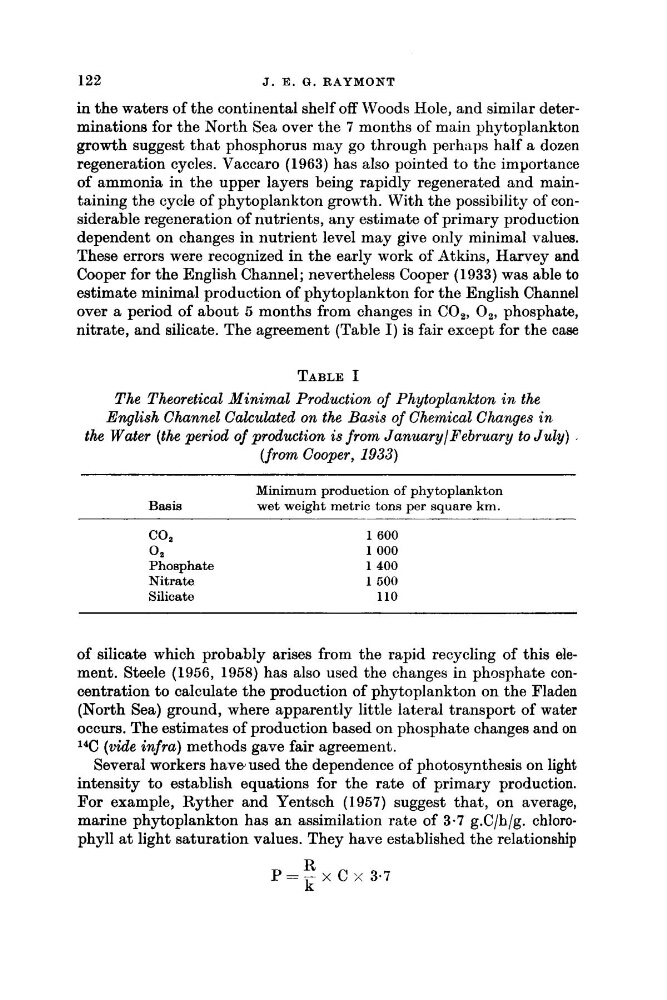
nitrate, and silicate. The agreement (Table I) is fair except for the case
TABLE I
The Theoretical Minimal Production of Phytoplankton in, the
English Channel Calculated on the Basis of Chemical Changes in.
the Water (the period of production is from JanuarylFebruary to July) .
(from Cooper, 1933)
Minimum production of phytoplankton
wet weight metric tons per square km.
Basis
COZ
0 2
Phosphate
Nitrate
Silicate
1600
1000
1 400
1600
110
of silicate which probably arises from the rapid recycling of this element. Steele (1956, 1958) has also used the changes in phosphate concentration to calculate the production of phytoplankton on the Fladen
(North Sea) ground, where apparently little lateral transport of water
occurs. The estimates of production based on phosphate changes and on
14C (vide infra) methods gave fair agreement.
Several workers have used the dependence of photosynthesis on light
intensity to establish equations for the rate of primary production.
For example, Ryther and Yentsch (1957) suggest that, on average,
marine phytoplankton has an assimilation rate of 3.7 g.C/h/g. chlorophyll at light saturation values. They have established the relationship
R
k
P = - x c x 3.7
J . E. a. RAYMONT
in the waters of the continental shelf off Woods Hole, and similar determinations for the North Sea over the 7 months of main phytoplankton
growth suggest that phosphorus may go through perhaps half a dozen
regeneration cycles. Vaccaro (1963) has also pointed to the importance
of ammonia in the upper layers being rapidly regenerated and maintaining the cycle of phytoplankton growth. With the possibility of considerable regeneration of nutrients, any estimate of primary production
dependent on changes in nutrient level may give only minimal values.
These errors were recognized in the early work of Atkins, Harvey and
Cooper for the English Channel; nevertheless Cooper (1933) was able to
estimate minimal production of phytoplankton for the English Channel
over a period of about 5 months from changes in CO,, 0,, phosphate,
nitrate, and silicate. The agreement (Table I) is fair except for the case
TABLE I
The Theoretical Minimal Production of Phytoplankton in, the
English Channel Calculated on the Basis of Chemical Changes in.
the Water (the period of production is from JanuarylFebruary to July) .
(from Cooper, 1933)
Minimum production of phytoplankton
wet weight metric tons per square km.
Basis
COZ
0 2
Phosphate
Nitrate
Silicate
1600
1000
1 400
1600
110
of silicate which probably arises from the rapid recycling of this element. Steele (1956, 1958) has also used the changes in phosphate concentration to calculate the production of phytoplankton on the Fladen
(North Sea) ground, where apparently little lateral transport of water
occurs. The estimates of production based on phosphate changes and on
14C (vide infra) methods gave fair agreement.
Several workers have used the dependence of photosynthesis on light
intensity to establish equations for the rate of primary production.
For example, Ryther and Yentsch (1957) suggest that, on average,
marine phytoplankton has an assimilation rate of 3.7 g.C/h/g. chlorophyll at light saturation values. They have established the relationship
R
k
P = - x c x 3.7