

ENERQETICS A N D A N I M A L P R O D U C T I V I T Y
105
I
-2
I
0
I
2
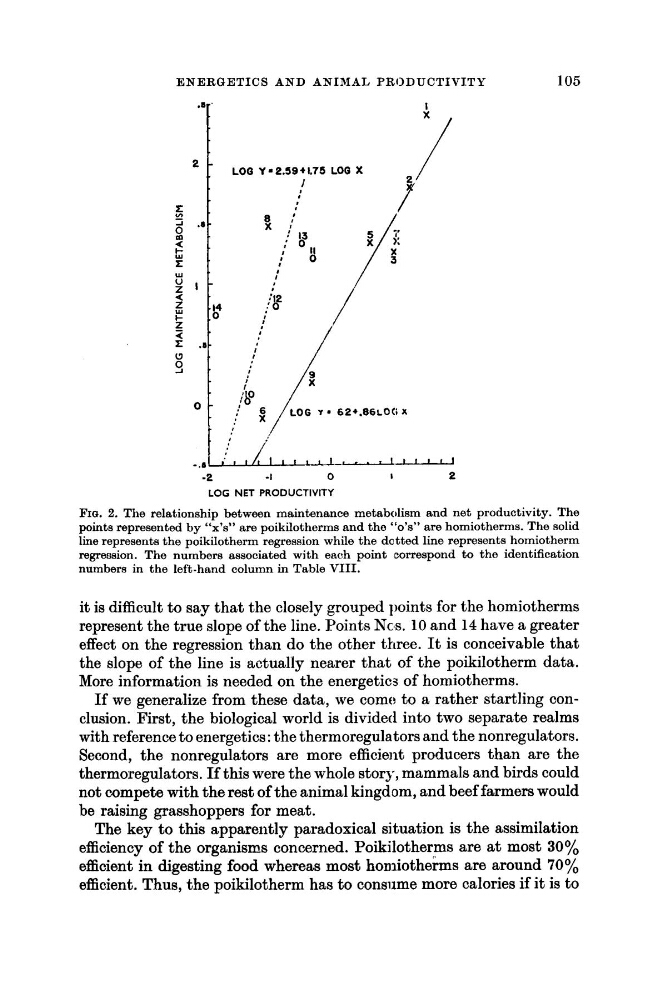
FIU. 2. The relationship between maintenance metabolism and net productivity. The
points represented by “x’s” are poikilotherms and the “o’s” are homiotherms. The solid
line represents the poikilotherm regression while the do tted line represents homiotherm
regreosion. The numbers associated with each point correspond to the identification
numbers in the left-hand column in Table VIII.
LOG NET PRODUCTIVITY
it is difficult to say that the closely grouped points for the homiotherms
represent the true slope of the line. Points Nos. 10 and 14 have a greater
effect on the regression than do the other three. It is conceivable that
the slope of the line is actually nearer that of the poikilotherm data.
More information is needed on the energetics of homiotherms.
If we generalize from these data, we come to a rather startling conclusion. First, the biological world is divided into two separate realms
with reference to energetics : the thermoregulators and the nonregulators.
Second, the nonregulators are more efficient producers than are the
thermoregulators. If this were the whole story, mammals and birds could
not compete with the rest of the animal kingdom, and beef farmers would
be raising grasshoppers for meat.
The key to this apparently paradoxical situation is the assimilation
efficiency of the organisms concerned. Poikilotherms are at most 30%
efficient in digesting food whereas most hoaiiothekus are around 70%
efficient. Thus, the poikilotherm has to consume more calories if it is to
105
I
-2
I
0
I
2
FIU. 2. The relationship between maintenance metabolism and net productivity. The
points represented by “x’s” are poikilotherms and the “o’s” are homiotherms. The solid
line represents the poikilotherm regression while the do tted line represents homiotherm
regreosion. The numbers associated with each point correspond to the identification
numbers in the left-hand column in Table VIII.
LOG NET PRODUCTIVITY
it is difficult to say that the closely grouped points for the homiotherms
represent the true slope of the line. Points Nos. 10 and 14 have a greater
effect on the regression than do the other three. It is conceivable that
the slope of the line is actually nearer that of the poikilotherm data.
More information is needed on the energetics of homiotherms.
If we generalize from these data, we come to a rather startling conclusion. First, the biological world is divided into two separate realms
with reference to energetics : the thermoregulators and the nonregulators.
Second, the nonregulators are more efficient producers than are the
thermoregulators. If this were the whole story, mammals and birds could
not compete with the rest of the animal kingdom, and beef farmers would
be raising grasshoppers for meat.
The key to this apparently paradoxical situation is the assimilation
efficiency of the organisms concerned. Poikilotherms are at most 30%
efficient in digesting food whereas most hoaiiothekus are around 70%
efficient. Thus, the poikilotherm has to consume more calories if it is to