

86
MANFRED D . ENOELMANN
ship to ambient temperature. The effects of nest, insulation of hair,
huddling and exercise upon metabolism are investigated. Finally, Pearson turned to the bioenergetics of the mice and using data from several
sources, calculated the oxygen consumption for an average mouse
during an average June day and an average December day in California.
He calculated energy estimates for the mice, assuming both diurnal and
nocturnal activity patterns. These values equalled 1 370 cc and 1 782 cc
of oxygen respectively, averaging 1 576 cc of oxygen per day and were
equal to 7.6 kcal/mouse/day for the nocturnal pattern. Using population data from another investigator, Pearson estimated that the mouse
population dissipated on an average 91 kcal/day/acre which is about
one-half to one yo of the daily energy stored by the plants on that acre.
If Pearson's average daily estimate were used to calculate an annual
respiration sum, it would equal 8.741 kcal/m2/ann. The final question in
Pearson's paper concerned the cost of nocturnal activity of the mouse
Reithrodontmys megalotis. Pearson estimated that nocturnal activity
costs 420 g callday or the energy contained in three and one-half grains
of wheat. This, then, is the price a mouse must pay to keep away from
hawks and other diurnal predators.
Comparison of these papers as a group with respect to their productivity significance is a difficult task, for the papers do not approach the
problem of metabolism in the same manner. The data were inconclusive,
in most cases, due to the lack of information about popuiation size and
structure, lack of data on the temperature of the environment, and lack
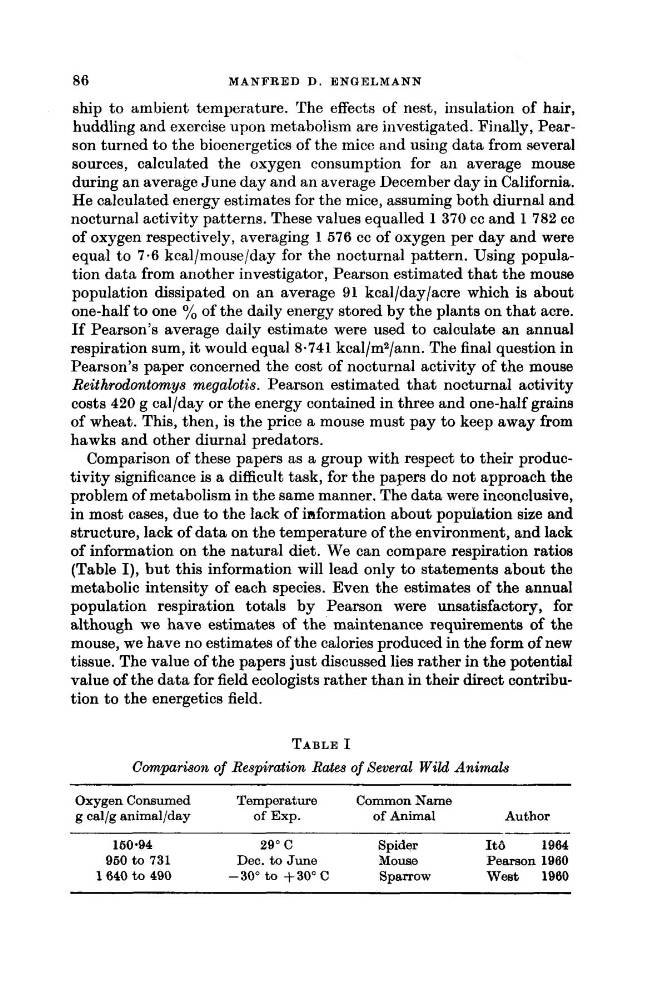
of information on the natural diet. We can compare respiration ratios
(Table I), but this information will lead only to statements about the
metabolic intensity of each species. Even the estimates of the annual
population respiration totals by Pearson were unsatisfactory, for
although we have estimates of the maintenance requirements of the
mouse, we have no estimates of the calories produced in the form of new
tissue. The value of the papers just discussed lies rather in the potential
value of the data for field ecologists rather than in their direct contribution to the energetics field.
TABLE I
Comparison of Respiration Rates of Several Wild Animals
Oxygen Consumed
Temperature
Common Name
g cal/g animal/day
of Exp.
of Animal
Author
160.94
29" C
Spider
Itti
1964
960 to 731
Dec. t o June
M o m e
Pearson 1960
1640 t o 490
-30" to $30" C
sp8mOw
West
1960
MANFRED D . ENOELMANN
ship to ambient temperature. The effects of nest, insulation of hair,
huddling and exercise upon metabolism are investigated. Finally, Pearson turned to the bioenergetics of the mice and using data from several
sources, calculated the oxygen consumption for an average mouse
during an average June day and an average December day in California.
He calculated energy estimates for the mice, assuming both diurnal and
nocturnal activity patterns. These values equalled 1 370 cc and 1 782 cc
of oxygen respectively, averaging 1 576 cc of oxygen per day and were
equal to 7.6 kcal/mouse/day for the nocturnal pattern. Using population data from another investigator, Pearson estimated that the mouse
population dissipated on an average 91 kcal/day/acre which is about
one-half to one yo of the daily energy stored by the plants on that acre.
If Pearson's average daily estimate were used to calculate an annual
respiration sum, it would equal 8.741 kcal/m2/ann. The final question in
Pearson's paper concerned the cost of nocturnal activity of the mouse
Reithrodontmys megalotis. Pearson estimated that nocturnal activity
costs 420 g callday or the energy contained in three and one-half grains
of wheat. This, then, is the price a mouse must pay to keep away from
hawks and other diurnal predators.
Comparison of these papers as a group with respect to their productivity significance is a difficult task, for the papers do not approach the
problem of metabolism in the same manner. The data were inconclusive,
in most cases, due to the lack of information about popuiation size and
structure, lack of data on the temperature of the environment, and lack
of information on the natural diet. We can compare respiration ratios
(Table I), but this information will lead only to statements about the
metabolic intensity of each species. Even the estimates of the annual
population respiration totals by Pearson were unsatisfactory, for
although we have estimates of the maintenance requirements of the
mouse, we have no estimates of the calories produced in the form of new
tissue. The value of the papers just discussed lies rather in the potential
value of the data for field ecologists rather than in their direct contribution to the energetics field.
TABLE I
Comparison of Respiration Rates of Several Wild Animals
Oxygen Consumed
Temperature
Common Name
g cal/g animal/day
of Exp.
of Animal
Author
160.94
29" C
Spider
Itti
1964
960 to 731
Dec. t o June
M o m e
Pearson 1960
1640 t o 490
-30" to $30" C
sp8mOw
West
1960