

ANALYSIS OF PROCESSES IN CONTROL OF INSECTS
43
a gain in numbers by some adjustment of its migratory movements),
predatory responses in the short term must be purely functional. I t is
therefore interesting to enquire whether or not functional responses
tend in general to be density-dependent. Holling (1959b) investigated
the basic relationships involved in the functional response by setting
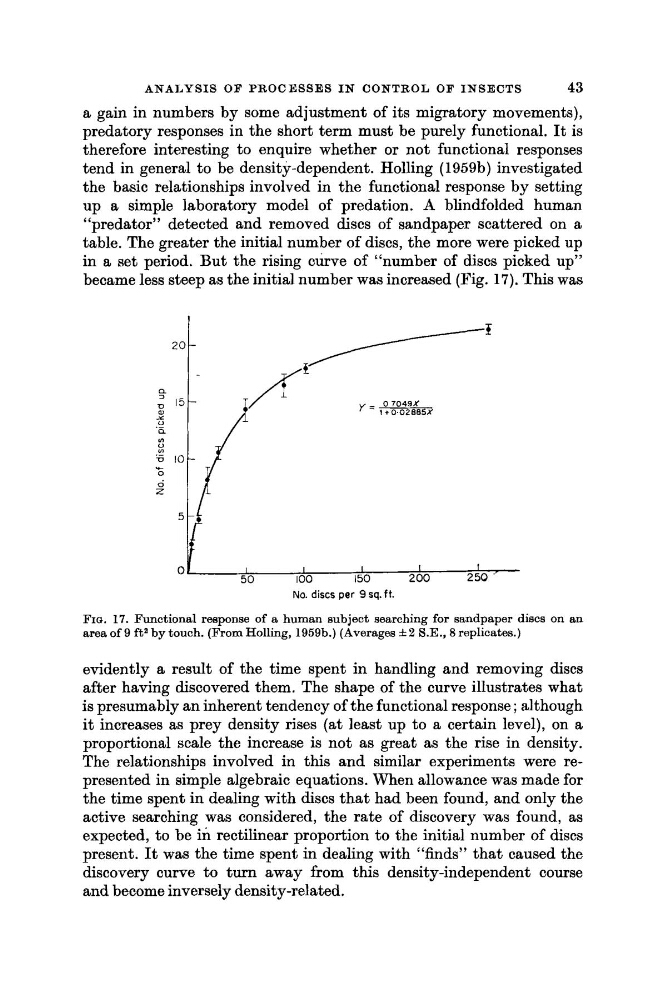
up a simple laboratory model of predation. A blindfolded human
“predator” detected and removed discs of sandpaper scattered on a
table. The greater the initial number of discs, the more were picked up
in a set period. But the rising curve of “number of discs picked up”
became less steep as the initial number was increased (Fig. 17). This was
I
I
I
I
1
5 0
100
I50
200
250
0
No. discs per 9 sq. f t.
FIG. 17. Functional response of a human subject searching for sandpaper discs on an
area of 9 fta by touch. (From Holling, 1959b.) (Averages 752 S.E., 8 replicates.)
evidently a result of the time spent in handling and removing discs
after having discovered them. The shape of the curve illustrates what
is presumably an inherent tendency of the functional response ; although
it increases as prey density rises (at least up to a certain level), on a
proportional scale the increase is not as great as the rise in density.
The relationships involved in this and similar experiments were represented in simple algebraic equations. When allowance was made for
the time spent in dealing with discs that had been found, and only the
active searching was considered, the rate of discovery was found, as
expected, to be in rectilinear proportion to the initial number of discs
present. It was the time spent in dealing with “finds” that caused the
discovery curve to turn away from this density-independent course
and become inversely density-related.
43
a gain in numbers by some adjustment of its migratory movements),
predatory responses in the short term must be purely functional. I t is
therefore interesting to enquire whether or not functional responses
tend in general to be density-dependent. Holling (1959b) investigated
the basic relationships involved in the functional response by setting
up a simple laboratory model of predation. A blindfolded human
“predator” detected and removed discs of sandpaper scattered on a
table. The greater the initial number of discs, the more were picked up
in a set period. But the rising curve of “number of discs picked up”
became less steep as the initial number was increased (Fig. 17). This was
I
I
I
I
1
5 0
100
I50
200
250
0
No. discs per 9 sq. f t.
FIG. 17. Functional response of a human subject searching for sandpaper discs on an
area of 9 fta by touch. (From Holling, 1959b.) (Averages 752 S.E., 8 replicates.)
evidently a result of the time spent in handling and removing discs
after having discovered them. The shape of the curve illustrates what
is presumably an inherent tendency of the functional response ; although
it increases as prey density rises (at least up to a certain level), on a
proportional scale the increase is not as great as the rise in density.
The relationships involved in this and similar experiments were represented in simple algebraic equations. When allowance was made for
the time spent in dealing with discs that had been found, and only the
active searching was considered, the rate of discovery was found, as
expected, to be in rectilinear proportion to the initial number of discs
present. It was the time spent in dealing with “finds” that caused the
discovery curve to turn away from this density-independent course
and become inversely density-related.