

38
M. E. SOLOMON
Although it is not so obvious, worked examples confirm that if three
density-dependent mortalities follow in succession, the greatest reduction
is achieved when the most potent comes first, and the least when it
comes last.
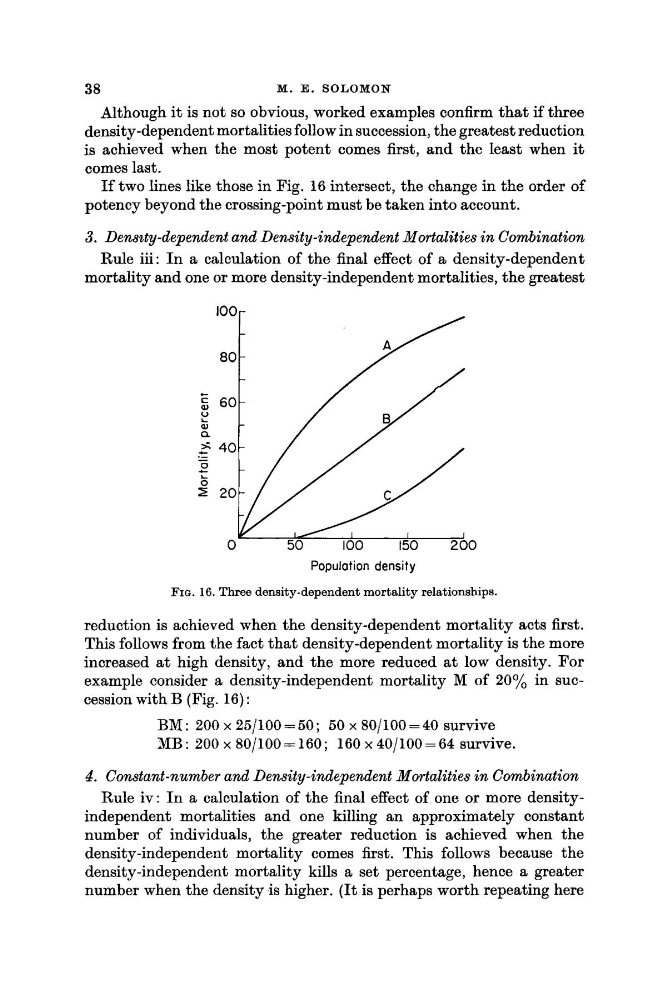
If two lines like those in Fig. 16 intersect, the change in the order of
potency beyond the crossing-point must be taken into account.
3. Denszty-dependent and Density-independent Mortalities in Combination
Rule iii: I n a calculation of the final effect of a density-dependent
mortality and one or more density-independent mortalities, the greatest
Population density
FIG. 16. Three density-dependent mortality relationships.
reduction is achieved when the density-dependent mortality acts first.
This follows from the fact that density-dependent mortality is the more
increased at high density, and the more reduced at low density. For
example consider a density-independent mortality M of 20% in succession with B (Fig. 16) :
BM : 200 x 25/100 = 50 ; 50 x SO/lOO = 40 survive
MB : 200 x 80/lOO = 160; 160 x 40/100 = 64 survive.
4. Constant-number and Density-independent Mortalities in Cornbination
Rule iv: In a calculation of the final effect of one or more densityindependent mortalities and one killing an approximately constant
number of individuals, the greater reduction is achieved when the
density-independent mortality comes first. This follows because the
density-independent mortality kills a set percentage, hence a greater
number when the density is higher. (It is perhaps worth repeating here
M. E. SOLOMON
Although it is not so obvious, worked examples confirm that if three
density-dependent mortalities follow in succession, the greatest reduction
is achieved when the most potent comes first, and the least when it
comes last.
If two lines like those in Fig. 16 intersect, the change in the order of
potency beyond the crossing-point must be taken into account.
3. Denszty-dependent and Density-independent Mortalities in Combination
Rule iii: I n a calculation of the final effect of a density-dependent
mortality and one or more density-independent mortalities, the greatest
Population density
FIG. 16. Three density-dependent mortality relationships.
reduction is achieved when the density-dependent mortality acts first.
This follows from the fact that density-dependent mortality is the more
increased at high density, and the more reduced at low density. For
example consider a density-independent mortality M of 20% in succession with B (Fig. 16) :
BM : 200 x 25/100 = 50 ; 50 x SO/lOO = 40 survive
MB : 200 x 80/lOO = 160; 160 x 40/100 = 64 survive.
4. Constant-number and Density-independent Mortalities in Cornbination
Rule iv: In a calculation of the final effect of one or more densityindependent mortalities and one killing an approximately constant
number of individuals, the greater reduction is achieved when the
density-independent mortality comes first. This follows because the
density-independent mortality kills a set percentage, hence a greater
number when the density is higher. (It is perhaps worth repeating here