

200
J. HESLOP-HARRISON
situations may be met. The conditions of the stable community, with
strong centripetal selection towards a progressively but slowly changing
optimum, favour the free release of variation; by this means a perennial
with high reproductive capacity can purchase long-term evolutionary
advantage at the cost of a great sacrifice of progeny. In terms of the
genetic system, this means high recombination index combined with
cross-pollination. In temporary habitats, or where environmental fluctuations are beyond the tolerance range of plants of a perennial habit,
the advantage will lie with the production of large, relatively uniform
populations through successive short generations, and a genetic stability
permitting the preservation of any adaptive peak achieved without
excessive segregation and without too rapid a response to selective
influences of a transient nature. This implies a genetic system parsimonious in the phenotypic release of variability, which means a low
recombbation index, or inbreeding, or, in the extreme case, apomixis.
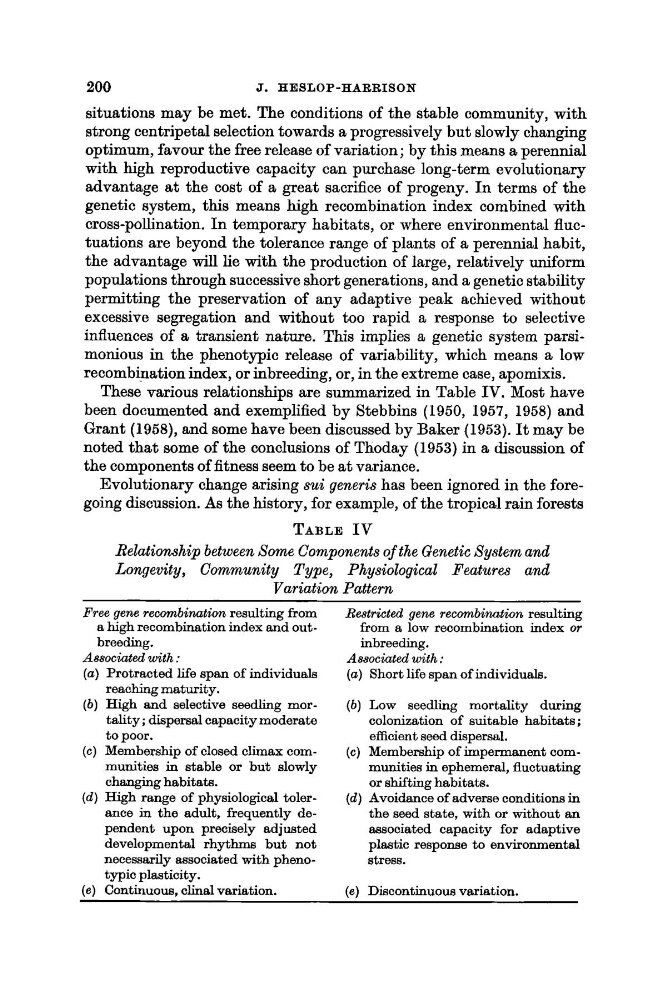
These various relationships are summarized in Table IV. Most have
been documented and exemplified by Stebbins (1950, 1957, 1958) and
Grant (1958), and some have been discussed by Baker (1953). It may be
noted that some of the conclusions of Thoday (1953) in a discussion of
the components of fitness seem to be at variance.
Evolutionary change arising sui generis has been ignored in the foregoing discussion. As the history, for example, of the tropical rain forests
TABLE IV
Relationship between Some Components of the Genetic System and
Longevity, Community Type, Physiological Features and
Variation Pattern
Free gene recmbinatim resulting from
a high recombination index and outReatricted gene recombination resulting
from a low recombination index or
breeding.
A880Ck&d with :
(a) Protracted life span of individuals
reaching maturity.
(b) High and selective seedling mortality ; dispersal capacity moderate
to poor.
(c) Membership of closed climax communities in stable or but slowly
changing habitats.
( d ) High range of physiological tolerance in the adult, frequently dependent upon precisely adjusted
developmental rhythms but not
necessarily associated with phenotypic plasticity.
( e ) Continuous, clinal variation.
inbreeding.
Associated with :
(a) Short life span of individuals.
(b) Low seedling mortality during
colonization of suitable habitats ;
efficient seed dispersal.
( c ) Membership of impermanent communities in ephemeral, fluctuating
or shifting habitats.
(d) Avoidance of adverse conditions in
the seed state, with or without an
associated capacity for adaptive
plastic response to environmental
stress.
(e) Discontinuous variation.
J. HESLOP-HARRISON
situations may be met. The conditions of the stable community, with
strong centripetal selection towards a progressively but slowly changing
optimum, favour the free release of variation; by this means a perennial
with high reproductive capacity can purchase long-term evolutionary
advantage at the cost of a great sacrifice of progeny. In terms of the
genetic system, this means high recombination index combined with
cross-pollination. In temporary habitats, or where environmental fluctuations are beyond the tolerance range of plants of a perennial habit,
the advantage will lie with the production of large, relatively uniform
populations through successive short generations, and a genetic stability
permitting the preservation of any adaptive peak achieved without
excessive segregation and without too rapid a response to selective
influences of a transient nature. This implies a genetic system parsimonious in the phenotypic release of variability, which means a low
recombbation index, or inbreeding, or, in the extreme case, apomixis.
These various relationships are summarized in Table IV. Most have
been documented and exemplified by Stebbins (1950, 1957, 1958) and
Grant (1958), and some have been discussed by Baker (1953). It may be
noted that some of the conclusions of Thoday (1953) in a discussion of
the components of fitness seem to be at variance.
Evolutionary change arising sui generis has been ignored in the foregoing discussion. As the history, for example, of the tropical rain forests
TABLE IV
Relationship between Some Components of the Genetic System and
Longevity, Community Type, Physiological Features and
Variation Pattern
Free gene recmbinatim resulting from
a high recombination index and outReatricted gene recombination resulting
from a low recombination index or
breeding.
A880Ck&d with :
(a) Protracted life span of individuals
reaching maturity.
(b) High and selective seedling mortality ; dispersal capacity moderate
to poor.
(c) Membership of closed climax communities in stable or but slowly
changing habitats.
( d ) High range of physiological tolerance in the adult, frequently dependent upon precisely adjusted
developmental rhythms but not
necessarily associated with phenotypic plasticity.
( e ) Continuous, clinal variation.
inbreeding.
Associated with :
(a) Short life span of individuals.
(b) Low seedling mortality during
colonization of suitable habitats ;
efficient seed dispersal.
( c ) Membership of impermanent communities in ephemeral, fluctuating
or shifting habitats.
(d) Avoidance of adverse conditions in
the seed state, with or without an
associated capacity for adaptive
plastic response to environmental
stress.
(e) Discontinuous variation.