

FORTY YEARS OF GENECOLOGY
193
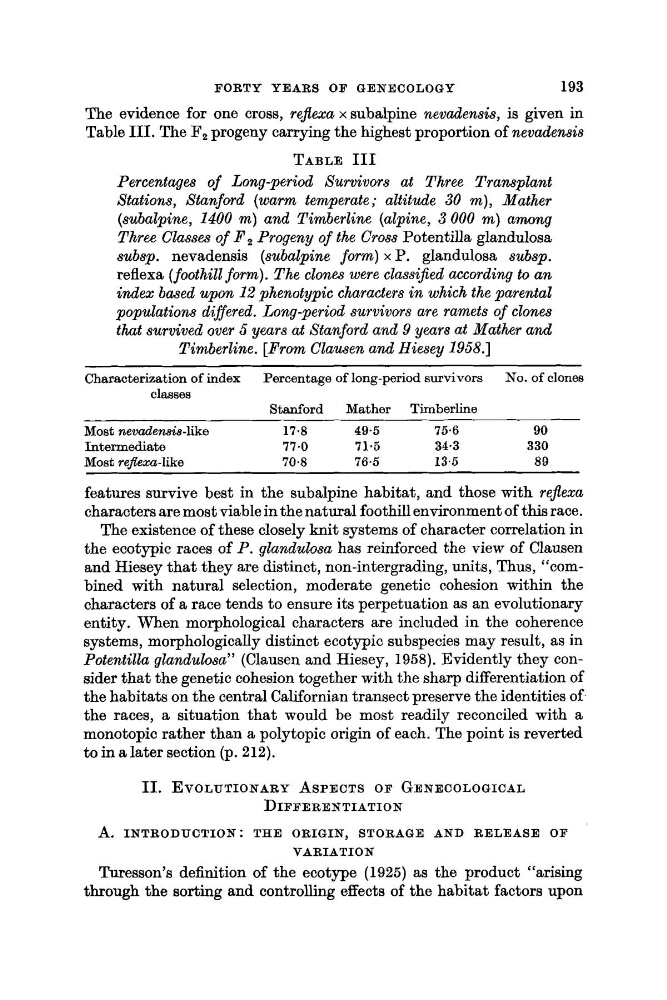
The evidence for one cross, reftexa x subalpine nevadensis, is given in
Table 111. The F, progeny carrying the highest proportion of nevadensis
TABLE I11
Percentages of Long-period Survivors at Three Transplant
Stations, Stanford (warm temperate ; altitude 30 m), Mather
(subalpine, 1400 m) and Timberline (alpine, 3000 m) among
Three Classes of F Progeny of the Cross Potentilla glandulosa
subsp. nevadensis (subalpine form) x P. glandulosa subsp.
reflexa (foothill form). The clones were classiJied according to a n
indw based upon 12 phenotypic characters in which the parental
populations differed. Long-period survivors are ramets of clones
that survived over 5 years at Stanford and 9 years at Mather and
Timberline. [From Clausen and Hiesey 1958.1
Characterization of index Percentage of long-period survivors No. of clones
classes
Stanford Mather Timberline
Most nevadenais-like
17.8
49.5
75.6
90
Intermediate
77.0
71.5
34.3
330
Most reJexa-like
70.8
76-5
13.5
8 9
features survive best in the subalpine habitat, and those with rejexa
characters are most viable in the natural foothill environment of this race.
The existence of these closely knit systems of character correlation in
the ecotypic races of P. glandulosa has reinforced the view of Clausen
and Hiesey that they are distinct, non-intergrading, units, Thus, “combined with natural selection, moderate genetic cohesion within the
characters of a race tends to ensure its perpetuation as an evolutionary
entity. When morphological characters are included in the coherence
systems, morphologically distinct ecotypic subspecies may result, as in
Potentilla glandulosa” (Clausen and Hiesey, 1958). Evidently they consider that the genetic cohesion together with the sharp differentiation of
the habitats on the central Californian transect preserve the identities of
the races, a situation that would be most readily reconciled with a
monotopic rather than a polytopic origin of each. The point is reverted
to in a later section (p. 212).
11. EVOLUTIONARY ASPECTS OF GENECOLOGICAL
DIFFERENTIATION
A. INTRODUCTION: THE ORIGIN, STORAGE AND RELEASE OF
VARIATION
Turesson’s definition of the ecotype (1925) as the product “arising
through the sorting and controlling effects of the habitat factors upon
193
The evidence for one cross, reftexa x subalpine nevadensis, is given in
Table 111. The F, progeny carrying the highest proportion of nevadensis
TABLE I11
Percentages of Long-period Survivors at Three Transplant
Stations, Stanford (warm temperate ; altitude 30 m), Mather
(subalpine, 1400 m) and Timberline (alpine, 3000 m) among
Three Classes of F Progeny of the Cross Potentilla glandulosa
subsp. nevadensis (subalpine form) x P. glandulosa subsp.
reflexa (foothill form). The clones were classiJied according to a n
indw based upon 12 phenotypic characters in which the parental
populations differed. Long-period survivors are ramets of clones
that survived over 5 years at Stanford and 9 years at Mather and
Timberline. [From Clausen and Hiesey 1958.1
Characterization of index Percentage of long-period survivors No. of clones
classes
Stanford Mather Timberline
Most nevadenais-like
17.8
49.5
75.6
90
Intermediate
77.0
71.5
34.3
330
Most reJexa-like
70.8
76-5
13.5
8 9
features survive best in the subalpine habitat, and those with rejexa
characters are most viable in the natural foothill environment of this race.
The existence of these closely knit systems of character correlation in
the ecotypic races of P. glandulosa has reinforced the view of Clausen
and Hiesey that they are distinct, non-intergrading, units, Thus, “combined with natural selection, moderate genetic cohesion within the
characters of a race tends to ensure its perpetuation as an evolutionary
entity. When morphological characters are included in the coherence
systems, morphologically distinct ecotypic subspecies may result, as in
Potentilla glandulosa” (Clausen and Hiesey, 1958). Evidently they consider that the genetic cohesion together with the sharp differentiation of
the habitats on the central Californian transect preserve the identities of
the races, a situation that would be most readily reconciled with a
monotopic rather than a polytopic origin of each. The point is reverted
to in a later section (p. 212).
11. EVOLUTIONARY ASPECTS OF GENECOLOGICAL
DIFFERENTIATION
A. INTRODUCTION: THE ORIGIN, STORAGE AND RELEASE OF
VARIATION
Turesson’s definition of the ecotype (1925) as the product “arising
through the sorting and controlling effects of the habitat factors upon