

FORTY YEARS OF QENECOLOQY
181
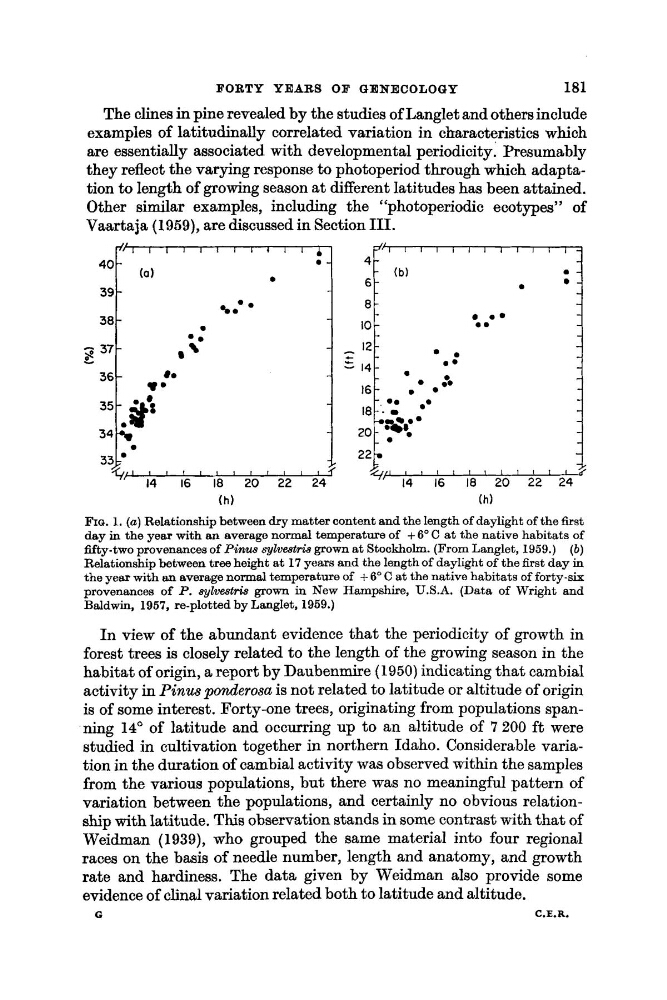
The clines in pine revealed by the studies of Langlet and others include
examples of latitudinally correlated variation in characteristics which
are essentially associated with developmental periodicity. Presumably
they reflect the varying response to photoperiod through which adaptation to length of growing season at different latitudes has been attained.
Other similar examples, including the "photoperiodic ecotypes" of
Vaartaja (1959), are discussed in Section 111.
1 0
Im *
am
14
16
18 20 22 24
(h)
(h)
FIG. 1. (a) Relationship between dry matter content and the length of daylight of the first
day in the year with an average normal temperature of + 6' C a t the native habitats of
fifty-two provenances of Pinw syzweet~h grown a t Stockholm. (From Langlet, 1959.) (b)
Relationship between tree height at 17 years and the length of daylight of the first day in
the year with an average normal temperature of + 6" C at the native habitats of forty-six
provenances of P . 8yZweetriS grown in New Hampshire, U.S.A. (Data of Wright and
Baldwin, 1957, re-plotted by Langlet, 1959.)
In view of the abundant evidence that the periodicity of growth in
forest trees is closely related to the length of the growing season in the
habitat of origin, a report by Daubenmire (1950) indicating that cambial
activity in Pinus ponderosa is not related to latitude or altitude of origin
is of some interest. Forty-one trees, originating from populations span.ning 14" of latitude and occurring up to an altitude of 7 200 ft were
studied in cultivation together in northern Idaho. Considerable variation in the duration of cambial activity was observed within the samples
from the various populations, but there was no meaningful pattern of
variation between the populations, and certainly no obvious relationship with latitude. This observation stands in some contrast with that of
Weidman (1939), who grouped the same material into four regional
races on the basis of needle number, length and anatomy, and growth
rate and hardiness. The data given by Weidman also provide some
evidence of clinal variation related both to latitude and altitude.
G
C.E.R.
181
The clines in pine revealed by the studies of Langlet and others include
examples of latitudinally correlated variation in characteristics which
are essentially associated with developmental periodicity. Presumably
they reflect the varying response to photoperiod through which adaptation to length of growing season at different latitudes has been attained.
Other similar examples, including the "photoperiodic ecotypes" of
Vaartaja (1959), are discussed in Section 111.
1 0
Im *
am
14
16
18 20 22 24
(h)
(h)
FIG. 1. (a) Relationship between dry matter content and the length of daylight of the first
day in the year with an average normal temperature of + 6' C a t the native habitats of
fifty-two provenances of Pinw syzweet~h grown a t Stockholm. (From Langlet, 1959.) (b)
Relationship between tree height at 17 years and the length of daylight of the first day in
the year with an average normal temperature of + 6" C at the native habitats of forty-six
provenances of P . 8yZweetriS grown in New Hampshire, U.S.A. (Data of Wright and
Baldwin, 1957, re-plotted by Langlet, 1959.)
In view of the abundant evidence that the periodicity of growth in
forest trees is closely related to the length of the growing season in the
habitat of origin, a report by Daubenmire (1950) indicating that cambial
activity in Pinus ponderosa is not related to latitude or altitude of origin
is of some interest. Forty-one trees, originating from populations span.ning 14" of latitude and occurring up to an altitude of 7 200 ft were
studied in cultivation together in northern Idaho. Considerable variation in the duration of cambial activity was observed within the samples
from the various populations, but there was no meaningful pattern of
variation between the populations, and certainly no obvious relationship with latitude. This observation stands in some contrast with that of
Weidman (1939), who grouped the same material into four regional
races on the basis of needle number, length and anatomy, and growth
rate and hardiness. The data given by Weidman also provide some
evidence of clinal variation related both to latitude and altitude.
G
C.E.R.