

FORTY YEARS OF OENECOLOOY
173
F. OENECOLOOICAL DIFFERENTIATION : SOME ILLUSTRATIVE
EXAMPLES
Notwithstanding the technical difficulties mentioned in the foregoing
paragraphs, a wealth of data now exists illustrating the patterns of
habitat-correlated variation encountered in higher plant species. As a
prelude to the discussion of evolutionary aspects of genecological
differentiation in Section 11, a number of examples will now be reviewed
under headings defining the main types of situation known at present.
1. Major Ecological Races with Vicarious Distributions
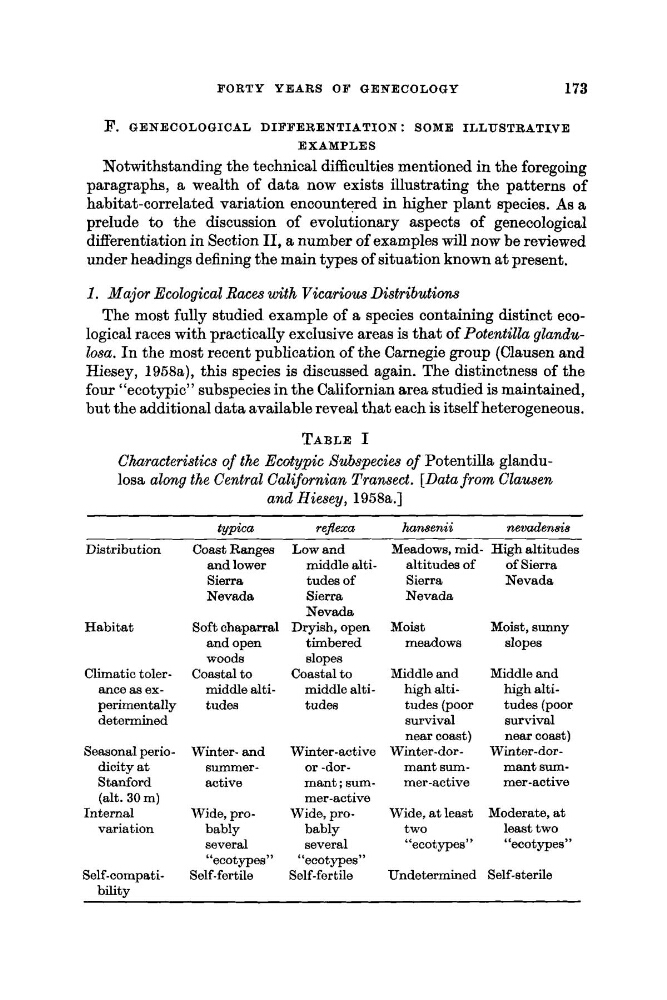
The most fully studied example of a species containing distinct ecological races with practically exclusive areas is that of Potentilla glanduZosa. In the most recent publication of the Carnegie group (Clausen and
Hiesey, 1958a), this species is discussed again. The distinctness of the
four “ecotypic” subspecies in the Californian area studied is maintained,
but the additional data available reveal that each is itself heterogeneous.
TABLE I
Characteristics of the Ecotypic Subspecies of Potentilla glandulosa along the Central Californian Transect. [Data from Clausen
and Hiesey, 1958a.l
typica
refiexa
hamenii
nevadensig
Distribution
Coast Ranges Low and
Meadows, mid- High altitudes
and lower
middle altialtitudes of
of Sierra
Habitat
Climatic tolerance as experimentally
determined
Seasonal periodicity at
Stanford
(alt. 30 m)
variation
Internal
Self-compatibilitv
Sierra
Nevada
Soft chaparral
and open
woods
Coastal to
middle altitudes
Winter- and
summer -
active
Wide, probably
several
‘Lecotypes”
Self- fertile
tudes of
Sierra
Nevada.
Dryish, open
timbered
slopes
Coastal to
middle altitudes
Winter-active
or -dormant ; summer-active
Wide, probably
several
“ecotypes”
Self-fertile
Sierra
Nevada
Moist
meadows
Middle and
high altitudes (poor
survival
near coast)
Winter-dormant s u m -
mer -active
Wide, at least
two
“ecotypes”
Undetermined
Nevada
Moist, sunny
slopes
Middle and
high altitudes (poor
survival
near coast)
Winter-dormant summer-active
Moderate, at
least two
“ecotypes”
Self-sterile
173
F. OENECOLOOICAL DIFFERENTIATION : SOME ILLUSTRATIVE
EXAMPLES
Notwithstanding the technical difficulties mentioned in the foregoing
paragraphs, a wealth of data now exists illustrating the patterns of
habitat-correlated variation encountered in higher plant species. As a
prelude to the discussion of evolutionary aspects of genecological
differentiation in Section 11, a number of examples will now be reviewed
under headings defining the main types of situation known at present.
1. Major Ecological Races with Vicarious Distributions
The most fully studied example of a species containing distinct ecological races with practically exclusive areas is that of Potentilla glanduZosa. In the most recent publication of the Carnegie group (Clausen and
Hiesey, 1958a), this species is discussed again. The distinctness of the
four “ecotypic” subspecies in the Californian area studied is maintained,
but the additional data available reveal that each is itself heterogeneous.
TABLE I
Characteristics of the Ecotypic Subspecies of Potentilla glandulosa along the Central Californian Transect. [Data from Clausen
and Hiesey, 1958a.l
typica
refiexa
hamenii
nevadensig
Distribution
Coast Ranges Low and
Meadows, mid- High altitudes
and lower
middle altialtitudes of
of Sierra
Habitat
Climatic tolerance as experimentally
determined
Seasonal periodicity at
Stanford
(alt. 30 m)
variation
Internal
Self-compatibilitv
Sierra
Nevada
Soft chaparral
and open
woods
Coastal to
middle altitudes
Winter- and
summer -
active
Wide, probably
several
‘Lecotypes”
Self- fertile
tudes of
Sierra
Nevada.
Dryish, open
timbered
slopes
Coastal to
middle altitudes
Winter-active
or -dormant ; summer-active
Wide, probably
several
“ecotypes”
Self-fertile
Sierra
Nevada
Moist
meadows
Middle and
high altitudes (poor
survival
near coast)
Winter-dormant s u m -
mer -active
Wide, at least
two
“ecotypes”
Undetermined
Nevada
Moist, sunny
slopes
Middle and
high altitudes (poor
survival
near coast)
Winter-dormant summer-active
Moderate, at
least two
“ecotypes”
Self-sterile