

LITTER PRODUCTION IN FORESTS OF T E E WORLD
151
is nearer t o Cold Temperate than to Equatorial forest productivity, and
that Arctic-Alpine forest is less than half as productive as Cold Temperate forest.
TABLE XXII
Ratios of Total, Non-leaf and Stem Production to Leaf Production
Total
Non-leaf
Stem
Leaf
Leaf
Leaf
~~
-
~
Cool temperate evergreen
Cool temperate deciduous
Gymnosperms
4.9
3.9
3.1
Angiosperms
3.7
2.7
2.1
Equatorial forest
3.3
2.4
2.0
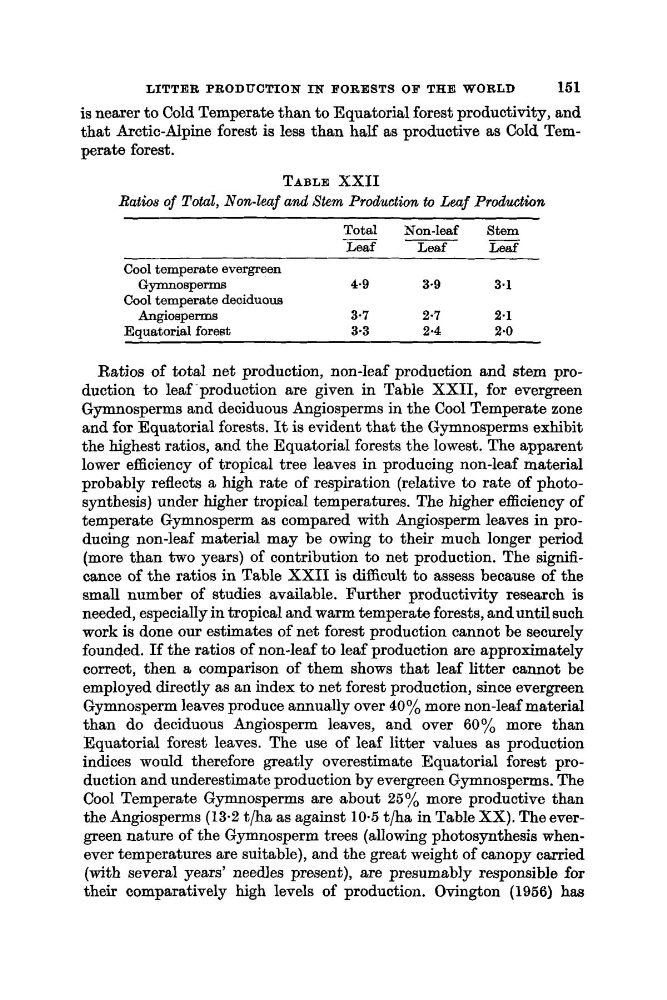
Ratios of total net production, non-leaf production and stem production to leaf-production are given in Table XXII, for evergreen
Gymnosperms and deciduous Angiosperms in the Cool Temperate zone
and for Equatorial forests. It is evident that the Gymnosperms exhibit
the highest ratios, and the Equatorial forests the lowest. The apparent
lower efficiency of tropical tree leaves in producing non-leaf material
probably reflects a high rate of respiration (relative to rate of photosynthesis) under higher tropical temperatures. The higher efficiency of
temperate Gymnosperm as compared with Angiosperm leaves in producing non-leaf material may be owing to their much longer period
(more than two years) of contribution to net production. The significance of the ratios in Table XXII is di%cult to assess because of the
small number of studies available. Further productivity research is
needed, especially in tropical and warm temperate forests, and until such
work is done our estimates of net forest production cannot be securely
founded. If the ratios of non-leaf to leaf production are approximately
correct, then a comparison of them shows that leaf litter cannot be
employed directly as an index to net forest production, since evergreen
Gymnosperm leaves produce annually over 40 % more non-leaf material
than do deciduous Angiosperm leaves, and over 60% more than
Equatorial forest leaves. The use of leaf litter values as production
indices would therefore greatly overestimate Equatorial forest production and underestimate production by evergreen Gymnosperms. The
Cool Temperate Gymnosperms are about 25% more productive than
the Angiosperms (13.2 t/ha as against 10.5 t/ha in Table XX). The evergreen nature of the Gymnosperm trees (allowing photosynthesis whenever temperatures are suitable), and the great weight of canopy carried
(with several years’ needles present), are presumably responsible for
their comparatively high levels of production. Ovington (1956) has
151
is nearer t o Cold Temperate than to Equatorial forest productivity, and
that Arctic-Alpine forest is less than half as productive as Cold Temperate forest.
TABLE XXII
Ratios of Total, Non-leaf and Stem Production to Leaf Production
Total
Non-leaf
Stem
Leaf
Leaf
Leaf
~~
-
~
Cool temperate evergreen
Cool temperate deciduous
Gymnosperms
4.9
3.9
3.1
Angiosperms
3.7
2.7
2.1
Equatorial forest
3.3
2.4
2.0
Ratios of total net production, non-leaf production and stem production to leaf-production are given in Table XXII, for evergreen
Gymnosperms and deciduous Angiosperms in the Cool Temperate zone
and for Equatorial forests. It is evident that the Gymnosperms exhibit
the highest ratios, and the Equatorial forests the lowest. The apparent
lower efficiency of tropical tree leaves in producing non-leaf material
probably reflects a high rate of respiration (relative to rate of photosynthesis) under higher tropical temperatures. The higher efficiency of
temperate Gymnosperm as compared with Angiosperm leaves in producing non-leaf material may be owing to their much longer period
(more than two years) of contribution to net production. The significance of the ratios in Table XXII is di%cult to assess because of the
small number of studies available. Further productivity research is
needed, especially in tropical and warm temperate forests, and until such
work is done our estimates of net forest production cannot be securely
founded. If the ratios of non-leaf to leaf production are approximately
correct, then a comparison of them shows that leaf litter cannot be
employed directly as an index to net forest production, since evergreen
Gymnosperm leaves produce annually over 40 % more non-leaf material
than do deciduous Angiosperm leaves, and over 60% more than
Equatorial forest leaves. The use of leaf litter values as production
indices would therefore greatly overestimate Equatorial forest production and underestimate production by evergreen Gymnosperms. The
Cool Temperate Gymnosperms are about 25% more productive than
the Angiosperms (13.2 t/ha as against 10.5 t/ha in Table XX). The evergreen nature of the Gymnosperm trees (allowing photosynthesis whenever temperatures are suitable), and the great weight of canopy carried
(with several years’ needles present), are presumably responsible for
their comparatively high levels of production. Ovington (1956) has